Winter golf gloves, cart mitts and hand warmers: what keeps U.S. golfers’ hands working
Cold hands squeeze the grip, and a squeezed grip rarely returns square. Here are four pieces of winter hand gear, gloves to swing in, mitts and a muff for between shots and the heat packs that go inside, with their published features, U.S. prices and what golfers say.

In brief
- Winter gear does two jobs: gloves you swing in, and mitts, muffs or heat packs that keep the hands warm between shots.
- Prices read at a U.S. golf retailer in November 2026: FootJoy WinterSof pair $27.95, Titleist StaDry Cart Mitts $54.99, StaDry Hand Warmer $49.99, HotHands $1.99 for two.
- Golfers praise the wet-weather grip of winter gloves and the mitt-plus-heat-pack setup, and complain about lost feel, mitts on wet grass and uneven heat packs.
- Rule 4.2a(2) forbids a stroke with a deliberately heated ball, on pain of disqualification. Nothing here was tested by Panxis Golf.
Cold hands cost more strokes than cold anything else. Your legs can be stiff and your ears can sting and you will still make a decent swing, but if you cannot feel the grip you squeeze it, and a club squeezed hard at address rarely comes back square. Most golfers who play from November to March learn this the slow way, one thin chip at a time, and then start buying things. Some of those things work and some end up at the bottom of the bag next to last spring’s rain glove.
This page presents four pieces of winter hand gear sold in U.S. golf shops this month, a pair of winter gloves, a set of cart mitts, a waist-strap hand muff and a pack of disposable heat packs, from $1.99 to $54.99 at a U.S. golf retailer in November 2026. For each one you get what the maker publishes, the price, and what golfers say about that kind of gear in public. It is a presentation, not a test. Nobody at Panxis Golf wore, swung or warmed up with any of these products for this page, and nothing here was measured by us.
Two different problems: holding the club, and the time between shots
Winter hand gear is easier to choose once you split it into two jobs. The first job is the swing itself. For the few seconds you hold the club, your hands need grip and some warmth, and they need to feel the handle through whatever they are wearing. A thick ski glove fails here, because it keeps you warm and takes away all the feedback. Winter golf gloves are a compromise, thin enough to swing in and warmer than a single leather glove.
The second job is everything else, which on a four-hour round is almost all of it. You walk or ride, you wait on the tee, you look for a ball in the leaves. Hands lose heat during those minutes, and the swing you make after a five-minute wait on a cold tee is the one that suffers. That is where mitts, muffs and heat packs come in. None of them is worn during the stroke. They keep the hands warm until the moment you take them out.
Most golfers who play all winter end up with something from each group. The question is which combination suits the way you play, on foot with a carry bag, behind a push cart, or in a riding cart.
The gloves you swing in: FootJoy WinterSof, sold as a pair
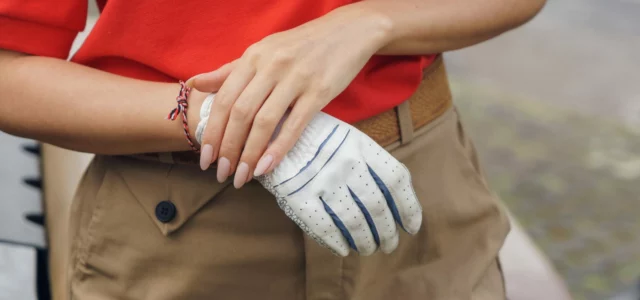
FootJoy’s WinterSof is one of the best-known winter gloves on the U.S. market, and it differs from an ordinary golf glove in one obvious way: it comes as a pair, a left and a right, because in the cold you want both hands covered. The maker describes a palm made of a knit synthetic suede it calls Sure-Grip Autosuede, which it says absorbs water and keeps a sure grip in cool and wet conditions. The back of the hand is a windproof foam fleece FootJoy calls Weather Shield, meant to hold warmth. The cuff is a soft, stretchy band with a fleece insert at the wrist, where cold air usually gets in.
What you do not get is the thin leather feel of a summer glove. These are thicker by design, and the palm is a synthetic, not cabretta leather. If you are curious about how leather and synthetic gloves age differently, our page on glove materials and lifespan covers that in detail.
U.S. price. $27.95 for the pair, shown as an “as low as” price, read in November 2026 at a U.S. golf retailer.
The mitts you wear between shots: Titleist StaDry Cart Mitts
Cart mitts are oversized mittens, big enough to slip on over a golf glove, worn while you ride, walk or wait and pulled off before you set up to the ball. The Titleist StaDry Cart Mitts are typical of the better ones. Titleist describes a shell made of 100 percent acrylic, a fleece lining, and the construction it brands StaDry, which it presents as keeping the hands dry. The product page does not publish a waterproof rating, a weight or a temperature range, so none is given here.
Mitts make the most sense in a riding cart or behind a push cart, where your hands have nothing else to do between shots. They are less convenient if you carry your bag, because you have to put them somewhere every time you play a shot, and a pair of mitts dropped on wet grass does not stay dry inside for long.
U.S. price. $54.99, against a listed price of $60.00, read in November 2026 at a U.S. golf retailer.
The muff around your waist: Titleist StaDry Hand Warmer
The hand muff solves the problem of where to put mitts. It is a padded tube worn on a strap around the waist, and you slide both hands into it from either side between shots. Titleist’s StaDry Hand Warmer, despite its name, does not produce heat itself. The maker lists a tube design, a fleece lining, the same StaDry construction as its mitts, an adjustable waist strap and a hidden zippered pocket meant for a heat pack. Heat packs are not included.
Golfers who walk tend to prefer this format, since the muff stays on the body and swings out of the way, usually to the back, while you play. It also gives one obvious place to keep a heat pack warm, which a glove pocket does not.
U.S. price. $49.99, against a listed price of $55.00, read in November 2026 at a U.S. golf retailer.
The heat itself: HotHands disposable hand warmers
A muff or a mitt only keeps in the heat your hands already have. On a raw morning with the wind blowing, that is not much, which is why most winter golfers carry heat packs. HotHands is the most common brand in U.S. golf shops. Each pack holds two air-activated warmers. You tear open the outer wrapper, the warmer reacts with the oxygen in the air, and the maker’s listing promises up to 10 hours of heat. The chemistry is the same as rust: iron powder oxidizes, and the reaction gives off warmth for as long as air reaches it.
Two practical notes. Heat packs need air, so a warmer sealed tightly in a waterproof pocket can run cooler than one in an open pocket. And they are single use, so a golfer who plays every weekend goes through a fair number of them over a season. Read the warnings printed on the packet before you use one.
U.S. price. $1.99 for a pack of two, read in November 2026 at a U.S. golf retailer.
The four side by side
| Product | What it is for | Worn during the swing | Makes heat | U.S. price, Nov. 2026 |
|---|---|---|---|---|
| FootJoy WinterSof (pair) | Grip and warmth while you play | Yes | No | $27.95 |
| Titleist StaDry Cart Mitts | Warmth between shots, riding or push cart | No | No | $54.99 (listed $60.00) |
| Titleist StaDry Hand Warmer | Warmth between shots, worn at the waist | No | Only with a heat pack | $49.99 (listed $55.00) |
| HotHands (pack of two) | Heat inside a pocket, mitt or muff | No | Yes, up to 10 hours per the maker | $1.99 |
What golfers are saying
This section gathers what comes back in public about winter gloves, cart mitts, muffs and heat packs, in golf forum discussions, owner reviews on retailer pages and published buying guides, read in November 2026. Nobody is quoted by name, nothing was counted, and none of it is a statistic.
In favor, three themes recur.
- The WinterSof grips better when it is wet. This is the praise that comes back most, in owner reviews and in British reviews from Golf Monthly, which describes the palm getting grippier as it gets wetter. Owners who play in drizzle mention it more than they mention warmth.
- Mitts with a heat pack inside are the setup that works. In forum threads that ask “mitts or hand warmer,” the most common answer is both: a heat pack dropped into the mitt or the muff, so the hands come out warm rather than merely not cold. Golfers who ride say mitts are worth the money after one bad morning without them.
- The muff suits walkers. Golfers who carry their bag or push a cart like that the muff stays on the body and never ends up on the ground, and that the hidden pocket keeps a heat pack in place for the whole round.
Against, four themes recur.
- Winter gloves trade feel for warmth. Golfers who play to a low handicap say the thicker palm takes away the feedback they get from a single leather glove, especially on chips and putts, and some take the winter gloves off on the green.
- Warmth has a limit. Owners who play in hard frost or strong wind say a winter glove alone is not enough on the coldest days, and that it needs to be paired with something between shots. The maker publishes no temperature range, so there is no way to know in advance where that limit lies for you.
- Mitts get in the way. Walkers complain about having nowhere to put them during a shot, and several owners say a pair of mitts left on wet grass soaks through. Some find that roomy mitts with a heat pack inside make their hands sweat, which is the last thing you want before you grip a club.
- Heat packs are uneven. Some owners report packs that never get properly warm or that cool off well before the promised hours, especially when sealed in a tight pocket. Others note the cost of a box adds up over a winter of weekly rounds.
One rule to know: warm hands, not a warm ball
Many golfers keep a ball in the mitt or the muff along with the heat pack, on the idea that a warm ball flies farther. The Rules of Golf are clear on the principle. Rule 4.2a(2) says you must not make a stroke at a ball whose performance characteristics have been intentionally changed, and it gives heating the ball as an example. The penalty is disqualification. A Golf.com rules column notes that whether a ball was deliberately heated can be argued, which is exactly why it is simpler to keep the ball in your trouser pocket and the heat pack with your hands. If you want to know what cold actually does to a golf ball, our page on golf balls below 50 degrees goes into it.
Where winter hand gear matters in the U.S.
The United States is too big for one winter. In Florida, Arizona and Southern California, the coldest problem most golfers face is a 45-degree first tee time that warms up by the turn, and a pair of winter gloves for the opening holes is plenty. The hard cases are the golfers in the Mid-Atlantic, the Ohio Valley, the Pacific Northwest and the parts of the Midwest where courses stay open on dry days through December and February. There, a round may start under frost delay and finish in wind, and the full kit of gloves, mitts or muff and heat packs earns its place.
Riding carts change the equation too. Much of American golf is played from a cart, and a cart in November is a cold, open seat with the wind coming straight at you. Golfers who ride lose more heat between shots than golfers who walk, which is why mitts are so common on U.S. courses and less so in countries where most people walk. If you walk your course, a muff and a heat pack may serve you better than mitts.
Finally, check with your course before a winter round. Many northern courses close or switch to temporary greens when the ground is frozen, and some do not allow carts on wet or frozen fairways at all, which turns a cart golfer into a walker for the day.
Where to buy winter hand gear, and what to ask
- The pro shop at your course. It usually stocks winter gloves and heat packs from November onward, and it is the easiest place to try a pair of gloves on with a club in hand.
- Golf superstores and specialty golf retailers. They carry gloves, mitts and muffs from several makers side by side, which is the only way to compare thickness and fit.
- Outdoor and sporting goods stores. Heat packs are often cheaper by the box there, and the hunting and hiking aisle sells the same air-activated warmers as golf shops.
- Online. The widest choice of sizes and colors, but you cannot feel the palm before you buy. Check the return policy for worn gloves, which many shops will not take back.
Whatever the shop, ask three things: whether the gloves come as a pair or as a single, whether “weather resistant” on a mitt means it keeps water out or only sheds a light shower, and whether the muff has a pocket that fits the heat packs you already buy.
How to put a winter kit together
- Start with the gloves. A pair of winter gloves is the one item you wear for every shot, so try it on and make a few swings with a club before you buy. Size the same as your usual glove or half a size up, never so loose that the fingertips slide.
- Add one thing for between shots. Mitts if you ride or push a cart, a muff if you carry your bag. One is enough for most golfers.
- Carry heat packs, and open them early. They take several minutes to warm up, so open one in the parking lot, not on the first tee.
- Keep a dry spare. A second pair of gloves in a plastic bag in the bag pocket saves a round that turns wet.
- Keep the ball out of the heat. Pocket it separately from the heat pack.
How this page was put together
This is a presentation of products and a reading of public opinion, not a test. Nobody at Panxis Golf wore, swung or warmed up with any of these products for this page. Features come from the makers’ published descriptions as reproduced on a U.S. dealer’s product pages: FootJoy for the WinterSof pair, Titleist for the StaDry Cart Mitts and the StaDry Hand Warmer, and the HotHands listing for the heat packs. Where a figure was not published on the pages read, such as a temperature range, a weight or a waterproof rating, it is left out rather than estimated. The explanation of how air-activated warmers work comes from published science explainers, and the rule on heating a ball is Rule 4.2a(2) of the Rules of Golf.
Prices were read on November 22, 2026, in U.S. dollars, at Carl’s Golfland, a U.S. golf retailer, for all four products. The product pages of PGA TOUR Superstore could not be read on that date, so no price from it appears here. Prices change with promotions, sizes and stock, so the figure at checkout is the one that counts.
What golfers say was read in golf forum discussions, including a Team Titleist forum thread on mitts and hand warmers, in owner reviews on retailer pages and in the buying guides of Golf Monthly, Golf Digest and Amateur Golf, some only through search excerpts. Nobody is quoted by name, nothing is counted, and no impression is presented as a statistic. There is no commercial link on this page, no affiliate arrangement and no commission of any kind. If content on this site is ever paid for by a brand, it will carry an advertising label at the top of the page.