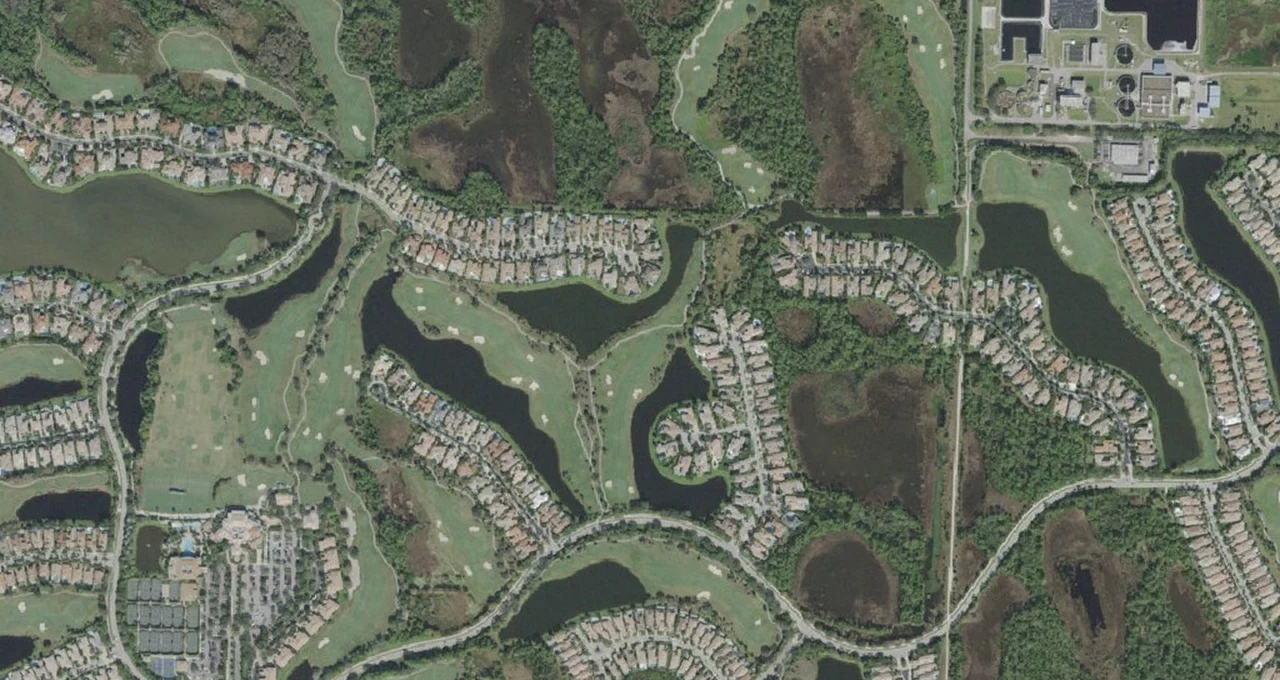
Country Club at Mirasol from the air. Aerial imagery USGS, domaine public.
Country Club at Mirasol
Holes
36 (two 18-hole courses: Sunrise and Sunset)
By
72 on each course (Chronogolf lists the Sunrise as par 73)
Length
Sunrise: up to 7,298 yards according to the club, 7,332 yards on 18Birdies and Chronogolf (rating 76.1, slope 144). Sunset: up to 7,141 yards according to the club and GolfPass (rating 75.2, slope 153); 7,192 yards in other directories
Green fee
—
Best season
—
The Country Club at Mirasol is a private club at the heart of a gated residential community in Palm Beach Gardens, Florida, in northern Palm Beach County. The club gives its address as 11600 Mirasol Way, Palm Beach Gardens, FL 33418. It has 36 holes on two 18-hole courses: the Sunset Course, designed by Arthur Hills and opened in 2001, and the Sunrise Course, designed by Tom Fazio and opened in 2003. Both are par 72 in most sources. Between them they hosted the PGA Tour’s Honda Classic four times, from 2003 to 2006, before the event moved down the road to PGA National.
The club’s own golf page describes the Sunrise Course as playing from 4,892 to 7,298 yards and the Sunset Course from 4,848 to 7,141 yards, each with nine sets of tees, and says water comes into play on 15 of the 18 holes on the Sunset. Membership is tied to the community: the real estate guide Waterfront Properties describes the club as private and for residents only, and a Links Magazine profile counted 1,170 homes in the community. This page is a portrait built from public sources. Because the club is private, most readers will only ever see these courses as a member’s guest or in old tournament footage.
Two courses, two architects
The development did not start out as the two-course community it became. According to the portfolio of Drew Rogers, the architect who later led work at the club, the project began as a Tom Fazio design in partnership with Golf Digest. In 1997 the London-based builder Taylor Woodrow took it over and planned two distinct courses within a high-end residential golf community. Arthur Hills had already worked with Taylor Woodrow on Addison Reserve in Delray Beach, and he was hired for the first course. Rogers, then working in Hills’s firm, was put in charge of the project, as Golf Course Architecture magazine reported in 2018.
The two courses were given different jobs from the start. In the Rogers account, the Sunset Course was the main draw for home sales, with most of its holes fronting homesites, while the Fazio course was intended as more of a players’ course. The same account says that Taylor Woodrow’s project manager, Craig Perna, wanted “drama,” which in South Florida, the page adds, usually means “more dirt and more water.”
The Sunset Course opened in 2001. The Sunrise Course followed in 2003; an Associated Press report from March 2004 says it had opened the previous November. Ryan Golf, the contractor that built it for Taylor Woodrow, lists the Sunrise as completed in 2003 and says it was built as the new permanent home of the Honda Classic, with about 1.7 million cubic yards of material excavated. That figure gives an idea of how much earth was moved to create relief on a flat South Florida site. The New Times Broward-Palm Beach, in 2004, called it Fazio’s first course to host a PGA Tour event.
The Honda Classic years, 2003 to 2006
The Honda Classic had moved often before it reached Palm Beach Gardens. According to Wikipedia’s history of the event, now called the Cognizant Classic, it was played at Inverrary, TPC Eagle Trace, Weston Hills and TPC at Heron Bay before coming to Mirasol in 2003, and it has been held at PGA National’s Champion Course since 2007. The club says it hosted the event four times. The two courses did not share the duty equally.
2003: the Sunset Course
The first Honda at Mirasol was played on the Sunset Course because the Sunrise was not finished, as the New Times explained the following year. Justin Leonard won with 264, 24 under par, one stroke ahead of Davis Love III, according to Wikipedia; that total is still listed as the tournament’s 72-hole record. The scoring was the story. The Associated Press wrote that the Sunset had been deemed too easy for a PGA Tour event: the cut fell at a record 6 under par, and 13 players finished at 20 under or better. The Rogers portfolio puts it plainly: the course “was never imagined as a test for tour players.”
2004 to 2006: the Sunrise Course
The tournament moved to the new Sunrise Course in March 2004. Contemporary reports confirm the Sunrise as the venue in 2004 (the AP and the New Times), in 2005 (several reports of Padraig Harrington’s win refer to the Sunrise Course) and in 2006 (the Sports Network’s report of the final round). An American Junior Golf Association release from 2004 also describes the Sunrise as the home of the Honda Classic through 2006. The results, as listed on Wikipedia, were:
- 2004: Todd Hamilton, 276 (12 under par), one stroke ahead of Davis Love III. It was his first PGA Tour win.
- 2005: Padraig Harrington, 274 (14 under), after a playoff with Vijay Singh and Joe Ogilvie. Harrington closed with a 63 that reports said tied the course record, and Singh missed a short par putt on the second extra hole.
- 2006: Luke Donald, 276 (12 under), two strokes ahead of Geoff Ogilvy, after a birdie on the final hole from about four feet.
The jump from 24 under to 12 under says a good deal about the difference between the two courses in tournament setup. Before the 2004 event, the AP reported that players were unusually worried. The course was listed at 7,468 yards. Fred Couples called it very hard to play and said 75 would be a mediocre score with good pin positions; Justin Leonard described a couple of greens as severe, among them the par-3 3rd, then a 245-yard hole; some players compared the course to Pinehurst No. 2, with steep, shaved slopes running off the greens into deep collection areas. Players were seen putting with fairway woods or chipping with 6- and 7-irons from tight grass around the greens. Brad Faxon said he liked it precisely because it would upset many players. In the event, tour officials set the course up cautiously: the AP reported that in the first round the 3rd was played from a forward tee at 158 yards, the 11th tee was moved up, and few pins were tucked close to the edges. Carl Pettersson led the first round with a 63.
The PGA Tour did not stay. A 2004 AP report said the Sunrise was due to host for at least three years, with an option through 2010; the event left after 2006. Writing about the 2006 tournament, the golf site The Sand Trap singled out three long par 4s on the back nine, the 13th, 14th and 16th, as “right up there as some of the toughest holes on the PGA Tour.”
Renovations and the master plan
Both courses have since been reworked for the club’s own members rather than for tour players. Club + Resort Business reported in 2017 that the Sunrise Course was being renovated from spring to late October 2017: a complete bunker renovation, enlarged tees, new fairway grass, new cart paths and added drainage in the rough, approved by the members. The same article said a similar renovation of the Sunset had been approved for 2018.
That Sunset work was led by Drew Rogers, returning to the course he had built for Hills. Golf Course Architecture said the aim was to make the course more playable for a maturing membership while honoring its original design: more forward tees, larger mid-length tees, all bunkers rebuilt with some moved or removed, fairways converted from TifSport to Celebration bermudagrass, and greens left untouched. Rogers’s own account adds stacked stone walls on the 4th, 8th and 14th holes, and native plantings in place of exotic species and some turf. Rogers had already redesigned the practice area, completed in 2015.
More work is coming. In July 2024 the club announced a multi-year second phase of its master plan, covering a new two-story building for the golf program with a casual restaurant overlooking the 18th holes of both courses, an indoor pickleball center and dining changes. A report on the announcement said the Sunset Course was scheduled for renovation in 2028 and the Sunrise in 2029. The club’s golf page now mentions restoration work on the 18th holes of both courses, covering greens, bunkers, drainage and irrigation, and a Golf Learning Center that opened in December 2023. We could not confirm the current timetable for the full course renovations.
What the course asks of you
The Sunrise Course (Tom Fazio)
The Sunrise is the longer and, by most accounts, the more demanding of the two. The scorecard published on 18Birdies, a golf app, gives the back tees as 7,332 yards, par 72, with a rating of 76.1 and a slope of 144; Chronogolf lists the same five tees from 5,173 to 7,332 yards. The club itself gives 7,298 yards as the maximum. The card on 18Birdies has an unusual shape: the front nine has two par 5s back to back at the 5th and 6th and par 3s at the 3rd and 8th; the back nine has par 5s at the 12th and 17th and par 3s at the 11th and 15th, and closes with a par 4.
- Front nine (back tees, per 18Birdies): 1st, par 4, 383 yards; 2nd, par 4, 435; 3rd, par 3, 162; 4th, par 4, 424; 5th, par 5, 562; 6th, par 5, 564; 7th, par 4, 389; 8th, par 3, 196; 9th, par 4, 445. Out: 3,560 yards, par 36.
- Back nine: 10th, par 4, 369; 11th, par 3, 221; 12th, par 5, 588; 13th, par 4, 473; 14th, par 4, 470; 15th, par 3, 185; 16th, par 4, 486; 17th, par 5, 556; 18th, par 4, 424. In: 3,772 yards, par 36.
The 3rd on that card measures 162 yards, far shorter than the 245 or 246 yards quoted for the tour in 2004; we do not know whether the hole was changed or the card simply reflects a different tee. Treat individual yardages as approximate.
The character of the course comes through consistently in the sources. The AJGA described it in 2004 as one of the most challenging sets of holes in the state, combining wetland features with green complexes it compared to Donald Ross’s work at Pinehurst No. 2, with steep bunkers and greenside collection areas. The New Times spoke of moderate length, tight fairways and tiered greens. Some holes stand out:
- The 9th, a par 4 of about 445 yards and the hardest hole on the stroke index of the 18Birdies card. In 2004 the AP called its green the most unusual on the course, stretching roughly 50 yards on a diagonal with large slopes front and back.
- The 8th, a par 3 where, in a 2004 practice round reported by the AP, a 4-iron from 183 yards that landed 20 feet from a front pin ran off the slope into the rough.
- The 13th and 14th, two long par 4s of over 470 yards. The Sand Trap described the 13th as a dogleg favoring a fade off the tee, and the 14th as a dogleg to an elevated green surrounded by grass bunkers, usually played downwind.
- The 16th, the longest par 4 on the card at 486 yards, a dogleg left with water down the left side, which The Sand Trap says usually plays with the prevailing wind. It ranks among the hardest holes on the stroke index.
- The 18th, a par 4 where Luke Donald set up his winning birdie in 2006, and where the 2005 playoff began. It is one of the two closing holes included in the club’s current restoration work.
The Sunset Course (Arthur Hills)
The Sunset is the shorter of the two and the one most closely woven into the housing. The club gives it 4,848 to 7,141 yards and says water comes into play on 15 of the 18 holes. Directories differ on the details: GolfPass lists the Black tees at 7,141 yards with a rating of 75.2 and a slope of 153, while Chronogolf and Waterfront Properties give 7,192 yards for the back tees, with Chronogolf showing a rating of 75.2 and a slope of 146. The Dutch Wikipedia article on the club says that, because of all the water, the Sunset is the harder of the two courses for members. That is not the tour’s experience, which found it far easier than the Sunrise in 2003, but members play from different tees and with different expectations.
Since the 2018 renovation, the Sunset has more forward tee options, rebuilt bunkers and stacked stone walls on the 4th, 8th and 14th. We did not find a reliable hole-by-hole card for it: Hole19 shows a card adding up to 6,570 yards for its Black tees, which does not match the club’s or other directories’ figures, so we do not reproduce it.
A regional directory describes both as parkland-style courses with water and strategic bunkering, and GolfPass lists bermudagrass greens. For club golfers, the many sets of tees bring both within reach, but ratings above 75 from the back tees describe two serious tests.
What golfers say
Because Mirasol is private, public opinion is thin. The golf apps and booking sites that usually collect reviews for public courses have little to offer here: most entries on 18Birdies, Hole19 and GolfN are ratings with no text, and we found no discussion of the club on public forums. We could not find either course on Top100GolfCourses.com. The material summarized here comes from the few written reviews on GolfPass and Hole19, from directory descriptions, and from what touring professionals told reporters in 2003 to 2006. These are other people’s opinions, not ours. Nobody from Panxis has played these courses, and we name no reviewer.
What comes up in its favor
- Conditioning: the recent ratings on 18Birdies are almost all at the top of the scale, and written reviews describe the courses as spotless or pristine.
- Pace: a GolfPass reviewer of the Sunrise reports a round of about three and a half hours, with the course nearly empty.
- Playability off the tee: the same reviewer notes lots of water but fairways that are mostly easy to hit.
- The Sunrise’s green complexes: in 2004, some touring professionals compared them to Pinehurst No. 2, and at least one welcomed a course that would test the field’s patience.
- Scenery: short reviews on Hole19 call the courses beautiful or simply fun, and a regional golf writer described them as scenic.
What comes up against
- The Sunset’s reputation as a soft tournament course: after the 2003 Honda Classic, the AP reported it had been judged too easy for a PGA Tour event, and its own architect’s firm says it was never meant as a test for tour players.
- The Sunrise’s severity, at least in its early years: in 2004 professionals called some greens severe, worried about balls running off steep slopes into collection areas, and some predicted more frustration than enjoyment.
- Small targets: a GolfPass reviewer found the greens small and tight.
- Water on most holes of the Sunset, which the Dutch Wikipedia article sees as the main source of difficulty for members.
- Value: on 18Birdies and GolfPass, the value score is the lowest of the categories rated, a common pattern for private clubs.
Getting there and playing
The Country Club at Mirasol is private, and sources describe membership as tied to residence in the community. There is no public tee-time booking. Guests play with a sponsoring member. The club’s guest page directs visitors to a guest booklet or to their host for arrival and golf details, and sets out some customs: cash tips for staff are not permitted, with a service charge added to services such as bag drop and valet; mobile phones must be kept on silent and calls taken outside; valet parking is available at the main clubhouse entrance; and the general dress standard is casual, with sleeved shirts required for men in the dining rooms. Ask your host about the golf dress code.
Directories list golf carts, pull carts and walking; GolfN also lists caddies, a teaching professional and club rental. The club’s golf page describes a driving range with ball-tracking technology, chipping and putting greens, and an indoor learning center. Guests should check with their host. The club does not publish a season, and the South Florida climate allows golf all year, subject to the club’s own maintenance schedule.
The club lies in Palm Beach Gardens, about 12 miles north of Palm Beach International Airport in a straight line, a distance measured on the map, not by road. Directories disagree on the address, as explained below; for a visit, follow your host’s directions to the guard gate. As a private club, Mirasol publishes no green fees or membership rates on its main pages, and we do not report any.
How we built this page
The factual frame comes from public sources: OpenStreetMap for the location and the two-course layout; Wikidata for the identifiers; the club’s website, mirasolcc.com, for its address, course lengths, water on the Sunset, practice facilities and guest rules; Drew Rogers’s portfolio and Golf Course Architecture magazine for the origins of the project and the 2018 Sunset renovation; Ryan Golf for the construction of the Sunrise; Club + Resort Business for the 2017 Sunrise renovation; Links Magazine and Waterfront Properties for the community; a July 2024 report on the club’s master plan; Wikipedia for the Honda Classic results; the Associated Press, the New Times Broward-Palm Beach, the AJGA, the Sports Network and The Sand Trap for the tournament years; and 18Birdies, Chronogolf, GolfPass, Hole19 and GolfN for the scorecards, ratings and reviews.
Where sources disagree, we say so. The club, OpenStreetMap and Hole19 give the address as 11600 Mirasol Way; Chronogolf and 18Birdies give 11300 Mirasol Boulevard. The Sunrise measures 7,298 yards at most according to the club, 7,332 on 18Birdies and Chronogolf, and about 7,400 to 7,470 yards in the tournament years (7,407 for the AJGA, 7,416 for the New Times, 7,468 for the AP). Chronogolf lists the Sunrise as par 73 from most tees; the club card on 18Birdies, OpenStreetMap and Wikidata give par 72. The Sunset measures 7,141 yards for the club and GolfPass, 7,192 for Chronogolf and Waterfront Properties. The architects are credited differently in some places: one regional golf column describes the Sunset as designed by Fazio, a golf site credits it to Jack Nicklaus, and one booking directory credits the Sunrise to Hills and Rogers with a 2002 opening; the club, Golf Course Architecture and Rogers’s own firm credit the Sunset to Hills and the Sunrise to Fazio, which we follow. Waterfront Properties says the Sunset hosted the Honda Classic from 2003 to 2006, and the Dutch Wikipedia says the club uses the Sunset for tournaments; contemporary reports show the Sunset hosted only in 2003 and the Sunrise from 2004 to 2006. The 2017 and 2018 renovations are dated separately by Club + Resort Business and Golf Course Architecture, while one columnist says both courses were renovated in October 2018. The 2028 and 2029 dates for the next course renovations come from a single report and may have changed.
Some details will age: the review scores, the tee ratings, which are revised periodically, the guest rules and the master plan timetable. The opinion section reports recurring themes rather than individual voices. Nobody from Panxis has played or visited these courses, and this page is no substitute for a round.
The club has not paid for this page, has not seen it before publication and has no say over its content. This page contains no commercial link and earns us no commission. If you know the club and something here is wrong or out of date, write to us and we will correct it. The club’s golf page describes both courses, and Golf Course Architecture’s report covers the Sunset renovation.
Other courses nearby
Closest to this one in our United States directory:
- Trump International Golf Club, West Palm Beach — 13 mi
- Disney’s Lake Buena Vista Golf Course — 135 mi
- Disney’s Palm Golf Course — 138 mi
- Disney’s Magnolia Golf Course — 139 mi
The hole to know
On the Sunrise Course, a par 4 of about 445 yards from the back tees and the hardest hole on the stroke index. In 2004 the Associated Press described its green as the most unusual on the course, stretching roughly 50 yards on a diagonal with large slopes front and back.