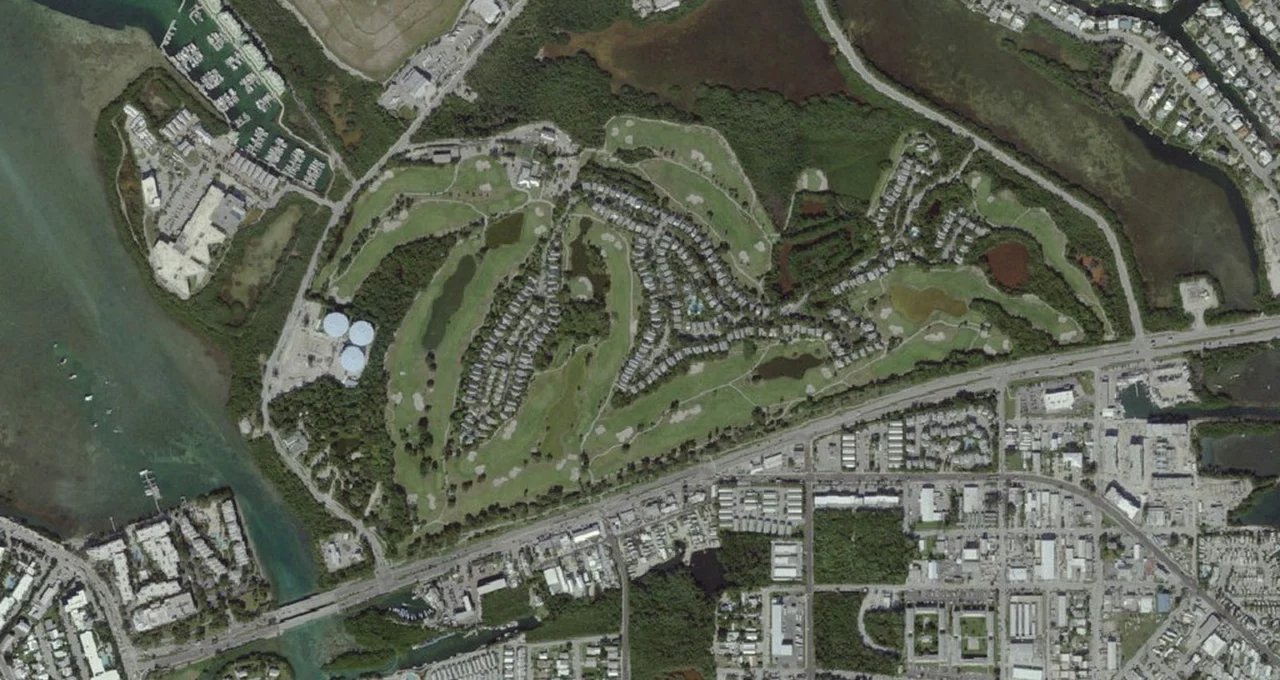
Key West Golf Club from the air. Aerial imagery USGS, domaine public.
Key West Golf Club
Holes
18
By
70
Length
—
Green fee
—
Best season
All year
There has been golf on Stock Island since 1924, when William Langford laid out the original course. Langford was one of the significant American architects of the 1920s, and the Florida Keys were then a railway destination rather than a highway one. In 1983 Rees Jones and co-designer Keith Evans completely rebuilt the property. It is the only golf course in the Keys, and the southernmost in the continental United States.
The course occupies around two hundred secluded acres on Stock Island, at mile marker four on US 1, immediately before Key West itself.
What it asks of you
A par 70 of about 6,500 yards through mangrove, hardwood hammock and salt pond, on an island where the highest natural point is a few feet above sea level. Water and mangrove are everywhere, and a ball hit into either is gone. There is no recovery from a mangrove root system, and no point looking.
The hole everyone talks about is the mangrove hole, a par three of around 143 yards played entirely over a field of thickly intertwined mangrove with nothing but a green on the other side. It is short, it is not subtle, and it decides a lot of matches.
The wind off the Straits of Florida is constant and is the real defense on a course of this length. Iguanas on the fairways are routine, along with egrets, ibis, pelicans and, in season, migrating hawks. It is not a long course and it does not play like an easy one.
What players say about it
This is a public course with a large review record, helped by being the only course in the Keys. The notes below summarize recurring themes across specialist golf sites, traveler review pages and player discussion threads. They are other people’s opinions, not ours: we have not played the course. We report what comes back repeatedly rather than isolated remarks, and we do not name or quote individual reviewers.
What comes up in its favor
- The setting is what people come away talking about: mangrove, salt pond and wildlife on every hole, and a quiet two hundred acres a few minutes from one of the busiest tourist towns in Florida.
- The mangrove hole is a genuine attraction and gets mentioned in almost every review.
- Reviewers who caught the course in good condition are enthusiastic, and several describe it as far better than they expected of an island course.
- The wildlife draws comment from non-golfing partners as much as from players, which matters on a trip where not everybody is there for the golf.
What comes up against
- Price is the loudest complaint by some margin, and the phrase that recurs is that the course is the only game in town. In-season rates are high for the standard of course, and off-season rates are not low.
- Charging for a non-playing passenger in the cart comes up repeatedly and irritates people out of proportion to the amount.
- Conditioning is inconsistent. After rain the course floods, bunkers are described as either rock hard or under water, and greens are called slower than they should be.
- Service and staff draw more criticism here than at most courses, and that theme recurs across independent accounts.
Getting there and when to go
The course is on Stock Island at mile marker four, immediately before Key West on US 1, and around ten minutes from Key West International. Driving down from Miami takes about three and a half hours and is a large part of the appeal of the trip.
The course plays all year. The season runs November to April, when the Keys fill up, the wind is steady and rates are at their highest; May to October is hotter, wetter and cheaper. Play early whatever the month: the heat and the afternoon storms both build after lunch.
Green fees
Rates and tee times are handled by the course and differ substantially between the winter season and the summer. See the course’s own site.
How this page was made
The factual frame comes from public sources: OpenStreetMap for the location, Wikipedia and published architecture coverage for the history and the 1983 rebuild, and the course’s own site for access and booking. The opinion section summarizes public reviews and player discussions read in September 2026; we report recurring themes rather than individual voices, and we do not reproduce or attribute quotes.
We have not played this course, and nothing here is a substitute for that. The course has not paid for this page, has not seen it before publication and has no say in what it says. If you know the course and something here is wrong or out of date, write to us and we will correct it.