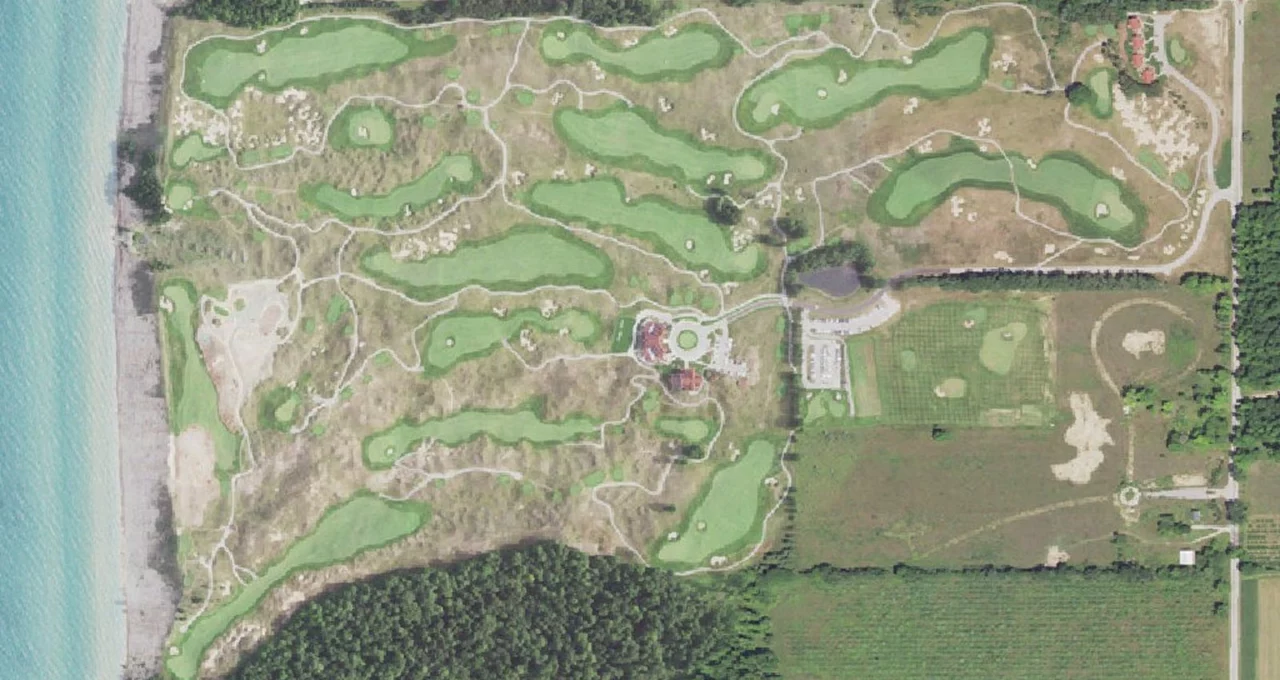
Arcadia Bluffs Golf Course from the air. Aerial imagery USGS, domaine public.
Arcadia Bluffs Golf Course
Holes
36 (the Bluffs and the South Course)
By
—
Length
—
Green fee
—
Best season
Roughly May to October
Arcadia Bluffs opened in 1999 on roughly 265 sloping acres above the Lake Michigan shore in Manistee County, designed by Warren Henderson and Rick Smith. The site is the whole argument. The routing starts high on the property and falls around two hundred feet to the bluff itself, which still stands close to two hundred feet above the water, with nothing between the course and the lake and nothing behind it but Michigan farmland. The Bluffs Course plays to a par of 72 and stretches past 7,300 yards from the back tees, with a course rating of 75.7 and a slope of 146 that tell you most of what you need to know about the choice of tee.
A second eighteen followed in 2018. The South Course was built by Dana Fry and Jason Straka in a deliberately different idiom, borrowing from Charles Blair Macdonald and Seth Raynor: squared bunkers, plateau greens, template holes, and an inland site that never sees the lake. It is a par 72 of around 7,400 yards. The two courses share a clubhouse and almost nothing else, which is the point of playing both in the same trip.
What it asks of you
The Bluffs is links-inspired rather than links. The ground was shaped rather than found, and the turf is not the fescue of Scotland or Ireland. But the effect on a windy afternoon is close enough that the distinction stops mattering. Fescue-framed corridors, revetted-style bunkering, enormous greens, and holes that run along the edge of the drop.
Wind off the lake is the single biggest factor in scoring. It changes direction through the day, and a club that was right at ten in the morning is two clubs wrong at four in the afternoon. Several holes are played toward the water with no visual reference for distance, which is harder than it sounds: the eye has nothing to measure against, and the tendency is to come up short.
The green complexes are heavily contoured and the surfaces run quick. Approaches that fall away leave recovery shots from short grass and sand rather than rough, which suits a player who can putt from off the green and punishes one who only owns a lob wedge. The fescue that makes the photographs is not decorative. A ball in it is often a ball you will not find, and the sensible play from the tee is the one that keeps you in the corridor rather than the one that shortens the hole.
What players say about it
The notes below summarize recurring themes in public reviews of the course, read across specialist golf sites, traveler review pages and player discussion threads. They are other people’s opinions, not ours: we have not played the course. We report what comes back repeatedly rather than isolated remarks, and we do not name or quote individual reviewers.
What comes up in its favor
- The setting is close to unanimous. The views over Lake Michigan and the sense of exposure at the top of the bluff are what almost every account leads with.
- Conditioning is praised consistently, tee to green, with putting surfaces described as receptive and quick.
- Players who like a course that gives them options on the ground rather than only through the air tend to come away satisfied.
- The clubhouse, the food and the lodging on the property come up often enough that the trip is judged as a whole, not only as eighteen holes.
What comes up against
- Pace of play is the most frequent complaint by some distance. The starter quotes a target under five hours; a large share of accounts report five and a half to six, especially in later tee times, and several note an absence of marshals moving groups along.
- The fescue is called out as punishing rather than merely penal. Reviewers describe losing balls a few steps off the corridor.
- The exposure that makes the course also makes it hard. Players who took the back tees on a windy day frequently say they wished they had moved forward.
- Green fees are regularly described as high for the region, and value is the point on which opinions divide most clearly.
Getting there and when to go
Arcadia sits on the M-22 shoreline route in northwest Lower Michigan. It is roughly four hours north of Detroit and two and a half from Grand Rapids, and most visitors combine it with the courses around Traverse City rather than making it a single destination. The nearest commercial airport of any size is Traverse City.
The season is short and northern, running from roughly May to October. High summer brings the fullest tee sheet and the busiest pace; late September combines the best odds on weather with the best odds on availability, and the light on the bluff at that time of year is part of why people go. Both courses are public, tee times are booked in advance, and lodging on the property fills first on weekends.
Green fees
Rates, stay-and-play packages and tee times are handled by the course, and they change by season and by day of the week. See the course’s own site.
How this page was made
The factual frame comes from public sources: OpenStreetMap for the location, Wikipedia and published architecture coverage for the history and the design credits, and the club’s own site for access, season and booking. The opinion section summarizes public reviews and player discussions read in September 2026; we report recurring themes rather than individual voices, and we do not reproduce or attribute quotes.
We have not played this course, and nothing here is a substitute for that. The club has not paid for this page, has not seen it before publication and has no say in what it says. If you know the course and something here is wrong or out of date, write to us and we will correct it.