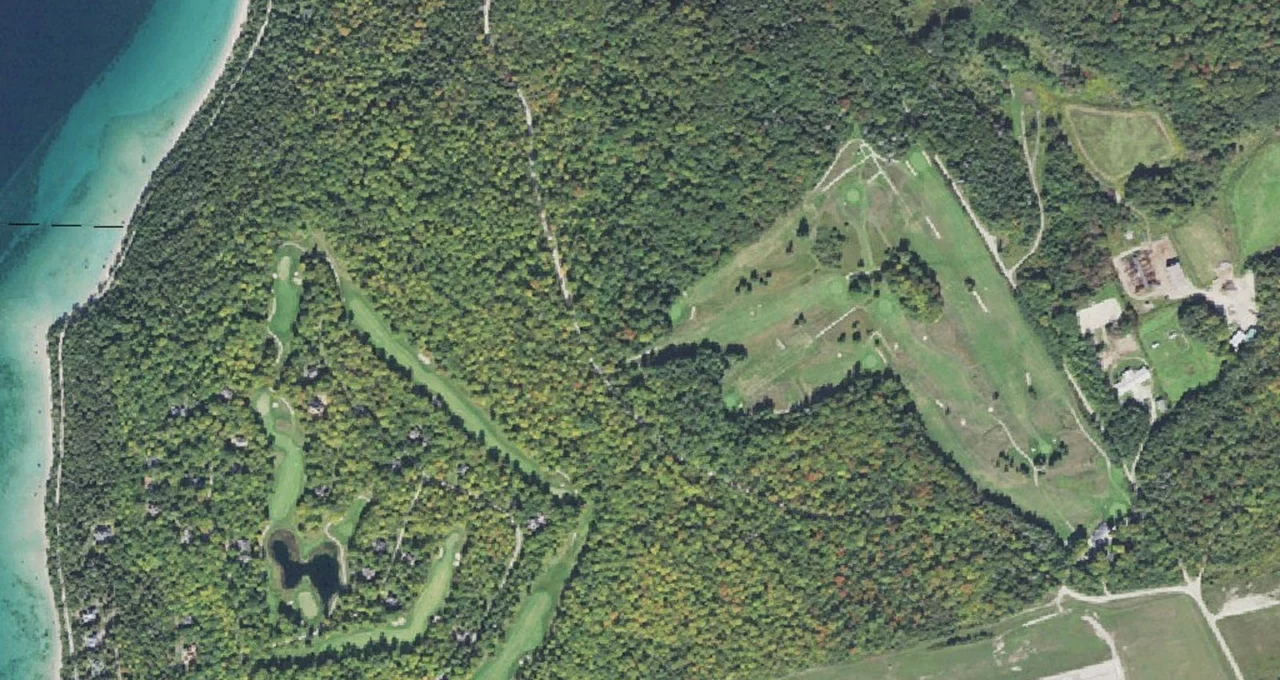
Wawashkamo Golf Club from the air. Aerial imagery USGS, domaine public.
Wawashkamo Golf Club
Holes
9
By
72 for 18 holes (two nines of par 36); the blue and yellow tees on the club's card add up to 73
Length
5,949 yards for 18 holes from the longest tees on the club's scorecard (rating 68.6, slope 121 for men); directories give 69.5/118 or 70.0/113
Green fee
—
Best season
Summer course; the club's rates page lists offers from early May to October 10, a tee-time site gives May 15 to September 30
Wawashkamo Golf Club is a nine-hole course on Mackinac Island, Michigan, the car-free island in Lake Huron that sits in the Straits of Mackinac between the state’s two peninsulas. It lies on British Landing Road, in the island’s interior, inside Mackinac Island State Park, on land owned by Mackinac State Historic Parks and leased by the club. The course was laid out in 1898 by Alex Smith, a professional from Carnoustie, Scotland, who later won the U.S. Open twice, and it is widely described as the oldest golf course in Michigan still in continuous use.
Nine holes are played twice from different tees to make an 18-hole round. On the scorecard the club publishes, the full round measures 5,949 yards from the longest tees for a par of 72, with a course rating of 68.6 and a slope of 121 for men. The ground it occupies is the battlefield of August 4, 1814, when an American force tried and failed to retake the island from the British during the War of 1812. Golf Digest named Wawashkamo one of “America’s Historic Golf Landmarks” in 1996; the club says it is the only nine-hole course among the dozen in the United States to receive that designation. Today the club is organized as a 501(c)(3) public charity, and the course is open to the public.
A Scottish links on a farmer’s field
The club was founded in 1898 by summer residents of the island; the state historical marker and several regional histories specify that they were cottagers from Chicago. They hired Alex Smith, born in Carnoustie in 1874, to lay out the course. According to Wikipedia, Smith knew the links of his boyhood home well, and he gave Wawashkamo the features of a nineteenth-century Scottish course: a nearly treeless layout, short holes and very long rough. Smith went on to win the U.S. Open in 1906, at the Onwentsia Club in Illinois, and again in 1910, at the Philadelphia Cricket Club, after a playoff.
The name comes from the Chippewa (Ojibwe) word waawaashkaamon, which Wikipedia and the club translate as the act of “walking a crooked trail.” The centennial history of the club, written by Frank Straus and Brian Leigh Dunnigan, borrows the phrase for its title, Walk a Crooked Trail.
The club explains why the course has changed so little. Its tees and greens are tiny by modern standards, a size that made sense in the 1890s when they were cut with twelve-inch push mowers. Elsewhere, heavy year-round play forced clubs to enlarge them; Wawashkamo, open only in the warm months, never had to. Most writers who have visited describe the layout as substantially unaltered since Smith, and a Michigan golf magazine went further in 2017 and said no alterations at all had been made. We found no detailed record of later work on the course to confirm or contradict either claim.
The battlefield of 1814
Mackinac Island had been taken by a British, Canadian and Native American force in July 1812, in the opening weeks of the war. In the summer of 1814 an American expedition came to recover it. According to Wikipedia, about 700 soldiers under Lieutenant Colonel George Croghan landed on August 4, 1814, on the north shore, near the spot now called British Landing, and advanced inland through the woods toward the fort. The British commander, Lieutenant Colonel Robert McDouall, did not wait inside Fort Mackinac. He took most of his force out to meet them at the clearings of Michael Dousman’s farm, where his troops and Native American allies, many of them Menominee warriors, held the Americans back. Major Andrew Holmes was killed, the Americans withdrew to their ships, and the island stayed British until the end of the war. Wikipedia counts 13 American dead and 55 wounded.
That farm is the golf course. The club’s history says the first tee sits on the ground where the British cannon fired that afternoon, and that American soldiers charged across what are now the fairways. Regional accounts place the charge on the 1st and 5th fairways and the British gun on a ridge near the first tee, where a cannon now stands; it is marked on the club’s course map, near the 1st tee and the 5th green. A 2002 archaeological survey with metal detectors, reported by a Michigan radio station’s website, turned up more than 250 battle artifacts, including military buttons, gun parts and a penny dated 1807. A 2017 magazine article says twelve American soldiers are buried beneath the 6th fairway; we found no primary source to confirm it.
Mackinac State Historic Parks also tells the story of a red oak that stood on the course and fell in a summer windstorm. A forester counted its rings and put its age at 207 years, so the tree was already growing, as a small sapling, on the day of the battle. A tourism site adds that a large mound between the 5th and 6th holes marks a witness tree from 1814. The battlefield has its own state historical marker on British Landing Road, separate from the golf club’s.
Frank Dufina, seventy years at one club
The figure most associated with Wawashkamo is Frank Dufina, born on Mackinac Island on June 30, 1884. According to Wikipedia, he began his career at the newly opened club in 1898, at the age of fourteen, and became its professional. He was a member of the Mackinac Island Band of Chippewa and Ottawa Indians, and he is described as one of the first Native Americans to play golf on the professional circuit; he entered the Western Open in 1911 and in 1922. Golf Digest named him the “Longest Working Golf Professional in History” in 1968. He stood under five feet tall, counted Walter Hagen among his friends and was a pallbearer at Hagen’s funeral. Hagen himself signed the club register on July 27, 1919, according to the island’s tourism bureau. Dufina died in Petoskey in 1972. The club holds an annual match play championship in his name.
How long he served depends on the source, as explained in the method section below: Wikipedia gives 70 years, from 1898 to 1968, which it says is believed to be the longest tie between a course and a professional in American golf history, while the club’s own history says 63 years.
The clubhouse and the landmarks
The clubhouse was built in 1899 and 1900 by Patrick Doud. The club describes it as a vernacular, one-story, cottage-type building in the Mackinac style, set on cedar posts, with columned porches on the north and east sides overlooking the 9th fairway. The final bill came to roughly 60 percent more than the original estimate, and the last payment was made on July 27, 1900, according to the club. The building still serves as the pro shop and is rented for weddings, family gatherings and company events. The grounds can also be booked for picnics.
Several designations overlap. The course is a contributing property of the Mackinac Island National Historic Landmark district, which Wikipedia lists on the National Register of Historic Places from October 15, 1966. It was made a Michigan State Historic Site on September 8, 1982, and its state marker, registered under number S550A, was put up in 1983. A regional history site quotes the marker as calling Wawashkamo “Michigan’s oldest unchanged private nine-hole golf links,” a wording that predates the club’s present status as a public charity open to all.
What it asks of you
Wawashkamo is short, but it is not a pitch-and-putt. The difficulty lies in three things that reviewers and writers mention over and over: very small greens, firm and unwatered fairways, and heather and long grass waiting just off the short grass. Several writers note that only the tees and greens are irrigated, so the fairways turn brown and hard in high summer and the ball can bounce and run a long way; you have to judge the release on every shot. Trees line the boundaries of the property rather than the holes themselves.
The club’s local rules say a lot about the course. Play is under USGA rules, with “winter rules” in your own fairway only. A ball lost in the heather is played as a lateral hazard, with a one-stroke penalty, and red stakes mark lateral hazards on holes 1 and 10, 2 and 11, 8 and 17, and 9 and 18. A ball that comes to rest in a garden or flower bed is dropped without penalty, and there is free relief from benches and from the netting that protects the clubhouse. Carts must stay out of the heather, and the course is a non-metal spike facility.
The published card gives the following holes, with par and yardage from the longest tees for the first nine (green) and second nine (white). The handicap index of each hole is in parentheses.
- 1st and 10th: par 5, 511 and 478 yards (7 and 8). Open fairway with dense woods on the right, and bunkers on both sides of the green, according to one golf blogger. The cannon stands near the tee.
- 2nd and 11th: par 4, 353 and 376 yards (1 and 2). Rated the two hardest holes on the card.
- 3rd and 12th: par 4, 336 and 315 yards (11 and 14). The green is ringed by the “Circus Ring,” a circle of long grass around the putting surface.
- 4th and 13th: par 3, 123 and 121 yards (17 and 18). The easiest hole on the card, but the green is hidden from the tee, where only the flagstick is visible.
- 5th and 14th: par 5, 464 and 512 yards (3 and 4). From the second-nine tee, the longest hole of the round, played across the heart of the battlefield.
- 6th and 15th: par 4, 308 and 319 yards (9 and 16). A low hedge in front of the tee, dense heather on the left and a fairway bunker on the right; one writer describes a cross bunker.
- 7th and 16th: par 3 of 219 yards on the first nine, par 4 of 284 yards on the second (15 and 10).
- 8th and 17th: par 3, 224 and 167 yards (13 and 12). The longest par 3 on the course, with mounds a blogger calls the “Chocolate Drops.”
- 9th and 18th: par 5 of 461 yards on the first nine, par 4 of 378 yards on the second (5 and 6). The hole bends left, with trees along the right side, and plays toward the clubhouse, whose porches overlook the 9th fairway.
That makes a first nine of 2,999 yards and a second nine of 2,950 yards, each a par 36. The card lists two other sets of tees. The blue and yellow tees give 5,183 yards, rated 64.9 with a slope of 112 for men and 69.7 and 121 for women. The red tees, the same on both nines, give 4,760 yards, rated 62.6 and 108 for men and 67.2 and 119 for women, on a par of 72. From the longest tees, women play a rating of 74.2 and a slope of 130.
The “Circus Ring” on the 3rd is the feature every writer mentions. A Wisconsin golf publication describes it as a foot-tall ring of fescue around the green and explains it as Smith’s way of forcing golfers to loft the ball onto the putting surface rather than run it on; a 2017 article calls it shin-high, and a blogger notes that it was once twice as high as it is now. The long par 3s on the first nine, at 219 and 224 yards, are the other test for most club golfers: with greens this small, a missed tee shot leaves a delicate chip from rough. For a high handicapper, the honest advice drawn from the reviews is to keep the ball on the short grass, take the heather penalty without argument when it comes, and expect the greens to be quicker than their size suggests.
The club rents clubs, including hickory-shafted sets, and several visitors recommend trying a round with them; it fits the course, which was built for that equipment. A PGA professional gives lessons, and there is a putting green near the entrance.
What golfers are saying
Wawashkamo draws far fewer public reviews than a mainland course: in October 2026 one golf app showed an average of 4.4 out of 5 from 19 reviews, the state tourism site 4.3 out of 5 from 18 travel reviews, and a course-ranking site 3.5 out of 5. We also read accounts by golf writers and bloggers. The points below summarize what recurs. They are other people’s opinions, not ours; nobody from Panxis has played the course, and we name no one.
What comes up in its favor
- The history is the main draw: the battlefield, the cannon, the 1898 clubhouse and a layout that feels close to how golf was played more than a century ago.
- The greens get the most praise for the playing surface itself: small “saucers,” but in several accounts smooth, true and quick.
- Getting there is part of the fun for many visitors, who describe the horse-drawn taxi ride to the course as half the experience.
- Hickory club rental comes up often, as do friendly staff at the desk.
- Rounds tend to move quickly, according to app reviews.
What comes up against
- Conditioning divides opinion. Some reviewers find little difference between fairway and rough, weeds such as dandelions in the fairways and grass that is hard to play from; one complains of painted greens.
- Several visitors find it expensive for a nine-hole course, especially once club rental is added.
- The holes feel short and tight to some golfers used to modern courses.
- Weather on the island can make the course hard to play, and one blogger felt unwelcome when asking to play in the rain.
- Even writers who love the course call it bare-bones: a small clubhouse, a single row of irrigation, nothing in the way of resort amenities. That is part of its charm for some and a letdown for others.
Who can play
Wawashkamo is open to the public, and it also has members. Tee times are booked by calling the golf shop at (906) 847-3871. The club’s rates page lists separate fees for nine and 18 holes, walking or riding, with a summer rate, lower spring and fall rates, a twilight rate in summer, and reduced fees for members’ guests and island residents. It also offers spring and fall weekday packages that include a cart, a hat and club rental. Walking is allowed; power carts and pull carts are for hire. The golf shop opens at 9 a.m. in May and at 8 a.m. from June to Labor Day, according to the club. Lessons are given by the club’s PGA professional for juniors and adults.
The season is short. The club says the course was always meant for summer play only, and its current rates page lists offers running from early May to October 10, while a tee-time site gives May 15 to September 30. Check with the club before planning a trip at either end of the season. Memberships, including patron levels that the club says are tax-deductible, help fund the charity that runs the course.
Getting there
No cars are allowed on Mackinac Island, so the trip is part of the round. Passenger ferries run to the island from Mackinaw City, on the Lower Peninsula, and from St. Ignace, on the Upper Peninsula. From the harbor, golfers reach the course by bicycle, on foot or by horse-drawn taxi; a ride of about twenty minutes is mentioned in reviews. The island is about eight miles around, according to one golf guide. Mackinac Island Airport, a small public airfield, lies just south of the course.
In a straight line, the course is about 0.4 miles from Mackinac Island Airport, 0.7 miles from British Landing on the north shore, about 1.7 miles from the harbor and the downtown on Main Street, about 4.4 miles from St. Ignace, about 7.6 miles from the ferry docks in Mackinaw City and about 22 miles from Pellston Regional Airport, a mainland airport with scheduled airline service. Detroit is about 257 miles away and Chicago about 314. These distances are measured on the map and not by road or ferry route.
Green fees
Wawashkamo publishes its own rates for nine and 18 holes, walking or with a cart, by season, with twilight, guest and resident rates, rental fees for steel and hickory clubs, and its membership categories. Rates change from year to year, so check them on the club’s own rates page or call the golf shop before you book.
How this page was made
The factual frame comes from public sources: OpenStreetMap for the location; the club’s website, wawashkamo.com, for its history, the clubhouse, the scorecard and course map, the local rules, the rates page, the season offers, the shop hours and the club’s status as a public charity; Wikipedia and Wikidata for the 1898 founding, the origin of the name, the designations and the identifiers; Wikipedia’s articles on Alex Smith, Frank Dufina and the Battle of Mackinac Island for the biographies and the battle; Mackinac State Historic Parks for the red oak; the Mackinac Island Tourism Bureau for the lease, the irrigation and Walter Hagen’s visit; regional golf writers and blogs (Midwest Golfing Magazine, GolfMichigan, a Wisconsin golf publication, AnnArbor.com, Always Time for 9) for hole descriptions and features such as the Circus Ring; a regional history site and a Michigan radio station’s website for the state marker and the 2002 archaeological survey; golf apps, tee-time and travel review sites for the reviews.
Where sources disagree, we say so. Frank Dufina’s tenure is 70 years, from 1898 to 1968, in Wikipedia and in the tourism bureau’s account (“nearly 70 years”), but 63 years on the club’s history page. The centennial history is dated 1999 in the body of Wikipedia’s article on Dufina and 2000 in its reading list. The club calls the course a par 72, but the blue and yellow tees on its own card add up to a par of 73, because the 18th is shown as a par 5 from those tees. Course directories give ratings that do not match the club’s card: one app shows 69.5 and 118 for the 5,949-yard round, a tee-time site 70.0 and 113, against 68.6 and 121 on the card, which this page follows. The season dates differ between the club and a tee-time site, as noted above. One hotel’s website says the course is walking only, while the club rents power carts. Another directory describes an 18-hole course with a driving range and a restaurant, which matches nothing the club publishes; we ignored it. The size of the American force in 1814 is 700 in Wikipedia and 750 in a radio station’s account. The height of the Circus Ring varies from one writer to another. The coordinates given by Wikipedia and by OpenStreetMap differ slightly; this page uses OpenStreetMap. The claim, in a 2017 headline, that Wawashkamo is the nation’s oldest continuously run course is not supported by the other sources, which speak of Michigan.
Some details will age: the season offers and their dates, the shop hours, the lesson offer, the review counts and averages read in October 2026, and the rates themselves, which we deliberately leave out. The opinion section reports recurring themes rather than individual voices. Nobody from Panxis has played or visited this course, and this page is no substitute for a round.
The club has not paid for this page, has not seen it before publication and has no say over its content. This page contains no commercial link and earns us no commission. If you know the course and something here is wrong or out of date, write to us and we will correct it.
Other courses nearby
Closest to this one in our United States directory:
- Arcadia Bluffs Golf Course — 125 mi
- The Meadows at Grand Valley State University — 210 mi
- Warwick Hills Golf & Country Club — 212 mi
- Blackwolf Run — 214 mi
The hole to know
A par 4 of 336 yards from the longest tees (315 when replayed as the 12th), whose green is ringed by the "Circus Ring", a circle of long grass that writers say Alex Smith used to force golfers to loft the ball onto the green rather than run it on.