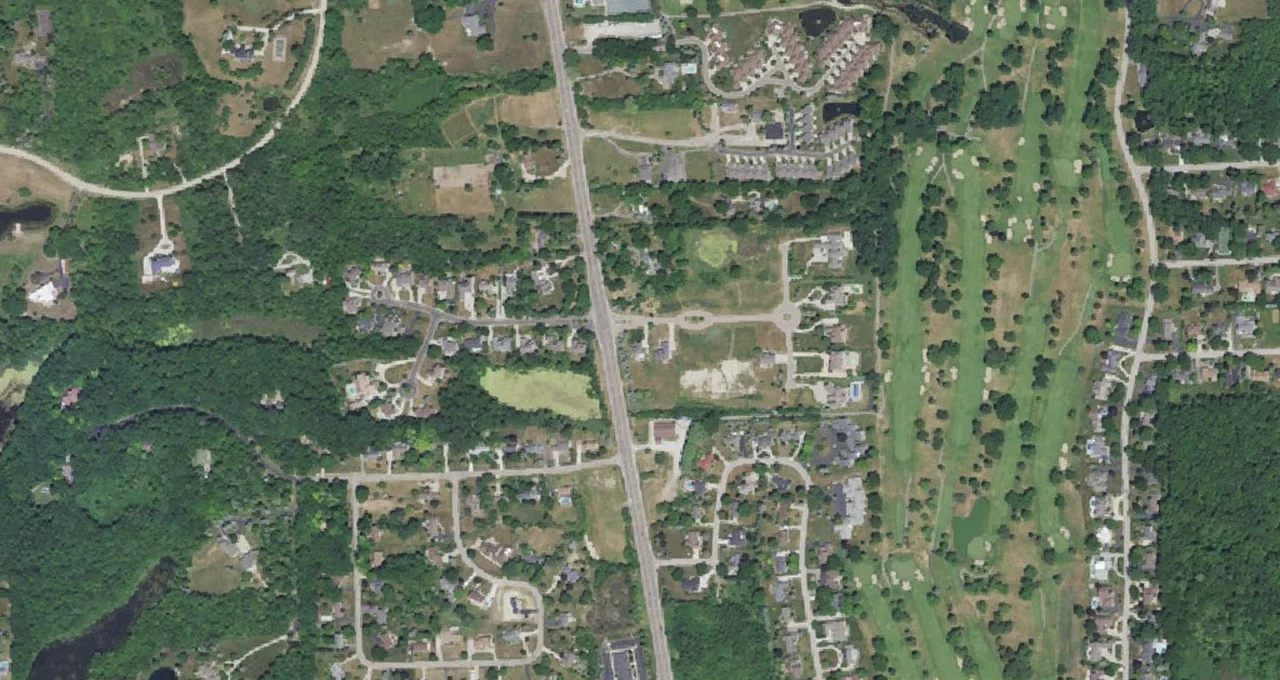
Warwick Hills Golf & Country Club from the air. Aerial imagery USGS, domaine public.
Warwick Hills Golf & Country Club
Holes
18
By
72
Length
7,127 yards from the Black tees on published scorecards (rating 74.5, slope 136); encyclopedic entries give 7,112 yards
Green fee
—
Best season
—
Warwick Hills Golf & Country Club is a private club at 9057 South Saginaw Road in Grand Blanc Township, Michigan, a few miles south of Flint in Genesee County. The club says it sits in the heart of Grand Blanc, just minutes from I-75. It opened in June 1957, and for most of the following half century it was a fixture of the PGA Tour as the home of the Buick Open. Since 2018 it has hosted The Ally Challenge presented by McLaren on the PGA Tour Champions, the tour for players aged 50 and over. The course is an 18-hole par 72, with 36 on each nine.
Two architects share the credit, and sources weigh them differently. According to the club’s own history, the original course was laid out by James Gilmore Harrison, a golf course architect from Turtle Creek, Pennsylvania, who drew the plans within sixty days; construction began in the late summer of 1956. After the 1967 Buick Open and into 1968, the course was completely rebuilt: many holes were changed and the tees, which had all been flat on the ground, were rebuilt. The club calls Joe Lee its latest architect and says the work cost $180,000. A specialist ranking site adds a third name to the original design, Ferdinand “Fred” Garbin, Harrison’s son-in-law, and describes Harrison as a former foreman of Donald Ross. Encyclopedic entries list Joe Lee alone as designer. This page follows the club: a 1957 Harrison design, rebuilt by Joe Lee in 1967 and 1968.
The length depends on the source. A scorecard published on a golf app gives 7,127 yards from the Black tees, with a course rating of 74.5 and a slope of 136, figures that match the USGA course rating database as cited by encyclopedic entries. Older published figures for the same tees, repeated by a booking platform and by a 2019 review, are 74.1 and 132. Encyclopedic entries give 7,112 yards, the booking platform 7,101 yards, and the course map of the 2026 Ally Challenge sets the course up at 7,088 yards for the professionals. This page follows the 7,127-yard scorecard. On that card the Blue tees measure 6,833 yards (73.1 and 133), the White 6,495 yards (71.4 and 131), the Green 6,183 yards (69.7 and 127), the Red 5,497 yards and the Gold 5,142 yards, with women’s ratings of 71.9 and 69.8 on those last two. The club’s golf page, in 2023, spoke of four sets of tees; published scorecards list six.
A members’ club built around a tournament
The club’s history says it began in 1955, when members of the Flint Golf Club decided the area needed a second private club because demand for membership exceeded what existed. Sixty-five investors formed a company called Warwick Realty and found their site on the Lenz farm in Grand Blanc, a property of 320 acres that included a Tudor-style mansion and stable. The mansion had belonged to Arnold Lenz, a General Motors vice president, and became the base of the first clubhouse, while the stable was turned into locker rooms, the golf shop and a dining room. Lots around the course were sold to the founding investors, and the first foursome teed off in June 1957 on what is now the 10th hole.
Membership sales were slow at first, and the club turned to professional golf to raise its profile. In 1958 it staged its first PGA Tour event, with a purse of $52,000 that the club describes as the largest of any tournament in the country that year. Billy Casper won it. Buick lent its name to the event from 1959, and it was played at Warwick Hills through 1969. In 1962, according to the club, Jerry Barber made the first hole in one ever shown on television, with a 2-iron on the 17th during the final round.
After 1969 the tournament left the PGA Tour schedule. It returned to the tour in 1977 at the Flint Elks club and came back to Warwick Hills in 1978, where it stayed until 2009, when General Motors ended its sponsorship. The Ally Challenge’s own site gives 1977 as the year of the return to Warwick Hills; the club’s timeline and encyclopedic entries give 1978, and this page follows them. The club reorganized as a stock corporation in 1972 and added recreational and social memberships in 1976.
What it asks of you
Warwick Hills is a parkland course on fairly flat ground. A Michigan golf blog describes it as laid out in the shape of the letter L, relatively flat except for the holes that play toward or away from a hill at the corner of the L; a ranking site describes two L-shaped nines heading out from the clubhouse on a narrow property. Both agree on the main defense: tree-lined corridors that reward accuracy more than power. The second defense is the greens. The tournament’s hole guide keeps returning to severe back-to-front slopes, two-tiered surfaces and the need to stay below the hole, and the ranking site notes asymmetrical knobs that extend from several greens and allow awkward pin positions.
For professionals, the course has usually been a scoring course. The Buick Open record aggregate is 262, 26 under par, set in 1987, and encyclopedic entries give the course record as 61, shared by Tiger Woods and Billy Mayfair. A 2009 article reported that the course had been rated the ninth easiest on the PGA Tour the previous year. For club golfers the picture is different: the review blog found it fair and enjoyable from the middle tees, with accommodating fairways, and said a bogey golfer can have a good time there when playing from the right tees.
On the app scorecard’s stroke index, the 7th is the hardest hole, followed by the 13th and the 1st; the 11th is the easiest. The tournament’s hole guide, written from the professionals’ point of view, calls the 15th traditionally the most difficult hole.
The front nine
The yardages below are from the 7,127-yard Black tees. The 1st is a par 5 of 567 yards that the tournament guide calls reachable in two for long hitters with the prevailing wind, with out of bounds on the left and fairway bunkers placing the emphasis on the drive. The green is about 150 feet from front to back, with several tiers. The 2nd, a par 4 of 431 yards, has out of bounds and overhanging trees on the left and a large, severely sloped green guarded by a bunker on the left. The 3rd, a par 3 of 187 yards, often plays into the wind to a green with three bunkers and a strong back-to-front slope.
The 4th, a par 4 of 401 yards, leads to the smallest green on the course; the guide warns that trees have encroached on the fairway and that the fairway bunkers leave a blocked approach. The 5th, 437 yards, has water down the left and trees, rough and bunkers on the right, then a large two-tiered green. The 6th, 421 yards, is a dogleg left where the thick trees on the left are the main threat from the tee, followed by a large, relatively flat green with three bunkers. The review blog named it its favorite hole.
The 7th is the longest par 5, 584 yards; a tree on the right blocks a second shot at the green for most drives, and layups leave a wedge from the bottom of a valley to a crowned green. The 8th, a par 3 of 199 yards, combines swirling wind with a severely sloped two-tiered green, with bunkers and a fall-off into the trees on the left. The 9th, a par 4 of 434 yards, usually plays into the prevailing wind, with bunkers on both sides of the landing area and three bunkers around the green, for a front nine of 3,661 yards.
The back nine
The tournament guide presents the 10th to the 14th as the stretch where birdies must be taken. The 10th, a par 4 of 401 yards, leaves a wedge to a green with a subtle back-to-front slope. The 11th, a par 3 of 190 yards in the trees, is hard to judge in the wind, with three greenside bunkers but a fairly level green. The 12th, a par 4 of 340 yards, can be played with anything from driver to a long iron, then a pitch that must not go over the green.
The 13th, a par 5 of 544 yards, is second on the stroke index: the drive must stay left of a large oak in the right rough, and the second shot faces about 220 yards of carry to the most severely sloped green on the course, with water guarding the front right. The 14th, a par 4 of 322 yards, invites an attempt to drive the green, which the guide calls large and forgiving. The 15th, 457 yards, has out of bounds and trees on the left, a well-bunkered green and a steep fall-off behind it.
The 16th, a par 5 of 580 yards, has fairway bunkers in the landing area and a dense chute of trees within 200 yards of a two-shelved, severely sloped green. The 17th is the signature par 3: 197 yards from the back tee on the scorecard, across a pond from one small rise to another, to a green that slopes gently toward the water, with bunkers short and left and trees beyond them. For the 2026 Ally Challenge it was set at 158 yards. It is also where the tournament puts its crowds, its skyboxes and its evening concert. The 18th, a par 4 of 435 yards, combines water, out of bounds, trees and bunkers, with a landing area graded from right to left and an undulating green, for a back nine of 3,466 yards.
What tournaments have shown
The Buick Open winners list at Warwick Hills reads like a history of the tour: Billy Casper in 1958, Tony Lema in 1964 and 1965, Julius Boros twice, Tom Weiskopf in 1968, and later Ben Crenshaw, Hale Irwin, Fred Couples, Justin Leonard, Vijay Singh three times, Kenny Perry twice and Tiger Woods three times, including the final edition in 2009. Encyclopedic entries note that long hitters dominated the last years of the event.
On the PGA Tour Champions, The Ally Challenge is a 54-hole event. Paul Broadhurst won the first edition in 2018, followed by Jerry Kelly, Jim Furyk, Joe Durant, Steve Stricker, Vijay Singh, Stewart Cink in 2024 and 2025, and Steven Alker in 2026. Furyk and Singh are the two players who have won both the Buick Open and The Ally Challenge. The tournament’s site says the greens were consistently ranked among the best on the PGA Tour by the players.
What golfers are saying
Because Warwick Hills is private, public reviews are few. The material behind this section is a detailed review by a Michigan golf blog written after a media-day round in 2019, the ratings summary of a golf app, the description of a specialist ranking site and the tournament’s own hole guide. The points below are other people’s opinions, not ours; nobody from Panxis has played the course, and we name and quote no one.
What comes up in its favor
- Conditioning is the constant: reviewers describe a course groomed to tour standard, and the golf app’s users rate course condition highly.
- The greens are the most praised feature, described as large, fast and demanding enough to keep good putters engaged.
- From the middle and forward tees, the course is described as fair and fun, with room off the tee and few holes that can wreck a card.
- The 17th, over the pond, and the dogleg 6th are singled out as the most enjoyable holes.
- The tournament history, from the Buick Open to the current senior event, gives many visitors a reason to want to play it at least once.
What comes up against
- Access is the obvious limit: it is a members’ club, and there is no public tee sheet.
- The ground is relatively flat, and the design relies on trees rather than terrain; the tournament guide itself notes trees encroaching on the 4th fairway.
- Bunkers across the front of some greens limit the ways to approach, which one reviewer says he does not normally like.
- Knobs on several greens allow tucked, awkward pin positions.
- From the back tees the course is long and narrow for amateurs, while for tour players it has often ranked among the easier courses, so its reputation varies with who is describing it.
- On the golf app, value is the lowest of the ratings shown, below condition.
How to play it
Warwick Hills is a private club. Its guest information page says that use of the facilities is exclusive to members, and that invited guests are welcome. In practice, a round there means playing as a member’s guest, or at an event the club hosts. The club lists golf memberships in several categories, including Class A for ages 40 and over, Junior and Legacy categories for ages 21 to 39 and a Non-Resident category for those living 40 miles or more away, as well as recreational, social and corporate memberships; the club handles enquiries through its membership office. The club publishes a dress code and a mobile phone policy that asks players to switch phones off or to vibrate on the course.
The club runs a caddie program, which it says employed more than 100 local young people as summer caddies in 2023, and supports the Evans Scholars Foundation, which gives tuition and housing scholarships to caddies. A booking platform lists carts and caddies as available. There is no published green fee, since the course is not open to the public.
The easiest way for the public to see the course is The Ally Challenge, played each August. The tournament has announced its 2027 edition for August 23 to 29 at Warwick Hills.
The facilities
The club describes a practice facility with separate areas for full swing, short game and bunker play, a golf shop and a team of instructors. Beyond golf, it lists a heated swimming pool, hydro-clay tennis courts that it calls the only ones in Genesee County, bocce courts and several dining rooms, including a grille room, a pub and a terrace overlooking the course.
Getting there and when to go
The club is at 9057 South Saginaw Road in Grand Blanc, MI 48439, close to I-75 and south of Flint. The golf season in mid-Michigan runs through the warmer months; the club does not publish its opening and closing dates, and schedules are its call. Visitors who are not guests of a member can see the course during The Ally Challenge week in late August.
How this page was made
The factual frame comes from public sources: OpenStreetMap for the location; the club’s website, read through its archived pages, for the address, the founding story, the 1957 opening, the original architect, the 1967 and 1968 rebuild, the 1958 purse, the 1962 hole in one, the 1972 reorganization, the guest policy, the membership categories, the caddie program and the facilities; encyclopedic entries (Wikipedia and Wikidata) for the location, the course record, the 7,112-yard figure and the lists of Buick Open and Ally Challenge winners; the website of The Ally Challenge for the hole-by-hole descriptions, the 2026 course setup, the 2026 winner and the 2027 dates; a golf app for the scorecard, stroke index and user ratings; a booking platform and a course directory for the older ratings and the services; a specialist ranking site for the second original architect and the green design; a 2009 golf article for the ranking among the easier tour courses; and a Michigan golf blog for its 2019 review. Where sources disagree, as they do on the architects, the length and the year the Buick Open returned, we say so and name the source we follow.
The opinion section summarizes public reviews and course guides read in September 2026. We report recurring themes rather than individual voices, and we reproduce no quotations. Nobody from Panxis has played or visited this course, and this page is no substitute for a round.
The club has not paid for this page, has not seen it before publication and has no say over its content. This page contains no commercial link and earns us no commission. If you know the club and something here is wrong or out of date, write to us and we will correct it.
Other courses nearby
Closest to this one in our United States directory:
- Oakland Hills Country Club — South Course — 29 mi
- The Country Club of Birmingham — 31 mi
- Plum Hollow Country Club — 35 mi
- Rackham Golf Course — 36 mi
The hole to know
The signature par 3, 197 yards from the back tee across a pond to a green that slopes gently toward the water, with bunkers short and left; Jerry Barber's 1962 ace here was, according to the club, the first hole in one shown on television.