Golf and wine: Barossa and Margaret River weekends
The difference between this and a golf trip is the number of rounds: one a day, in the morning, with the afternoon belonging to somebody else's priorities.

In brief
- Barossa is the easiest to organise, Margaret River the destination.
- The Mornington Peninsula is close enough to be a genuine weekend.
- Choose the base for the town, not the course.
- Spring and autumn in all three regions; ask about coring dates.
- Book the tee time first: everything else can be sorted on the day.
Golf and wine make an obvious weekend, and Australia has two regions that do it better than anywhere: the Barossa Valley in South Australia and Margaret River in Western Australia. Both combine playable courses with the country’s best cellar doors, and both work as a two or three-day trip rather than a week.
Barossa Valley, South Australia
An hour north-east of Adelaide, the Barossa is compact: the courses, the cellar doors and the accommodation sit within a short drive of each other, which is the whole point of the region for a weekend.
The golf is inland Australian parkland and it plays firm through the warmer months, with the ball running on landing. The wine is Shiraz country, which means the afternoons need planning rather than improvisation.
Margaret River, Western Australia
Three hours south of Perth, Margaret River combines coastal scenery, surf beaches and one of the best wine regions in the country. The golf is spread along the coast, and the distances between courses are longer than in the Barossa, so a two-course weekend is realistic and a four-course weekend is not.
The coastal weather is the variable: mornings are frequently still and afternoons breezy, which argues for early tee times and cellar doors after lunch.
The Mornington Peninsula, an hour from Melbourne
The third of the three, and the easiest to reach for the largest number of people. The Peninsula puts links-style courses on sandy ground alongside a dense concentration of cellar doors, within about an hour of Melbourne, which makes it the only one of the three that works as a genuine weekend rather than a short break.
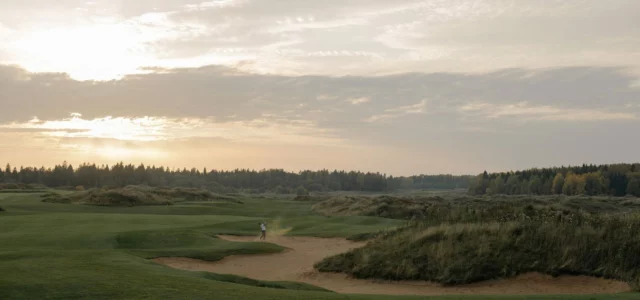
The golf plays firm because of the soil, which means run off the tee and approaches that want to land short. The wind off the bay is the variable that decides the round, and it gets up in the afternoon almost every day in summer.
Because it is close to a capital, it is also the busiest. Book tee times well ahead for weekends, and consider midweek, when the rates are lower and the cellar doors are quieter as well.
What makes a golf-and-wine weekend work
The difference between this and a golf trip is the number of rounds. A golf trip plans four or five rounds in four days and treats everything else as a gap. A golf-and-wine weekend plans one round a day and treats the rest as its own programme, which is the only version that satisfies two people with different priorities.
That has one practical consequence: play in the morning. It leaves the whole afternoon for everything else, and in summer it is the more comfortable golf anyway.
The second consequence is the choice of base. A town with somewhere to walk, eat and taste sustains an afternoon for a non-golfer; a resort course surrounded by paddocks does not. Choose the town first and the course second, which is the reverse of how golfers usually plan.
The rule that makes these weekends work
Golf in the morning, wine in the afternoon, never the other way around. This is not a moral position, it is a scoring one: an afternoon round after three cellar doors is a wasted green fee, and a tasting after eighteen holes in the heat is a waste of good wine.
One round a day, two nights, two or three cellar doors in total. Trying to fit five of each into a weekend produces a poor version of both.
The regions compared
The Barossa is the easiest to organise from Adelaide, with short drives, a dense concentration of cellar doors and a golf offering that is smaller but perfectly sufficient for one round a day. It is hot in summer and genuinely cold on winter mornings.
Margaret River is the destination version: a longer drive from Perth, better courses, a coastline that justifies the trip on its own, and a climate that stays comfortable for most of the year. It rewards three nights rather than two.
The Mornington Peninsula is the convenient one, close enough to Melbourne to be a genuine weekend, with links-style golf on sand and the busiest tee sheets of the three. It is the one to book earliest.
All three share the same structure: one round a day in the morning, an afternoon that belongs to somebody else’s interests, and a base chosen for the town rather than the course.
Getting around, and the obvious problem
Both regions require a car, and both regions involve alcohol. Plan the driving before the trip: a designated driver, a hired driver for the tasting afternoons, or accommodation within walking distance of two or three cellar doors.
Several operators in each region run tasting tours precisely because of this, and using one for the wine half of the day is cheaper than the alternative.
What the golf actually asks
All three regions play firmer than most Australian parkland, on sandy or gravelly soil that drains and runs. That means more roll off the tee than you are used to, approaches that want to land short and release, and a low runner rather than a lofted wedge around the greens on a tight lie.
Wind is the second variable, off the bay on the Peninsula and off the ocean at Margaret River. Into it, take more club and swing at eighty per cent, because a hard swing adds spin and spin is exactly what a headwind punishes.
And on the greens, expect them to be quicker than they look on a dry afternoon. Ten minutes of long putts before the round is worth more here than any amount of work on the stroke.
The non-golfer’s half of the deal
Worth saying plainly, because it is the reason these weekends exist. A morning round plus preparation and a drink afterwards is five or six hours, and that is a long time for somebody who is not playing.
Two things fix it: a fixed lunch appointment that gives the day a hinge, and a base with enough within walking distance that the morning stands on its own. A third works occasionally, which is taking them out for nine holes late in the afternoon with hire clubs and no score.
What to book first
Accommodation, then tee times, then cellar doors. In both regions the good accommodation is limited and books out on weekends well ahead, while the golf can usually be arranged closer to the date.
Ask the course whether visitors are accepted on the weekend day you want, since some of the regional clubs keep Saturday mornings for members.
When to go
Spring and autumn are the answer in all three regions: September to November and March to May give good surfaces, comfortable temperatures and cellar doors that are open without being crowded. Vintage, in February and March, is the exception in wine terms and worth checking if tasting is the point of the trip.
Summer is hot in the Barossa and inland Margaret River, and the golf moves to early morning and twilight. Winter is quiet and cheap, greens are softer, and in the Barossa and on the Peninsula it can be genuinely cold in the morning.
Ask about aeration when you book. Courses hollow-core twice a year and the greens stay bumpy for two or three weeks afterwards; the green fee is often reduced then, which argues for a spontaneous outing rather than the weekend two couples have been planning since winter.
Where to book and what to ask
Book the tee times before the accommodation. Rooms exist in all three regions; weekend morning tee times at the best-known courses do not, and the times you get should decide the shape of the weekend.
Golf Australia and the state associations list affiliated clubs and their visitor conditions, and the clubs’ own pages carry the rates and any handicap requirement. Ring the pro shop for the things that are not online: whether a competition blocks the course, whether buggies are compulsory, and whether there is a package with a local hotel.
And ask about midweek rates in all three regions. They are consistently lower, the courses are emptier, and for a weekend that is half about the wine, a Thursday and Friday work as well as a Saturday and Sunday.
The mistake that spoils these weekends
It is always the same one: two rounds on the Saturday. The second round eats the afternoon that was supposed to belong to somebody else, the golfer is tired for the Sunday, and the person who came for the wine spends four hours waiting.
One round a day is not a compromise, it is the format. If the golf is genuinely the point, book a golf trip instead and go with golfers; both trips are good and they are not the same trip.
The second mistake is the driving. Cellar doors and golf courses are both spread out, and a day that involves an hour in the car between them is a day nobody enjoys. Choose a base with both inside twenty minutes and accept the shorter list of options.
If you only book one thing
Book the tee time. Everything else in these regions can be sorted out on the day; a Saturday morning slot in spring cannot.
What to pack
- Golf clothes that survive a cellar door: most tasting rooms are relaxed, but golf shoes stay in the car.
- A cooler bag for anything you buy, because a boot in the Australian sun is not a wine cellar.
- Sunscreen and water for the golf, since both regions get hot from November onward.
Green fees, tasting fees and accommodation vary by season, and both regions have peak weekends tied to local events. Confirm dates and rates when you book.