How to start playing golf in Australia: clubs, handicaps and public courses
Participation passed four million adults in 2024/25, and roughly 1.8 million Australians play regularly without belonging to a club. You do not need a membership to start.
In brief
- A Golf Australia handicap costs roughly $100 to $150 a year through a social club.
- Three range visits with hire clubs before you buy anything.
- Seven pre-owned clubs cover a first season.
- Play nine late in the afternoon, six balls, and pick up when the hole is lost.
- Winter in the south is the cheapest time to start.
Golf in Australia has never been more popular. Participation passed four million adults in 2024/25, the highest total ever recorded, and roughly one in seven Australians now swings a club somewhere, whether on a course, at a range, in a simulator or at mini-golf. Here is how to join them without wasting the first six months.
You do not need a club membership
Around 1.8 million Australians play golf regularly without belonging to a club. Social and virtual memberships grew 14.8 per cent last year, roughly four times the growth rate of traditional club membership, which tells you where the game is heading.
What a membership still buys is a handicap, competitions and a home course. What it no longer buys is the right to play, because public and resort courses take everyone.
Getting a handicap without joining a club
An official Golf Australia handicap requires membership of a club affiliated with Golf Australia, but that includes social and virtual clubs designed exactly for non-members. Several providers offer this for roughly $100 to $150 a year, and the handicap they issue is the same one a club member holds.
Compare on two points before signing up: whether the provider runs events you would actually enter, and whether it includes insurance. The handicap itself is identical.
Where to play at the start
Australia’s public course network is the best entry point in the country. Council-run and public-access courses take bookings online, charge modest green fees and expect beginners. Par-3 and nine-hole courses are better again for a first round, because you will lose fewer balls and hold up nobody.
Twilight rates apply almost everywhere, and in summer daylight lasts long enough to finish eighteen holes after work.
Clubs: start with seven, buy used
Seven clubs cover a first season: a driver or 3-wood, a hybrid, three irons, a wedge and a putter. The pre-owned market is deep, and last season’s clubs perform identically to this season’s.
Get the lie angle and shaft flex checked once your swing settles, usually after a few months. A fitting on a beginner’s swing measures a swing that will not exist by spring.
Winter is the best time to start
In the southern states, winter is when lesson diaries are open, ranges are quiet and professionals have attention to give. Someone who finishes a beginner block in August walks onto a course in September with the whole season ahead rather than half of it.
Indoor simulator bays have spread through every capital and are booked by the bay rather than the person, which makes an hour with three friends a quarter of the price. In the north, the same logic applies in reverse: the wet season is the time to work indoors.
Summer changes everything
Australian summer golf is played early or late, not in the middle of the day. From December to February, a 6am tee time is not enthusiasm, it is self-preservation. Carry more water than you think you need, wear a hat with a brim and reapply sunscreen at the turn.
The greens change too: Australian summer surfaces run fast and firm, and the ball releases on landing rather than stopping. Expect to play more running shots than you would on a wet winter course.
The month before you commit to anything
Before you pay for lessons or a handicap, go to a range two or three times and hit a bucket with a hire club. It costs very little and answers the only question that matters: do you enjoy this movement, including when it goes wrong?
The ball-tracking ranges and simulator venues that have spread across every capital make that evening genuinely sociable, because every shot gets a number and four people can play a game. For a large share of the four million adults now playing, that is the real first contact with golf, and it is a good one, because it assumes nothing.
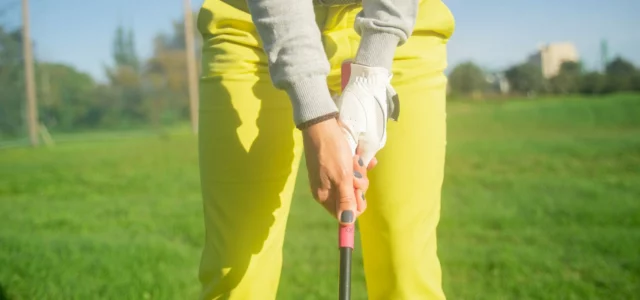
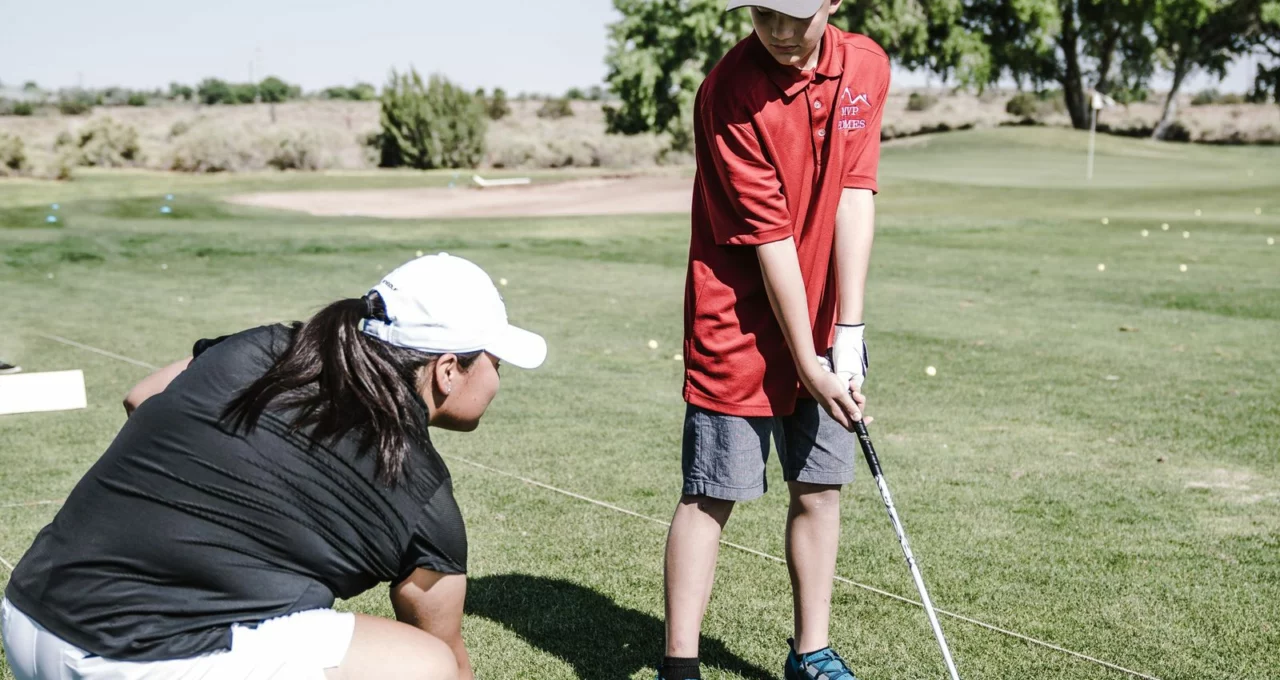
Take one lesson in those weeks, not ten. A PGA professional will set your grip and your address position, and learning those two wrong costs more time later than anything else in the game.
What you do not need
A full set, a club membership, or special clothing. For the first few weeks, comfortable clothing with a collar, flat shoes with some grip and hire clubs will get you round almost anywhere.
You also do not need a fitting. A fitting measures a swing, and a beginner’s swing changes monthly. What is worth doing immediately, if you inherit second-hand clubs, is new grips in the right size: hard, shiny grips force you to hold on tightly, and holding on tightly is precisely the fault every beginner already has.
Your first rounds on a course
Play nine holes rather than eighteen, and play them late in the afternoon when the course is empty. A first round with a group waiting behind you is the quickest way to decide golf is unpleasant.
Take six balls at most and pick up as soon as a hole is lost. That is entirely normal: if you are not playing for a score, you lift and walk to the next tee rather than finishing a nine.
And learn exactly one point of etiquette in that first round: keep moving, and let the group behind through if a hole opens up in front of you. Everything else you will pick up along the way.
The mistakes that cost a season
Buying a full new set before the swing is repeatable. Practising only with the driver. Playing eighteen holes in February heat at midday. And waiting until you are “good enough” to book a tee time, which is the mistake that keeps people out of the game altogether.
What the first year actually costs
Think in three blocks. A handicap through a social or virtual club, typically $100 to $150 a year. Equipment, bought pre-owned. And then green fees, which repeat and are therefore the only block worth thinking about for more than five minutes.
Three habits cut that third block sharply. Play midweek where you can, because weekend mornings are the dearest and the hardest to book. Play twilight, which is cheaper everywhere and, in summer, the only comfortable golf available. And play nine rather than eighteen when time is short: it counts towards your handicap and costs well under half.
Where to start
- A handicap: through a Golf Australia affiliated club, including the social and virtual clubs built for non-members, typically $100 to $150 a year.
- Practice: a public range or a ball-tracking venue, three visits with hire clubs, before you buy anything at all.
- Lessons: your nearest public course or range will have a PGA professional. Ask about a beginner block rather than one-off lessons.
- Clubs: buy pre-owned first, and get fitted when the swing has settled, not before.
Do it in that order and after twelve months you have a handicap, a course you like, and no clubs in the garage that belong to a swing you no longer own.
And if you take one thing from all of it: book the tee time before you feel ready. Nobody is ready, and the course does not check.
Panxis Golf has no commercial relationship with any provider or retailer and earns nothing from your purchases.