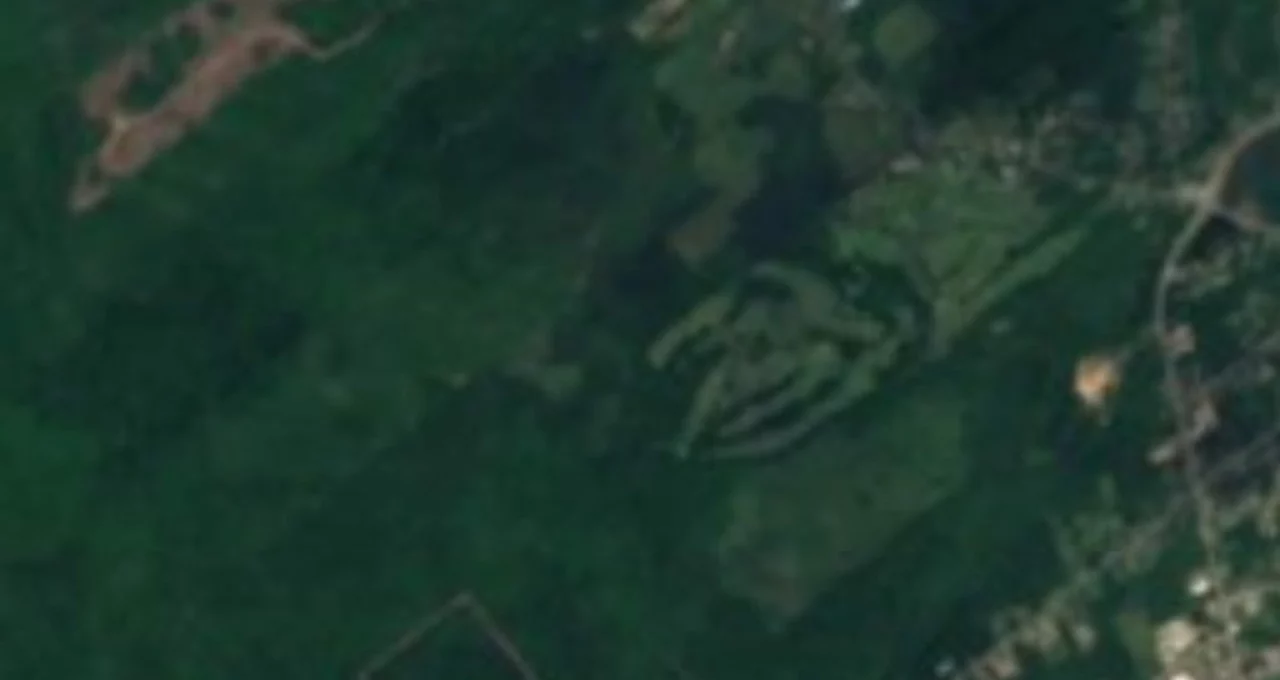
Digby Pines Golf Course from space. Sentinel-2 cloudless 2016 by EOX IT Services GmbH (contains modified Copernicus Sentinel data), CC BY 4.0.
Digby Pines Golf Course
Holes
18
By
71: 35 out, 36 in; five par 3s, nine par 4s, four par 5s (scorecard on 18Birdies)
Length
6,283 yards from the blue tees, 5,995 white, 5,665 gold, 5,007 red (scorecard on 18Birdies); men's rating and slope 70.7/127 blue, 69.5/124 white, 67.9/121 gold, 65.1/116 red (18Birdies)
Green fee
—
Best season
Opens for the season on 1 May (club website); May to October according to the provincial tourism listing
Digby Pines Golf Course is an 18-hole course on Culloden Road in Digby, Nova Scotia, on high ground above the Annapolis Basin. It was laid out by Stanley Thompson, the Canadian architect of Banff Springs, Jasper Park and Highlands Links, for the Canadian Pacific Railway, which was then building a new resort hotel in the town. The course belongs to the Digby Pines Golf Resort and Spa and is open to the public as well as to hotel guests. The scorecard published by the golf apps gives it a par of 71 and a length of 6,283 yards from the blue tees, with three shorter sets of tees down to 5,007 yards. The club’s page is at digbypines.ca.
The course is one of the older resort layouts in the Maritimes and, according to several golf writers, one of the Thompson courses that has changed least since it opened. Its routing runs through stands of pine and crosses a brook that widens into ponds on the 2nd and 16th holes. Top 100 Golf Courses ranks it 11th in Atlantic Canada.
Which club is this?
This page is about the golf course at 111 Culloden Road, Digby, NS B0V 1A0, at the coordinates shown on the map below. The address and the course’s outline come from OpenStreetMap, which names it Digby Pines Golf Course and links it to the resort’s golf page.
Two points of naming are worth knowing. First, the course and the hotel are not on the same site: the hotel stands at 103 Shore Road, on the waterfront of the Annapolis Basin, about 1.7 km in a straight line from the course by our measurement on the map, and the provincial tourism listing describes the course as a few minutes from the resort. Second, the course has carried several names. It began as the golf course of the New Pines Hotel; a 1951 photograph in the Nova Scotia Archives calls it the Pines Golf Club; the hotel was renamed The Pines Hotel after 1965 and Digby Pines Golf Resort and Spa in 2005, and directories today list the course under the resort’s name, as Digby Pines Golf Club or simply Digby Pines. These are all the same course. It should not be confused with the many other courses called The Pines in North America, several of which share listing pages with it on the golf apps.
History: a railway resort course
The hotel came first. According to the resort’s own history page, a three-storey hotel called The Pines was built in Digby in 1903 by its proprietor, H.B. Churchill; Wikipedia gives 1905 for its opening. During the First World War it was used to quarter army officers, and the Canadian Pacific Railway, through its Dominion Atlantic Railway, bought it in 1917 and reopened it the following year. Construction of a new building began on 14 May 1928, the old hotel closed for good that September, and the New Pines Hotel, in a Norman chateau style, opened on 24 June 1929.
The golf course followed. The resort’s history page says the CPR bought 250 acres of land in 1929 to build an 18-hole course. Top 100 Golf Courses, quoting a book extract on Thompson, reports that the president of the railway, Edward Beatty, announced the purchase of 250 acres next to the new hotel that year and said he expected play to begin in 1930. The archive kept by the Stanley Thompson Society credits both the design and the supervision of construction to Stanley Thompson and Co., and lists among its evidence a course plan for the Pines Hotel and correspondence from Thompson to the federal Minister of the Interior.
The opening year is not settled. Top 100 Golf Courses says the course opened in 1930. The resort’s own history page says it was built in 1931 under Thompson’s direction and opened that summer, and a 2018 golf-travel feature on The Golf News Net also calls it a 1931 design. GolfPass, as shown in a search excerpt, dates the course to 1929, which is the year of the land purchase and the hotel’s opening. We give the three dates as the sources do.
The resort’s history page adds that Babe Ruth played a round at the hotel in 1936, during a visit to Nova Scotia; Wikipedia also mentions his visit to the course. The Golf News Net feature reports a local tradition that Ruth was the first to drive the green of the 11th, a short par 4. A photograph taken by John Collier Jr. in September 1951 and held by the Nova Scotia Archives shows the caddies’ dugout at the Pines Golf Club, with a caption noting that local children could earn up to seventy dollars a season, C$70, as caddies. The same Golf News Net feature says three generations of the Nickerson family have served as head professional since the course opened; we found no second source for this.
Ownership has changed twice since the railway era. Wikipedia says the Province of Nova Scotia bought the hotel when Canadian Pacific sold its Dominion Atlantic Railway hotels in 1957; the resort’s history page dates the purchase to 1965. The province ran it for decades as one of its three Signature Resorts, alongside Keltic Lodge and Liscombe Lodge. In December 2019 the province announced the sale of the resort, including the golf course, for C$1 million to a group formed by two Halifax businessmen, Besim Halef and Glenn Squires, and the Bear River First Nation. The provincial release noted that a 2012 appraisal had valued the property at nothing because of overdue repairs, that engineers had found the main building needed mechanical, electrical and structural work, and that the province would grant a C$1 million credit at closing. The new owners pledged to invest C$6.9 million over five years, and Pacrim Hospitality Services of Halifax manages the property. The resort’s press releases describe the Bear River First Nation as the lead partner, and report that in 2022 the hotel opened year-round for the first time in its history, after work on the main lodge and the cottages. Those releases do not describe work on the golf course itself.
What it asks of you
The club’s website does not publish a scorecard. The figures below come from the scorecard reproduced by 18Birdies, which matches the totals, ratings and slopes shown by GolfPass and 1golf.eu in search excerpts. The course has four sets of tees: blue at 6,283 yards, white at 5,995, gold at 5,665 and red at 5,007. Par is 71, 35 out and 36 in, with five par 3s (the 2nd, 5th, 8th, 14th and 16th), four par 5s (the 7th, 9th, 10th and 18th) and nine par 4s. The men’s course ratings and slopes are 70.7 and 127 from the blue tees, 69.5 and 124 from the white, 67.9 and 121 from the gold and 65.1 and 116 from the red. The women’s ratings differ from one app to another, and we do not reproduce them: ask the pro shop if you need them for handicap purposes.
At 6,283 yards from the back, Digby Pines is short by modern standards, and its length is distributed unevenly. The front nine is the shorter half, at 3,098 yards from the blue tees against 3,185 for the back, but it contains the longest hole on the card. The variety is in the par 3s, which run from 116 to 207 yards, and in a pair of short par 4s on the back nine. Golf writer Dale Dunlop, in a 2023 Saltscapes feature on affordable Maritime courses, singled out the par 3s as the course’s strength.
The character of the course, as the sources describe it, comes from Thompson’s shaping rather than from length. Top 100 Golf Courses notes the large number of bunkers and mound complexes he built, which it calls earth sculptures, and quotes the view that the course has remained virtually unaltered since it opened. The terrain rolls, the routing passes through pines, and the brook that crosses the property comes into play on at least two holes. The Golf News Net feature describes the course as perhaps the best example of a relatively untouched Thompson design that the public can play. GolfPass users rate the difficulty as medium.
The course in sequences
Holes 1 to 5
The round opens with a par 4 of 408 yards from the blue tees, stroke index 5. The 2nd is the hole most sources single out: a par 3 of 177 yards from the blue tees, played over a rectangular pond, one of the two places where the brook widens out, to a green cut into the hillside, as The Golf News Net describes it. Top 100 Golf Courses calls it a memorable hole and says Thompson used it in his advertising into the 1940s. The 3rd and 4th are mid-length par 4s of 340 and 359 yards, and the 5th is a par 3 of 184 yards.
Holes 6 to 9
The 6th is a par 4 of 394 yards and stroke index 3. The 7th is the longest hole and stroke index 1, a par 5 of 579 yards from the blue tees. The 8th, a par 3 of 169 yards, is ranked stroke index 17, and the outward half finishes with the 9th, a par 5 of 488 yards.
Holes 10 to 13
The back nine opens with a par 5 of 473 yards, the shortest of the four. The 11th is the shortest par 4 on the course, 278 yards from the blue tees and stroke index 16. The Golf News Net describes it as an uphill hole where the drive is best played to the right side of the fairway, and mentions a bunker it calls Thompson’s question-mark bunker; this is the green Babe Ruth is said to have driven. The 12th and 13th are the two hardest holes of the inward half on the card, par 4s of 418 and 445 yards ranked stroke index 2 and 4.
Holes 14 to 18
The 14th is the longest par 3, 207 yards from the blue tees. The 15th is a par 4 of 412 yards, stroke index 6. The 16th is the shortest hole on the course, a par 3 of 116 yards ranked stroke index 18, and the second hole where the brook widens into a pond. The 17th is a par 4 of 344 yards, and the round ends with a par 5 of 492 yards, stroke index 8. The card thus finishes with two par 5s at either end of the back nine.
What golfers say
Digby Pines is reviewed only lightly online. 18Birdies shows 15 reviews averaging 3.9 out of 5, with sub-scores of 3.5 for value and 3.3 for course condition and a pace of play rated fast. Top 100 Golf Courses has two reader reviews, from August 2024 and September 2025, averaging 4.5. The provincial tourism listing shows a Google rating of 4.1, and Hole19 a score of 4.3 with no written reviews. Alongside these, a handful of travel and golf writers have described the course. The points below are recurring themes from what we could read in October 2026. They are other golfers’ opinions, not ours, and we quote and name no one.
What comes up in its favour
- The design is the most consistent compliment. Reviewers and writers praise the Thompson layout, the quality visible from the tees and the sense of playing a course that has kept its original shape.
- The greens draw unusual praise: both reader reviews on Top 100 Golf Courses rate them excellent, one of them among the best its author had played.
- The par 3s, the 2nd in particular, are singled out as the most memorable holes.
- The setting, among pines and above the Annapolis Basin, and the history of the resort are mentioned as reasons to make the trip, along with friendly small-town service.
- Rounds move quickly, according to the 18Birdies ratings.
What comes up against
- Condition outside the greens is the main complaint. Reviewers in 2024 and 2025 describe fairways, rough and bunkers in poor shape, and an 18Birdies reviewer reports bunkers that are overgrown or short of sand.
- One reviewer found the fairways dry and hard after a summer of more than two months without rain, and suggested that the course shows better in a normal season.
- Value is rated lower than the layout itself on 18Birdies, which reviewers tie to the state of the course rather than to the design.
- Several writers call the course overlooked; for the visitor, that also means few recent, detailed accounts to rely on.
Playing as a visitor
Digby Pines is open to the public as well as to hotel guests. The club’s page asks golfers to book tee times by telephone at 902-245-7709, and gives proshop@digbypines.ca as the off-season contact. Rates vary across three periods of the season and by time of day, with nine-hole rounds and a twilight offer from Sunday to Thursday after 3 p.m. The resort offers golf packages with an overnight stay, and the club gives a discount to CAA members and to package guests playing extra rounds. Children aged 15 and under play free after 3 p.m. with a paying adult, subject to tee-time availability. Groups of eight or more can ask the resort’s sales team for special pricing, and the club also sells seasonal memberships.
Power carts, pull carts and sets of TaylorMade rental clubs are available at the pro shop. The provincial tourism listing says the course accepts debit, Mastercard and Visa, and describes it as wheelchair accessible while advising golfers to contact the course for details. The club’s page does not mention a driving range, lessons or a dress code, and we found no reliable source for them.
The clubhouse holds The Trophy Room, a bar and grill with an open-air deck overlooking the course, craft beer from Nova Scotia breweries and a summer menu. Its page gives opening hours of 11 a.m. to 6 p.m. from Friday to Sunday, and says it welcomes visitors whether or not they are playing.
Getting there and when to go
The course is at 111 Culloden Road on the edge of Digby, a town on the Annapolis Basin at the western end of the Annapolis Valley, in the region the provincial tourism office calls the Bay of Fundy and Annapolis Valley. In a straight line it lies about 175 km west of Halifax and about 90 km north-east of Yarmouth, by our measurement on the map; The Golf News Net gives the drive from Halifax as roughly two and a half hours. The hotel, 1.7 km away on Shore Road, faces the Digby Gut, the narrow opening between the basin and the Bay of Fundy.
The season is short. The club’s page announces an opening for the season on 1 May. The provincial tourism listing gives May to October in its overview but June to October in its dates section, and GolfPass, in a search excerpt, gives 1 May to 1 November. Prices on the club’s page are lowest at either end of the season, before late May and after early September, and highest in July and August. Given the reviews of a dry summer in 2025, the shoulder seasons may also be the time when the turf is at its best, but no source says so directly, and conditions depend on the year.
Green fees
Rates vary by period of the season and time of day, with twilight and package offers and carts charged on top: see the club’s website for current prices.
How this page was made
The factual frame comes from public sources read in October 2026: OpenStreetMap for the location, address and outline of the course; the club’s golf page for the designer, the brook and ponds, the season opening, booking, discounts, rentals and contact details; the resort’s history page and press releases for the hotel’s history, the land purchase, the opening of the course, Babe Ruth’s visit, the 2019 sale and the 2022 year-round opening; the Province of Nova Scotia’s news release of 18 December 2019 for the terms of the sale; Wikipedia for the hotel’s history and ownership; Top 100 Golf Courses for the ranking, the opening year, the Beatty announcement, the bunkering, the 2nd hole and its two reader reviews; the Stanley Thompson Society’s course archive for the attribution of design and construction; 18Birdies for the hole-by-hole scorecard, the ratings and slopes and its review scores; The Golf News Net (May 2018) for the 2nd and 11th holes, the Nickerson family and the drive from Halifax; Saltscapes (June 2023) for the par 3s; the Nova Scotia Archives for the 1951 photograph; the provincial tourism listing for the season, payment, accessibility and Google rating; The Trophy Room’s page for the clubhouse; and Hole19. GolfPass, GolfClubAtlas, CBC News and SaltWire could not be opened directly, so their contribution is limited to what search excerpts showed, or nothing.
Where sources disagree, we say so. The course’s opening is dated 1930 by Top 100 Golf Courses, 1931 by the resort and The Golf News Net, and 1929 by GolfPass. The original hotel is dated 1903 by the resort and 1905 by Wikipedia, and the province’s purchase 1965 by the resort and 1957 by Wikipedia; the province’s own 2019 release says it had owned the resort for about 30 years, which matches neither. The season is given as May to October, June to October and May to November. Hole19 shows a total of 5,737 for the blue tees, with the 7th at 529 and the 16th at 106; these appear to be metres labelled as yards, and we follow the 18Birdies card. The women’s ratings and slopes differ between 18Birdies and GolfPass, and we leave them out.
We did not find a scorecard published by the club, the date of any work on the course since it opened, the name of the current head professional or superintendent, or reliable information on practice facilities and lessons. The claims about the Nickerson family and about Babe Ruth driving the 11th green each rest on a single source.
The opinion section summarises reviews and descriptions read in October 2026. We report recurring themes rather than individual voices, and we reproduce no quotations. Nobody from Panxis has played or visited this course, and this page is no substitute for a round.
The club has not paid for this page, has not seen it before publication and has no say over its content. This page contains no commercial link and earns us no commission. If you know the course and something here is wrong or out of date, write to us and we will correct it.
Other courses nearby
Closest to this one in our Canadian directory:
- The Riverside Country Club — 84 km
- Aspotogan Ridge Golf Club — 134 km
- Glen Arbour Golf Course — 159 km
- Brookfield Golf & Country Club — 209 km
The hole to know
A par 3 of 177 yards from the blue tees (18Birdies), over a pond formed by the brook (club website) to a green cut into the hillside (The Golf News Net, 2018); Thompson used the hole in his advertising into the 1940s (Top 100 Golf Courses).