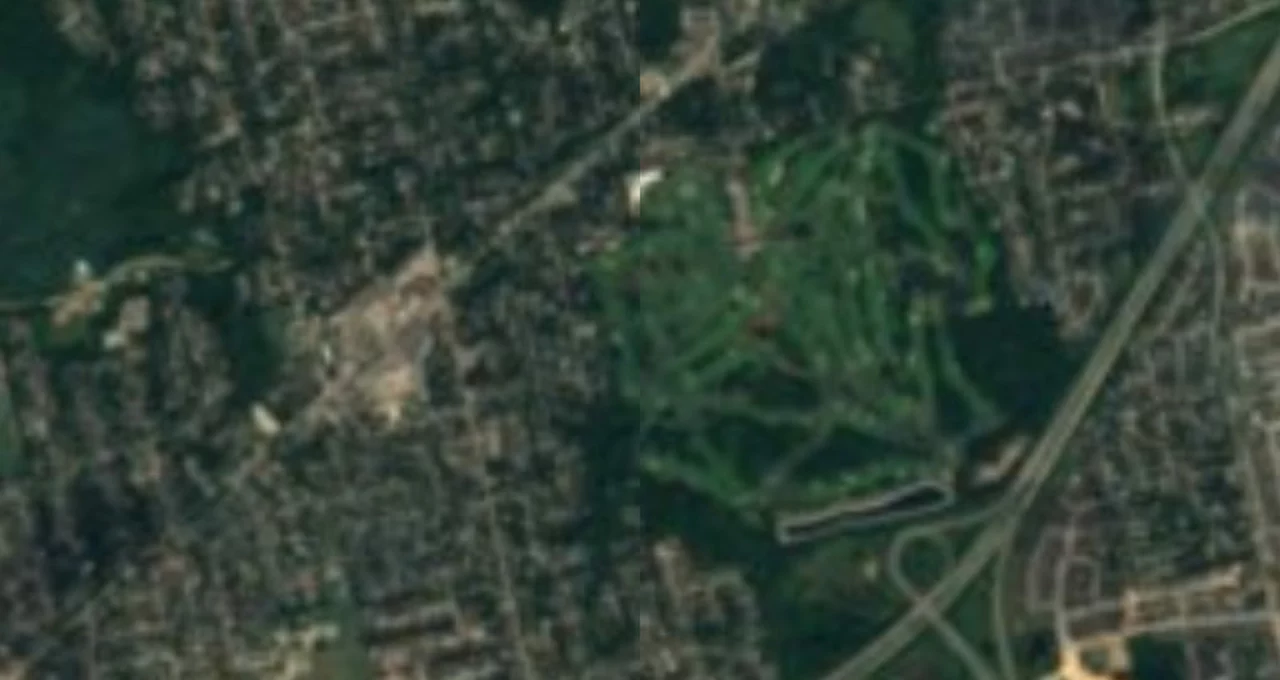
Hamilton Golf and Country Club from space. Sentinel-2 cloudless 2016 by EOX IT Services GmbH (contains modified Copernicus Sentinel data), CC BY 4.0.
Hamilton Golf and Country Club
Holes
27: West and South nines by Harry Colt, East nine by Robbie Robinson, plus a nine-hole short course (club website; Wikipedia); OpenStreetMap maps one 18-hole course
By
70, 35 out and 35 in, on the West and South championship course (PGA Tour, 2024 Canadian Open); GolfPass and 18Birdies give 70, 1golf.eu gives 72
Length
7,084 yards for the 2024 Canadian Open (PGA Tour); directories give 6,928 yards from the black tees, rating 74.1, slope 136 (GolfPass, search excerpts), 6,934 yards (1golf.eu) or 6,737 yards (18Birdies), probably before the 2019 to 2022 rebuild
Green fee
—
Best season
—
Hamilton Golf and Country Club is a private club at 232 Golf Links Road in Ancaster, part of the City of Hamilton, Ontario, west of Toronto at the western end of Lake Ontario. It has 27 holes on the property. Eighteen of them, the West and South nines, were laid out by the English architect Harry Colt on land the club bought in 1914; the third, the East nine, was added by the Canadian architect Robbie Robinson in the 1970s. The club also has a nine-hole short course built as a tribute to Colt. OpenStreetMap maps the property as a single golf course and some directories list it as an 18-hole course, which is why the hole count you see elsewhere may be lower than the real one.
Hamilton is best known as a Canadian Open venue. It has hosted the national championship seven times, most recently in 2024, and between 2019 and 2022 it went through a complete rebuild of its greens and bunkers under the architect Martin Ebert. It is also a members’ club: there is no public tee sheet, and the only way onto the course for a visitor is as the guest of a member. This page sets out what the public record says about the course and the visit, and where the sources disagree.
History: from Barton Street to The Grange
According to the club’s own history page, Hamilton Golf and Country Club was founded on 24 October 1894 with a 12-hole links course at the corner of Barton and Ottawa streets, next to the old Hamilton Jockey Club grounds. In 1896 it moved to Paradise Farm on Aberdeen Avenue, the site now occupied by Chedoke, a municipal course run by the city. In 1914 the club bought around 200 acres of farmland in Ancaster known as The Grange, for 40,000 dollars, and hired Harry Colt to design a new course.
Colt was in North America at the time for his work at Pine Valley in New Jersey and in Toronto. The PGA Tour’s 2024 course preview says he visited Hamilton only once, and that the club has kept his 1914 drawings. The club quotes him telling the members that there was no reason why they should not have one of the finest courses in North America. His partner Charles Alison is credited by the club with suggesting the purchase of neighbouring land for an extra nine holes.
The opening date depends on which page you read. The club’s history timeline gives 1 June 1916, with a total cost, land included, of 108,000 dollars, and the PGA Tour and Wikipedia also give 1916; the club celebrated its centenary in Ancaster in 2016. The club’s golf page, however, says the West and South courses opened in 1915, and the GolfN directory follows that date. The most likely reading is that the course was ready for some play in 1915 and formally opened in 1916, but no source we read says so in those words.
The East nine has the same problem. The club’s golf page says it opened in 1973, its history timeline says Robinson designed the nine new holes in 1974, and the 2014 press release from Mackenzie and Ebert describes it as completed in 1975. We give all three dates rather than choose one.
The championship record
The club’s timeline lists seven Canadian Opens: 1919, won by J. Douglas Edgar in a field that included Bobby Jones and Francis Ouimet; 1930, won by Tommy Armour; 2003, when Bob Tway beat Brad Faxon in a playoff, the first Open here in more than seven decades; 2006, won by Jim Furyk; 2012, won by Scott Piercy; 2019, won by Rory McIlroy with a final-round 61; and 2024, Robert MacIntyre’s first PGA Tour title, with his father caddying. Wikipedia gives the same list. In the second round in 2019 Brandt Snedeker shot 60, ten under par, which Wikipedia lists as the course record; that score was made before the Ebert rebuild, on greens that no longer exist.
The amateur record is just as long. The club lists six Canadian Men’s Amateur Championships (1922, 1927, 1935, 1948, 1977 and 1994), three Canadian Ladies’ Amateurs in the 1920s, the first Willingdon Cup interprovincial matches in 1927, two Canadian PGA Championships in the 1950s and the Senior Canadian Open in 1996.
The Ebert rebuild
The club first appointed Mackenzie and Ebert in 2014, according to the firm’s press release, to study how Colt’s design could be strengthened and how the East nine could be brought closer to the other two. The work started in the autumn of 2019, after that year’s Open. Eighteen holes reopened in 2021 and the East nine in the summer of 2022. The club’s golf page describes the result as a complete rebuild of all 27 greens with extensive changes to the bunkers; the PGA Tour adds new tees, a new irrigation system, a new putting green and a new practice area, as well as tree removal and wider mown areas to reopen views across the property. A 2021 ScoreGolf report, republished by Turf and Rec, notes that a tree removal plan for light and air flow had already been started in 2014.
Because of COVID-19 travel restrictions, Ebert directed much of the work from England with drones, video and virtual reality, and the PGA Tour says he first saw the finished course in person in September 2021. Golf Digest named it the best restoration or renovation of 2022 in its awards published in January 2023. The cost is not given consistently: 11 million dollars in the club’s history and on Wikipedia, 11.5 million on the club’s golf page, and nearly 8.5 million in the PGA Tour preview.
What it asks of you
The championship course combines the two Colt nines, West going out and South coming in. For the 2024 Canadian Open the PGA Tour’s course statistics give a par of 70, 35 on each side, and 7,084 yards. That card has twelve par 4s, four par 3s and only two par 5s, the 4th at 542 yards and the 17th at 580. The PGA Tour says the course played 112 yards longer than in 2019, with new length at the 6th, 7th, 11th, 14th, 17th and 18th, and a new green on the 17th moved back and to the left.
Members do not play that card every day. We could not find a scorecard published by the club, and the figures in directories predate the rebuild or do not agree. Search excerpts of GolfPass give the West and South combination as a par 70 of 6,928 yards from the black tees, with a course rating of 74.1 and a slope of 136, and 6,564 yards from the blue tees (72.1 and 131); the 1golf.eu directory gives the same ratings but calls the course a par 72 of 6,934 yards. The 18Birdies app lists 6,737 yards from the black tees for a par 70, but with a hole layout that does not match the tournament card, so we do not rely on it. A long-standing reviewer on Planet Golf writes that the course has been stretched by more than 500 yards and its par reduced by three over the years, mainly for championships. Ask the club for the current card before playing.
The ground does more of the work than the length. Every description of the course starts with the terrain: a rolling, hilly property with large elevation changes, falling to Ancaster Creek, which runs along the bottom of the site and crosses several holes. The PGA Tour describes a routing that works its way in triangles around the hills. Reviews by golf course critics agree that distance control is the main difficulty, because so many approaches are played uphill or downhill, and that mature trees catch shots that drift off line. Bunkering sets the strategy from the tee, and the rebuilt greens, according to the PGA Tour, offer more pin positions than before.
The par 4s carry the round. On the 2024 card the 2nd and 18th are 457 yards, the 7th 447, the 14th 474 and the 11th 502 yards, which made it the hardest hole of the week by scoring average. At the other end, the 5th, 346 yards on the tournament card, is a short par 4 that critics describe as driveable, with deep bunkers on the right and a green set on a small rise. The par 3s are a strong set: the 6th, at 249 yards, played as the second hardest hole in 2024, with the ground falling away to the right into the trees; the 8th is 207 yards, the 13th 209, and the 16th, 180 yards, is played uphill to a green set into the hillside behind cross bunkers.
The 7th draws comment from almost everyone who writes about the course: a dogleg with bunkers on the inside and trees on the outside, and an approach that one review describes as climbing about 50 feet to a three-tiered green. The 17th, the longest hole, plays down and then back up, with bunkers in the landing area and a green that slopes hard from back to front.
The finish
The 18th, the 9th of the South nine, is the hole most often singled out. On the 2024 card it is a par 4 of 457 yards and it played as the third hardest hole of the championship; the PGA Tour also lists it as the hardest hole in 2019. The tee shot drops into a valley where the creek crosses the fairway, and the approach climbs to a green set in a natural amphitheatre below the clubhouse. One critic calls it one of the best finishing holes in the country. It is a hole where a mid-handicapper may well decide to lay up short of the creek and accept a longer second shot rather than risk the water.
What golfers say
Because Hamilton is a private club, its public review record is thin. We read the course write-ups on Golf Course Gurus and Planet Golf, the ratings and the few written comments on 18Birdies, and search excerpts of GolfPass, which blocked our requests, in November 2026. The points below summarise themes that recur across those sources. They are other people’s opinions, not ours: nobody from Panxis has played the course, we do not name or quote individual reviewers, and we have not tried to count or score their views.
What comes up in its favour
- The routing and the land: reviewers rank the hilly site and the way Colt used it as the course’s main strength.
- The variety of the holes, from a driveable par 4 to long par 3s and par 4s, and the number of shots that have to be judged up or down a slope.
- The closing stretch of the South nine, and the 18th in particular, with the creek and the green below the clubhouse.
- Conditioning and very fast greens, mentioned in the app ratings, which also rate the course as very hard.
- The history: a course where the national open has been played from 1919 to 2024.
What comes up against
- Difficulty: one player warns that high handicappers may not enjoy it much, given the length, the slopes and the speed of the greens.
- Design purists regret that the original rugged, grass-faced Colt bunkers were replaced over the years by sharper modern ones, and that some changes, such as a straightened bend of the creek and an added greenside bunker, were made to suit modern players. Most of those comments predate the Ebert rebuild, which set out to bring Colt’s style back.
- The lengthening and the reduction of par for championships, which one critic sees as a loss of the original character.
- Access itself: the course can only be played as a member’s guest.
Playing as a guest
The club describes itself as one of the most prestigious and established private clubs in Canada. It does not sell tee times to the public, and its guest information page is written for visitors invited by a member: guests are told to ask their host, and the member is responsible for the dress and behaviour of guests. The club’s policies limit how often a member may bring the same guest, with stricter limits and the consent of the board for guests who live more than 80 or 300 kilometres away. Guests can pay through a Member for a Day programme by credit card, and members of approved clubs can sign their purchases back to their home club. People interested in joining are invited to fill in the membership form on the club’s website or contact the membership office.
The club calls itself a walking course, and its own golf page says the course is readily walkable; if a guest needs a cart, the host makes the arrangements. The club runs a caddie programme for local teenagers aged 12 to 17. The dress code is strict: collared shirts at all times for men, no T-shirts and no denim, shorts of conservative length, soft spikes or spikeless shoes only, and players change in the locker room, not in the car park. Telephones may be used on the course in silent mode, without earbuds, and voice calls are limited to the locker rooms and the car park. The practice facilities include a practice tee, a short game area and putting greens, and the club has indoor simulators.
Getting there and when to go
The club is at 232 Golf Links Road, Ancaster, ON L9G 2N5; the entrance is off Halson Street. The club’s directions from Toronto are to take the QEW and then Highway 403 west to Mohawk Road in Hamilton, turn left on McNiven Road, right on Golf Links Road and left on Halson Street into the club. From London or Windsor, take Highway 401 east and Highway 403 east to exit 58 for Wilson Street West, then follow Wilson Street and turn right on Halson Street. The clubhouse number is 905-648-4471 and the golf shop’s 905-648-2294.
The club does not publish opening and closing dates for the golf season, so a guest should confirm them with the host or the golf shop in spring and autumn.
Green fees
Hamilton is a private club and guest fees depend on the member’s invitation, so we do not reproduce any rates. See the club’s own site for guest and membership information.
How this page was made
The factual frame comes from public sources read in November 2026: OpenStreetMap for the location and outline of the course; Wikidata (item Q5644958) for the identifier; the club’s website (hgcc.ca) for its history timeline, its golf, membership and guest information pages and its club policies; the English Wikipedia article on the club for the architects, the list of Canadian Opens and the course record; the PGA Tour’s 2024 course statistics and course preview for the tournament card, the scoring by hole, the 2024 changes and the details of the rebuild; the Mackenzie and Ebert press release of February 2014; a ScoreGolf report republished by Turf and Rec in October 2021; the course reviews on Golf Course Gurus and Planet Golf; and the 18Birdies app and search excerpts of GolfPass and 1golf.eu for the ratings, slopes and player opinions.
Where sources disagree, we say so. The opening of the Colt course is dated 1916 by the club’s history, Wikipedia and the PGA Tour, and 1915 by the club’s golf page and GolfN. The East nine is dated 1973, 1974 or 1975 depending on the source. The cost of the rebuild is 11 million, 11.5 million or nearly 8.5 million dollars. The everyday par and length differ between directories (par 70 or 72, 6,737 to 6,934 yards from the back tees), and those figures probably predate the rebuild; we use the PGA Tour’s 2024 card for the hole lengths quoted above, and remind readers that members play shorter tees. OpenStreetMap shows one 18-hole course, while the club has 27 holes and a short course.
We could not read the club’s own scorecard, a current course rating and slope after the rebuild, or the season dates, and we have left them out. The GolfPass and golfclubatlas.com pages refused our requests, so we used only search excerpts of the former and nothing from the latter. Nobody from Panxis has played or visited this course, and this page is no substitute for a round.
The club has not paid for this page, has not seen it before publication and has no say over its content. This page contains no commercial link and earns us no commission. If you know the course and something here is wrong or out of date, write to us and we will correct it.
Other courses nearby
Closest to this one in our Canadian directory:
- Brantford Golf & Country Club — 27 km
- Glen Abbey Golf Club — 33 km
- Greystone Golf Club — 37 km
- Mississaugua Golf & Country Club — 47 km
The hole to know
The 9th of the South nine, a par 4 of 457 yards on the 2024 Canadian Open card and the third hardest hole that week: the tee shot drops into a valley where the creek crosses the fairway, and the approach climbs to a green in an amphitheatre below the clubhouse (PGA Tour; Golf Course Gurus; Planet Golf).