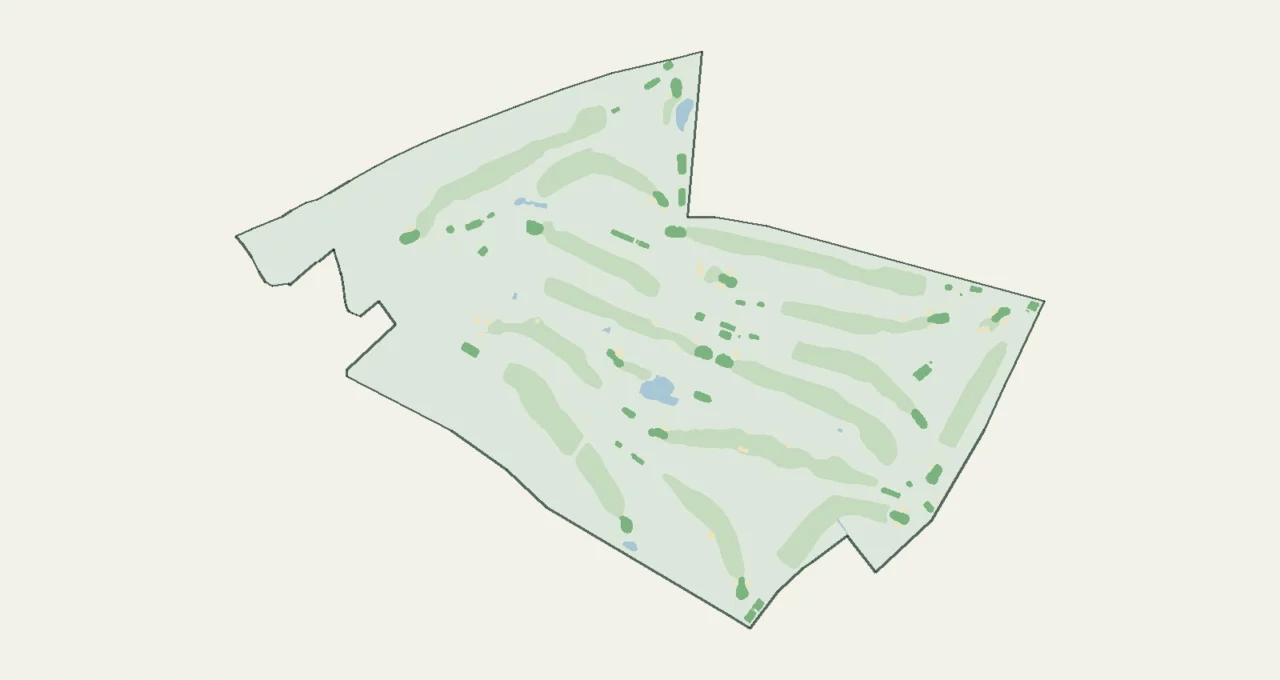
Layout of Radcliffe-on-Trent Golf Club from OpenStreetMap survey data (ODbL licence).
Radcliffe-on-Trent Golf Club
Holes
18
By
70 (men); 72 (women's red tees)
Length
6,495 yards from the black tees, 6,357 white, 6,066 yellow, 5,794 green, 5,522 red (club scorecard); 6,483 on GolfPass, 6,471 on 18Birdies
Green fee
—
Best season
—
Radcliffe-on-Trent Golf Club lies on the south-eastern edge of Radcliffe on Trent, a large village in the borough of Rushcliffe, Nottinghamshire, about five miles east of the centre of Nottingham. The club gives its address as Dewberry Lane, Cropwell Road, Radcliffe-on-Trent, NG12 2JH, and the course sits just south of the A52, the old road from Nottingham to Grantham. It is a private members’ club that welcomes visitors, with an eighteen-hole parkland course of par 70 measuring 6,495 yards from the black tees on the club’s own scorecard, rated 71.2 with a slope of 125. The red tees play to 5,522 yards and par 72.
The club was founded in 1909, when Tom Williamson laid out a first nine holes, and it was extended to eighteen in 1925. The layout that golfers play today owes a good deal to a second architect, Frank Pennink, who reshaped it in 1972 after a road scheme took part of the land. The club calls itself an England Golf Championship Venue, and the claim rests mainly on one event: the McGregor Trophy, England Golf’s under-16 boys’ championship, which began here in 1982 and whose winners include Justin Rose.
A club built on Lord Manvers’ land
According to the club’s own history, the story starts in 1903, when several local sportsmen approached Lord Manvers, the landowner, who agreed to lease them about forty acres on what the club describes as very favourable terms. The club itself was formed in 1909 and adopted the Manvers coat of arms. Tom Williamson, the architect whom the club credits with more than sixty courses in Britain and abroad, laid out a nine-hole course. On 9 October 1909 he and Harry Vardon, six times Open champion and the man whose name is attached to the overlapping grip, played an exhibition match to open it. The club says almost two hundred people watched; the Wikipedia article on the club says over two hundred, and adds that Vardon won the trophy at stake, which the club bought back for its centenary in 2009.
The club bought its land in February 1920 and acquired another fifty acres in 1924, which made room for nine more holes. The full eighteen were formally opened in June 1925 with another exhibition match: Vardon and Williamson against C. A. Whitcombe and George Carlin, the club professional, a match the club records as finishing all square. The Wikipedia article on the club also records an earlier professional, William McGowan, a Scot from Prestwick who had trained under Williamson; he was killed in action in France on 24 October 1918, a few weeks before the armistice.
More land beside Dewberry Lane was added in 1966. The decisive change came in 1972, when Nottinghamshire County Council decided to re-route and widen the A52. The club lost its original clubhouse and twenty-one acres, and gained thirty acres through an exchange of land. Frank Pennink, the English course architect, was commissioned to re-lay the course with new holes, and the present clubhouse opened on 17 July 1972. Top 100 Golf Courses, in its description of the course, says Pennink’s work added new holes at the 1st, 2nd and 3rd and modified the 10th, 11th and 12th. The club adds that it has planted hundreds of trees since 1972, which explains why a course laid out on open farmland now reads as mature parkland.
The McGregor Trophy began at Radcliffe in 1982 as a junior open tournament played over 72 holes. The club says the English Golf Union adopted it in 1993 as the English Boys Under 16 Open Championship and agreed in 1998 to move it around the country. The results table in the Wikipedia article on the trophy lists Radcliffe as the venue every year from 1982 to 1998 and again in 2001, 2005, 2009, 2014, 2019 and 2025. Graeme Storm won it here in 1994, Justin Rose in 1995 and Edoardo Molinari in 1996, three names who went on to win on the European Tour. The 2009 edition fell in the club’s centenary year, which the club also marked with matches against Rushcliffe Golf Club, founded the same year, according to Wikipedia.
What the course asks of you
The figures here come from the scorecard and rating table on the club’s website, read in October 2026. There are five sets of tees. From the black tees the course measures 6,495 yards, 3,255 out and 3,240 back, each nine a par 35. The white tees measure 6,357 yards, the yellow 6,066, the green 5,794 and the red 5,522. The men’s course ratings are 71.2 from the black tees with a slope of 125, 70.4 and 127 from the white, 69.0 and 124 from the yellow, and 66.4 and 114 from the red. For women the club gives 75.3 and 129 from the yellow tees and 71.9 and 125 from the red. From the red tees two holes change par: the 1st and the 16th become par 5s, which brings the total to 72.
The structure is simple and rather demanding. There are only two par 5s, the 7th, called Long Straight, at 540 yards, and the 12th, Trent End, at 533. They are stroke index 1 and 2, which tells you the club regards them as the holes where shots are most often lost. There are four par 3s, and none of them is a short iron for most players: the 6th, Saxondale, is 175 yards, the 8th, Spectacles, 211, the 11th, The Pond, 195, and the 17th, Warren, 174. The Wikipedia article singles out these relatively long par 3s, along with tight fairways lined with mature trees, as the course’s main features. Everything else is a par 4, and several are long: the 1st, Wishme Well, at 428 yards, the 4th, Manvers, at 444 and stroke index 3, the 13th, Drumlins, at 481 from the black tees, and the 16th, Jacob’s Ladder, at 423 and stroke index 4.
The round does give something back. The 2nd, Belvoir View, at 341 yards, the 15th, Short Straight, at 335 and stroke index 18, and the closing hole, Dram Awaits, at 338 are short par 4s where a good drive leaves a wedge. The difference between tees is mostly small: on many holes the black and white tees are the same, and the real gap appears at the 10th, the 11th and the 13th, where the black tees add around 30 to 40 yards.
Water comes into play at both ends of the round. The club’s local rules, dated April 2026, describe a penalty area on the 1st with a stone bridge inside it, which is treated as part of the course, and a pond to the right of the green, where a dropping zone is provided. The same document gives a dropping zone at the 17th, to the right of the tee along the path, for balls in the penalty area there. Out of bounds is marked by white posts around the whole boundary, and conservation and wildlife areas are marked with blue stakes as no-play zones, which you may not enter to look for a ball unless you can do so without damage. Since the rules are written to the current numbering of the Rules of Golf, they are worth reading before a first round.
The 17th is the hole the club itself calls its signature. Its description on the course page is brief: holes 16, 17 and 18 will make any golfer concentrate, especially in a medal round, and the 17th starts many conversations in the bar afterwards. Top 100 Golf Courses fills in the detail: a long, hourglass-shaped green set beyond a large pond, with bunkers closely guarding both sides of an offset putting surface. At 174 yards from the back and 165 from the whites, it is a mid-iron for most club golfers, played over water in the closing stretch, which is exactly where it can undo a good card.
The other names on the card hint at the ground. The 9th is called Ridges and the 13th Drumlins, though we found no description of the terrain to say how pronounced either feature is. One reviewer on Top 100 Golf Courses mentions a hole lengthened by moving its tee about a hundred yards back into a neighbouring field, where the old furrows of earlier farming are still visible, but does not say which hole. Another singles out the 10th, a par 4 that bends around to what the reviewer considered the most undulating green on the course.
From 1 November 2026, according to a notice on the club’s green fees page, mats will be compulsory throughout the course, except when playing from hazards. Golfers planning a winter round should expect to hit from mats on the fairways as well as on the tees.
What golfers say
The points below summarise the public reviews we could read: two reviews on Top 100 Golf Courses, from 2019 and 2022; the reviews and summary shown by GolfPass in search results, since its own pages refused our requests; the star ratings and category scores on 18Birdies, which carry no written comments; and the visitor comments the club chooses to publish on its own green fees page, which are by nature favourable. They are other people’s opinions, not ours. Nobody from Panxis has played the course, and we name no reviewer.
What comes up in its favour
- The welcome. Staff in the office and the pro shop, and members on the course, are repeatedly described as friendly to visitors, including on golf days and in open competitions.
- The clubhouse. The bar, its real ales and the food, especially the Sunday lunch, come up often, and GolfPass’s summary rates them as good value compared with nearby clubs.
- The 17th. It is the hole reviewers mention most, as a par 3 over a pond that makes a genuine challenge late in the round.
- The greens, in the main. Several reviewers found them true and in good order, and 18Birdies users tag them as fast; one reviewer of 2022 added that they become scoring chances once you have their pace.
- Views over Nottingham and the surrounding countryside, mentioned by one reviewer, and the overall ratings on 18Birdies, which are mostly four or five stars from 2024 to 2026.
What comes up against
- Character. Both Top 100 Golf Courses reviewers rate it three out of five and find it pleasant but short of anything really memorable, with straight, flat holes on the front nine singled out.
- Condition, at times. One reviewer in 2022 found tee boxes, bunkers and the edges of the water features less well kept than on earlier visits, and a GolfPass reviewer found the course below its best in early May.
- Greens slower than they look. One reviewer found they broke less than expected, a contrast with the 18Birdies users who call them fast.
- Its reputation. One reviewer remembered it as a local gem and wondered whether it still deserves the word, mentioning past management difficulties.
- Occasional friction in the pro shop over tee time changes, raised in one review.
Getting there and when to go
The course is on the south-eastern side of Radcliffe on Trent, reached from Cropwell Road and Dewberry Lane, with the A52 running past its northern edge. By our measurement on the map, Radcliffe railway station, on the Nottingham to Grantham line, is a little under a mile away in a straight line. Nottingham station is about five miles to the west, and East Midlands Airport about fifteen miles to the south-west, both further by road. Trent Bridge and the city centre are reached along the A52, which becomes Radcliffe Road as it enters Nottingham.
Visitors book tee times through the club’s online visitor booking page, linked from the home page, or through the pro shop. The club’s green fees page divides the week into time bands and says the best rates are online. Members of Nottinghamshire clubs can play under the county card scheme. The club runs open competitions and welcomes societies.
Buggies can be hired, but the club asks golfers to check with the pro shop on the day that they are running. Its buggy policy, which follows England Golf’s guidance, treats buggy use by disabled golfers as a reasonable adjustment and manages restrictions through routes and traffic controls rather than blanket bans. The club also has a halfway house, a bar and restaurant, and a golf store with custom fitting, club repairs and a simulator studio.
The dress code on the course asks for recognised golf clothing, tailored golf shorts only, shirts tucked in, caps worn forwards and golf shoes at all times; denim, sports or cargo shorts, t-shirts and tracksuits are not accepted. In the clubhouse the rules are looser, with smart casual wear, trainers and denim allowed, but no waterproofs or caps, and no golf shoes in the main dining area. Phones must be on silent and used on the course only in an emergency.
The club publishes no season; its notice on mats from November 2026 suggests play continues through the winter, on mats. The course is likely to be at its best from late spring to early autumn, when the trees are in leaf and the ground firm. The club’s website has a course status page, worth checking before setting out in wet weather.
How this page was made
The factual frame comes from public sources: OpenStreetMap for the location and our distance measurements; the club’s website, read in October 2026, for the address, the history, the scorecard, the course and slope ratings, the hole names, the local rules of April 2026, the notice on mats, the visitor booking, the buggy policy, the dress code and the clubhouse facilities; Top 100 Golf Courses for its course description, the Pennink holes and two reviews; the English Wikipedia articles on the club, on the McGregor Trophy and on Radcliffe on Trent for the trophy, the centenary, William McGowan, the railway and the village; GolfPass, as shown in search results, and 18Birdies for golfer opinions and ratings. Wikidata identifies the club as Q7280018; its coordinates place the club about 230 metres from the OpenStreetMap point we use.
Where sources disagree, we say so. The length from the back tees is 6,495 yards on the club’s scorecard and on Top 100 Golf Courses, 6,483 on GolfPass and 6,471 on 18Birdies. Top 100 Golf Courses gives par 70 in its description but 71 in its summary panel; the club’s scorecard gives 70. Top 100 Golf Courses says Pennink expanded the course to eighteen holes in 1972, whereas the club dates the eighteen holes to 1925 and Pennink’s work to the re-laying of 1972; we follow the club. The same site names Tom Vardon as Williamson’s partner in the opening match, where the club and Wikipedia name Harry Vardon. The club says almost two hundred people watched that match, Wikipedia over two hundred. The club and Wikipedia spell the architect’s name Pennick; the usual spelling, which we use, is Pennink. Reviewers disagree on the pace of the greens. In OpenStreetMap’s address data the course is attached to the City of Nottingham, but Radcliffe on Trent is in the borough of Rushcliffe, outside the city.
The opinion section summarises reviews on Top 100 Golf Courses, GolfPass and 18Birdies, read in October 2026. We report recurring themes rather than individual voices, and we reproduce no quotations from reviewers. Nobody from Panxis has played or visited this course, and this page is no substitute for a round.
The club has not paid for this page, has not seen it before publication and has no say over its content. This page contains no commercial link and earns us no commission. If you know the club and something here is wrong or out of date, write to us and we will correct it.
Other courses nearby
Closest to this one in our British directory:
- Lindrick Golf Club — 28 mi
- The Belfry — Brabazon Course — 40 mi
- Forest of Arden Country Club — 43 mi
- Little Aston Golf Club — 43 mi
The hole to know
Warren, the club's signature hole: a par 3 of 174 yards from the black tees, played over a large pond to a long, hourglass-shaped green guarded by bunkers on both sides.