How to break 90: the practical eight-week plan
Eighteen bogeys is 90, and nothing in that requires a good shot in the conventional sense. It requires the absence of disasters, which is a different skill and a cheaper one to learn.

In brief
- Penalty strokes, three-putts and shots from inside 50 yards are the whole gap.
- From trouble, play back to the fairway. You will feel like you are giving up shots and score lower.
- Under four fairways from fourteen: change the tee-shot club, not the swing.
- One chip, the 8-iron low runner, and one drill, the putting ladder.
- Eight weeks, three numbers, and deliberately no swing changes.
Breaking 90 is not a swing problem. It is an arithmetic problem: 90 means bogey golf with two pars, and bogey golf means never taking more than two shots to move the ball from the tee to somewhere near the green. Here is the plan that works, in the order that works.
Start with the arithmetic, because it changes what you practice. Eighteen bogeys is 90. Sixteen bogeys and two pars is 88. Nothing in that requires a single good shot in the conventional sense: no birdies, no long putts, no 250-yard drives. What it requires is the absence of disasters, and disasters are a different skill from good shots.
Where the shots actually go
Count your last three rounds by category: penalty strokes, three-putts, and shots taken from inside 50 yards.
For nearly every golfer stuck in the 90s, those three categories account for the entire difference between where they are and where they want to be. A typical mid-90s round contains three or four penalty strokes, two or three three-putts, and a dozen shots from inside 50 yards where six or seven would do.
That is eight to ten strokes, none of which involves the full swing. Meanwhile the thing most golfers in the 90s practice is the full swing, which is why they are still in the 90s.
Rule one: stop making doubles
A double bogey costs the same as two bad drives, and it is far more avoidable.
Doubles come from three sources: penalty shots, short-game disasters, and heroic recovery attempts from the trees. The third one causes the first one about half the time.
The fix is unglamorous. From trouble, play the shot that puts you back in the fairway, even sideways, even backwards. From a bad lie, take one more club and swing at eighty percent. When a hole has already gone wrong after two shots, play the third to the widest part of the fairway and accept the bogey.
You will feel like you are giving up shots. You will finish with a lower number, and the feeling goes away after about three rounds of seeing it work.
The private test before any recovery attempt: could you pull this off four times out of ten? If not, it is not a golf shot, it is a lottery ticket bought with strokes you already own.
Rule two: use a tee-shot club you can find
If your driver finds fewer than four fairways in fourteen, replace it off the tee on the tightest holes.
A 5-wood or hybrid 25 yards shorter and in play beats a driver 25 yards longer and in the trees, because the second shot is played from grass rather than from a lateral drop, and because the difference between a 160-yard approach and a 135-yard approach is much smaller than the difference between playing from the fairway and playing sideways.
Keep the driver for the wide holes. This is not a permanent surrender, it is a club selection.
Rule three: aim at the middle of the green
Flags near edges exist to tempt you, and the temptation is expensive.
From 150 yards, the difference between the middle of the green and the flag is one putt. The difference between the middle of the green and short-sided in a bunker is two shots and a bad mood that carries to the next tee.
Your shot pattern with a mid-iron is something like fifteen to twenty yards wide. Aim that at a flag five paces from the edge and a third of it finishes somewhere you cannot get up and down from. Aim it at the center and nearly all of it finishes on the green or on the fat side.
Aim center, take your two putts, walk to the next tee with a par or a bogey.
Rule four: own one chip and one putt drill
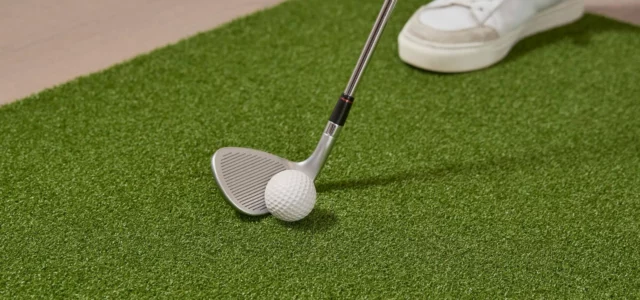
One chip: a low running shot with an 8-iron, ball back of center, hands slightly ahead, weight on the lead foot, putting-length stroke. It works from any decent lie within thirty yards, it does not require a perfect strike because the club never has to work under the ball, and it turns disasters into bogeys.
Stop using a lob wedge from a normal lie with green to work with. That single change is worth two shots a round to most golfers in the 90s.
One putt drill: the ladder. Balls at ten, twenty and thirty feet from the same hole, putting to each in turn and then back down. You are not trying to hole them. You are calibrating stroke length, which is what eliminates three-putts, and three-putts are what separate 92 from 88.
The eight-week plan
- Weeks 1 to 2: two range sessions a week, half the balls with a wedge. One nine-hole round, counting penalty strokes only and nothing else.
- Weeks 3 to 4: add twenty minutes of the chip and the ladder drill before every round. Play the tee-shot club that finds fairways rather than the one that goes furthest.
- Weeks 5 to 6: play eighteen with one rule, that no shot is attempted which you would not pull off seven times out of ten.
- Weeks 7 to 8: post scores for your Handicap Index and look at the pattern. The card will tell you which of the three categories is still costing you.
Two things about this plan. It contains no swing changes, deliberately, because a swing change takes three weeks to stop feeling wrong and this plan is eight weeks long. And it front-loads the short game, because that is where the strokes are.
What to measure
Not your score. Score is the outcome, and watching it round to round tells you mostly about the weather.
Count penalty strokes, three-putts and shots taken from inside 50 yards, round by round, on the back of the card. When those three numbers fall, 89 arrives on its own, usually on a day you were not thinking about it.
Benchmarks worth aiming at: one penalty stroke or none, one three-putt or none, and under twelve shots from inside 50 yards. Hit those and you are shooting in the 80s whatever your swing looks like.
Where to work on it in the U.S.
The short-game area at your local municipal course is the single most useful facility available to you, it is usually free with a green fee, and it is almost always empty. Check that chipping is permitted before buying a bucket, since a few facilities restrict it.
Two lessons with a PGA professional, one on the low running chip and one on your tee-shot club, will do more than a swing overhaul. The PGA of America directory lists coaches by area, and a nine-hole playing lesson is the format that exposes the decisions costing you strokes.
A Handicap Index through your state or regional golf association, so that the pattern is measured rather than remembered, and so that a good round is recorded rather than retold.
Twilight nine-hole rounds at a municipal course are the cheapest laboratory in the country for testing one rule at a time, and GolfNow and TeeOff list them by time across most metro areas.
Panxis Golf has no commercial relationship with any facility, coach or platform mentioned here.
The eight weeks, in one line
Eight weeks, three numbers, no new equipment required, and not a single swing change. That is genuinely the whole plan.