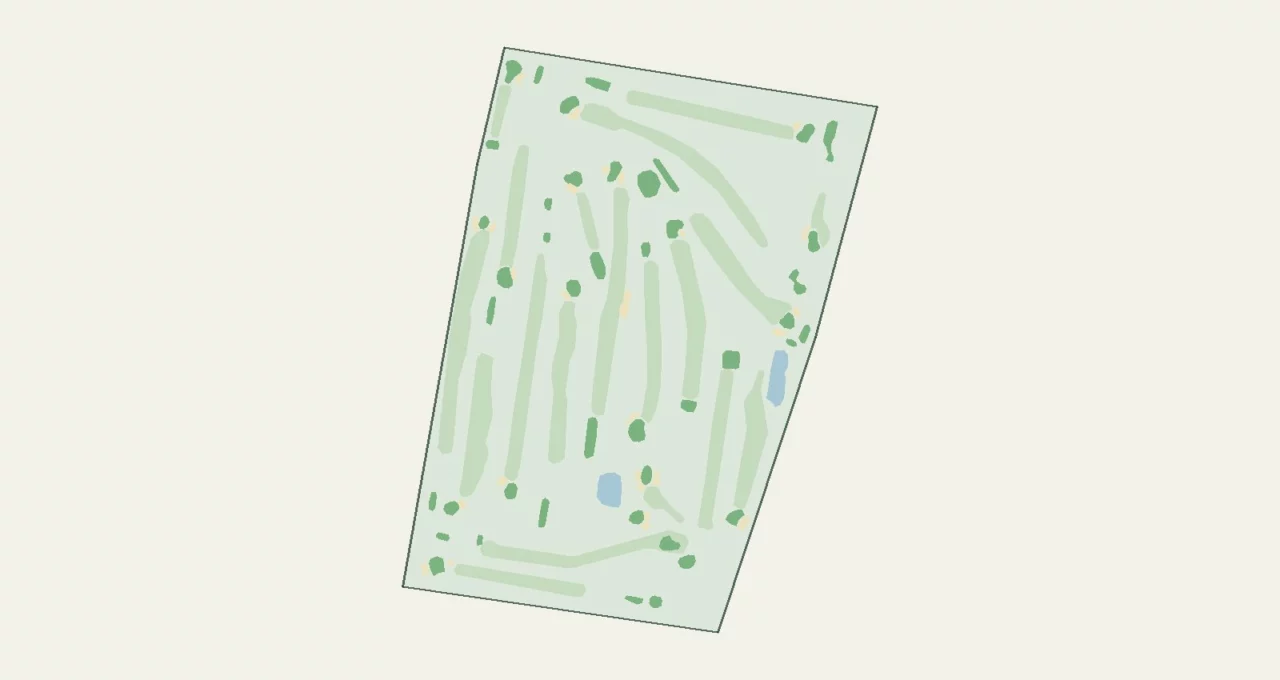
Layout of Hawks Nest Golf Club from OpenStreetMap survey data (ODbL licence).
Hawks Nest Golf Club
Holes
18 (club website; OpenStreetMap); 9 holes in the early 1970s, 12 in 1986, 18 in 1989 (club history)
By
72, 36 out and 36 in, four par 3s and four par 5s (club website, 2019 master plan, 18Birdies)
Length
6,110 m from the back tees by the hole lengths in the 2019 master plan; 6,079 m Yellow and 5,277 m Red (GolfPass); Blue 6,641 yds, White 6,468, Red 5,727, Grey 4,583 (18Birdies, men 72.2/131 from the Blue, app figures not confirmed by the club); Australian Course Rating 72 (Wikipedia, Planet Golf)
Green fee
—
Best season
All year; open 364 days a year from 7 am, 6 am during daylight saving (club website); greens renovated in autumn and spring (club, 2025)
Hawks Nest Golf Club is an 18-hole, par-72 course at 1 Sanderling Avenue, Hawks Nest, on the New South Wales coast where the Myall River meets Port Stephens. The club describes itself as being on the Mid-North Coast, about an hour north of Newcastle; tour operators who bring groups up from Port Stephens put it at roughly two and a half hours’ drive from Sydney. The course runs through coastal bush on old sand dunes a few hundred metres back from the beach, which is why the club calls it an all-weather course and why older write-ups single it out for how well it drains.
The club was formed in 1963, built its first nine holes with volunteer labour in the early 1970s, went to 12 holes in 1986 and to 18 in 1989. Its master plan names Kel Nagle and Michael Cooper as the designers, and since 2019 the former tour player Craig Parry has guided changes to the layout. The longest set of tees measures a little over 6,000 metres, depending on the source, and the course is listed with an Australian Course Rating of 72.
This page sets out what the public record says about the course, what it asks of a golfer, what published reviews report, and how a visitor gets a game. It draws on the club’s own website, its 2019 master plan and a 2025 report by its outgoing course superintendent, the regional newspaper News Of The Area, a tour operator’s review, Top 100 Golf Courses, Planet Golf, Wikipedia, golf apps and review aggregators, and OpenStreetMap, all read in November 2026.
Which course is this?
The name is shared. Search for Hawks Nest Golf Club and you will also find courses in the United States, including a Hawks Nest in Vero Beach, Florida, and a Hawks Nest course at the Ohio State ATI campus in Ohio. Several golf directories and apps mix their scorecards and ratings, so it pays to check that the listing you are reading is the one at postcode 2324. The course on this page is the one in New South Wales, in the Port Stephens and Myall Lakes area, on the northern side of the Port Stephens estuary opposite Nelson Bay. OpenStreetMap maps it as a golf area just behind Bennetts Beach, with its centre at about 32.665 degrees south, 152.182 degrees east, and Wikipedia gives a point a few hundred metres away from that, close to the clubhouse.
Even the Australian listings disagree in places. Planet Golf files the course under the name “The Vintage” and places it in the Hunter Valley; The Vintage is a different course near Rothbury in the Hunter wine country, and nothing else in the record links that name to Hawks Nest. Planet Golf’s own text, though, is clearly about this club: it repeats the 1963 founding, the 12 holes of 1986 and the 18 of 1989. Wikipedia and Planet Golf both place the club in the Hunter Region, while the club and the tour operators speak of the Mid-North Coast or the Myall Coast; the town sits in the MidCoast Council area, which absorbed the former Great Lakes Council from which the club first leased its land. Top 100 Golf Courses lists a phone number, (02) 4997 0740, that differs from the one on the club’s website, (02) 4997 0145; the club’s own number is the one to use.
The course is active. The club’s website and the local newspaper report a full 2026 calendar: a Vets Week of Golf in February that filled up and opened a waiting list, the 35th Myall Classic over 36 holes on 3 and 4 May 2026, a 40th Ladies Classic, the 2026 ladies club championship, a charity golf day and club-fitting sessions in August, and the Sanderling Pro-Am, which the club says “has officially wrapped up” for 2026. Golfers posted ratings on Hole19 in April 2026 and on 18Birdies as late as 30 August 2026.
History: from a volunteer nine to eighteen holes
The club’s history page tells a short, local story. Golf enthusiasts in Hawks Nest formed the club in 1963, but it was not until the early 1970s that the club leased land from the Great Lakes Council. Volunteers cleared the site and built the first nine holes themselves. The original clubhouse followed in 1977, when the club was also granted a liquor licence. The course was extended to 12 holes in 1986 and to 18 holes in 1989, which is the opening date Planet Golf gives for the full layout. The clubhouse has been extended and renovated several times since; the club’s site says the latest internal refurbishment was in 2021, while Planet Golf, apparently working from an older version of the club’s text, still gives January 2004.
The club’s history page does not name the architects. The master plan the club published, written by Craig Parry in May 2019, opens with a single line of background: “Designed by Kel Nagle and Michael Cooper.” Kel Nagle, the 1960 Open champion, is one of the best-known names in Australian golf; the plan gives no detail of when or how the two men were involved, and no other source read for this page adds any.
In April 2019 the club’s board commissioned Parry, a former PGA Tour and European Tour winner who now designs courses, to write a master plan that would “prescribe and constrain” any future change to the course. The document is frank about what it wanted to keep: a landscape “heavily oriented towards natural Australian bushland” that “would make no sense at all” to change. Its proposed style is what it calls the “Mackenzie tradition”: rolling, natural-looking ground and white-faced bunkers, with room for both high and running approach shots, and fairway-height grass around many greens so that a missed green still leaves a clean lie. It goes hole by hole: realigning tees on the 4th, 10th, 15th and 18th, making hidden greenside bunkers visible from the fairway, widening fairway cuts, removing lomandra and stumps from play, and adding a forward tee on the 7th that would turn it into a driveable par 4 for long hitters. The plan also deals with a possible change to the 18th, should a planned development next to the clubhouse require the green to move. The club’s homepage still says Parry is “guiding ongoing course improvement”.
The fullest account of what followed is a report by Ben Mills, the course superintendent, published by the club in August 2025 as he left the job after about a decade. He writes that 18 bunkers have been rebuilt with Capillary Concrete liners and EcoBunker edging, with 11 more planned; that more than 1,200 metres of concrete paths have been laid, including tee-to-green paths on every par 3; that fairways have been widened, several tee complexes rebuilt, bunkers that no longer suited the modern game removed, and hundreds of tree stumps taken out. A root-pruning programme cuts back tree roots that compete with the turf, greens are renovated twice a year in autumn and spring, and fairways are scarified and cored once a year. The 13th now carries a tribute to the During family. Mills also lists the problems: nematode counts in the thousands, Pythium root rot in hot summers, droughts, floods and above all storms that brought down trees. He says all the major works were done in-house. The club’s homepage, read in November 2026, still names Mills as superintendent; his own report says he has stepped away.
The club’s tournament has been a large part of its recent profile. The pro-am held each year with the PGA of Australia, known until 2025 as the Hawks Nest Beachside Pro-Am and from 2026 as the Sanderling Pro-Am after its new naming-rights sponsor, drew more than 280 players in 2026 according to the club. The club says it was named NSW/ACT Tournament of the Year at the PGA’s Golf Industry Awards in 2023 and 2025 and was a finalist in 2024. The 2026 winner, Andrew Campbell, who had also won in 2023, shot 68 and 65 to finish 11 under par, which is consistent with the par of 72.
One local issue sits right on the club’s boundary. A 1.4-hectare vegetated lot next to the eastern edge of the club, formerly Crown land granted to the Karuah Local Aboriginal Land Council and sold in 2018, was rezoned by MidCoast Council in April 2021 from public recreation to medium-density housing, a decision that drew national attention through an ABC Four Corners report that year. News Of The Area reported on 8 May 2026 that the current proposal, three four-storey buildings with 104 dwellings, had been declared a State Significant Development, with upgrades to the golf club’s car park included. The newspaper did not report the club’s own position, and this page does not guess at it.
The layout
The routing has not changed in shape since the master plan was drawn. The par is 36 on each nine, with four par 3s (the 3rd, 5th, 10th and 16th) and four par 5s (the 2nd, 6th, 13th and 14th), which matches Top 100 Golf Courses’ description of two of each per nine. The 2019 master plan lists four lengths for every hole. From the back tees its figures run from 135 metres on the 10th to 480 metres on the 14th and add up to 6,110 metres, 3,084 out and 3,026 in.
The published totals differ slightly, as they often do when tees move and apps copy older cards. GolfPass gives 6,079 metres from the Yellow tees and 5,277 metres from the Red, both par 72. The 18Birdies app lists four sets of tees in yards: Blue 6,641 yards, White 6,468, Red 5,727 and Grey 4,583. The Blue figure is about 6,070 metres and its hole lengths convert almost exactly to the master plan’s back-tee metres, so the app appears to have converted a metric card. 18Birdies gives men’s ratings of 72.2 with a slope of 131 from the Blue, 71.0 and 125 from the White, 71.1 and 122 from the Red and 65.8 and 112 from the Grey; for women, 77.3 and 137 from the Blue, 76.3 and 135 from the White, 73.5 and 126 from the Red and 66.3 and 113 from the Grey. These are app figures and were not confirmed on the club’s website or by Golf NSW. Wikipedia and Planet Golf say only that the course is championship rated with an Australian Course Rating of 72. The club’s current scorecard was not found online.
The same 18Birdies card gives the stroke indexes: the 11th is index 1, the 4th index 2 and the 12th index 3, while the 10th is index 18. That fits the account of the round given by reviewers, who pick out the 11th and 12th as the hardest stretch.
What it asks of you
Hawks Nest is a tree-lined course. The tour operator Warren McCourt of Classic Capital Golf Tours, in a 2024 review, writes that the fairways are tight and that the course “could become suffocating” without the tree work the club has done; clearing the understorey, he says, means a wayward ball is usually found and can be played out. The master plan and Mills’s report point the same way: widened fairways, trimmed overhanging gums and paperbarks, and corridors defined by native vegetation rather than dense scrub.
The opening holes set the tone. McCourt describes the 1st, a par 4 of 347 metres in his account, with bush and out of bounds tight on the left; into a southerly he needed a 5-wood for his second. The 2nd, a par 5 of 450 metres, also has out of bounds and the road on the left. Golfers who hook will feel those two holes. The master plan suggests moving the 2nd’s fairway cut to the right to steer play away from the boundary.
The 4th, 371 metres in McCourt’s account, has bush on the left and a narrow, bunkered green. The 10th is the short hole by the clubhouse, a par 3 of 135 metres to a well-bunkered green that McCourt calls redan-style, played in full view of diners. The master plan noted that the original tee left the green and its front-right bunker hidden, and proposed a new tee to the left so that a running shot could be played in.
The 11th is the hole everyone mentions. It is a par 4 of 419 metres from the back tee in the master plan, a slight dogleg with heavy trees on the left, and McCourt calls it “probably the toughest hole”, especially into a north-easter; 18Birdies makes it stroke index 1. The 12th follows at 384 metres, with a tight tee shot that has to move from left to right and a raised green with a large swale where, in McCourt’s words, three putts are likely. The two par 5s at the 13th and 14th, 452 and 480 metres in the master plan, come back to back after that.
Wind matters. McCourt notes that the front nine sends holes in different directions, so the breeze is not the same grind on every shot, and Peter Birch, writing for Top 100 Golf Courses after a round in October 2007, describes holes playing into, across and with the wind. Bunkering, according to McCourt, is “not extensive but well placed”, and the rebuilt bunkers now carry premium sand, according to the club. The surfaces are kikuyu fairways and bentgrass greens on sand, says McCourt, and the greens are the course’s best-known feature: the club calls them immaculate, reviewers call them quick and true, and one reviewer on Wanderlog guessed they ran at around 9 or 10 on the Stimpmeter.
A hole to remember: the 18th
The finishing hole is a short par 4: 312 metres from the back tee in the master plan, 341 yards from the Blue on 18Birdies. McCourt says it holds the only water carry on the course, and that grey tee markers let players who would rather avoid it go round; Peter Birch called it the standout hole, a short par 4 with marshy ground below the tee. The master plan recommended moving the red and yellow tees to the right to line them up with the fairway, widening the start of the fairway to make the tee shot less intimidating, and pulling the left greenside bunker, which sits partly on the boundary, back inside the property.
What golfers say
The written record is modest for an 18-hole course: one detailed tour operator’s review, one older article on Top 100 Golf Courses, and short comments on apps and aggregators. On aggregators, Wanderlog shows a Google rating of 4.1 from 463 reviews and a Tripadvisor rating of 3.5 from 38, though many of those cover the clubhouse, its restaurant and its family events rather than the golf. Hole19 shows 4.8 from 21 ratings and 18Birdies 4.7 from 30, where golfers rate the greens as fast and the course as hard. Top 100 Golf Courses ranks it 84th in New South Wales.
What comes up in its favour
- Condition. McCourt credits Ben Mills and his staff with keeping the course to a very high standard. A golfer on Wanderlog in July 2025 found it in excellent condition with consistent greens and good bunkers; John Jackson on Hole19 in March 2025 wrote that the greens were “in great nick”; Sean Fitzgerald on 18Birdies in August 2026 called it an excellent course in great condition and worth the trip.
- The greens. Birch rated them as good as you get, and reviewers on Wanderlog describe them as true and consistent.
- Drainage. The club calls it one of Australia’s best all-weather courses, Planet Golf’s text “probably the finest wet weather course in the Newcastle district”, and McCourt explains why: shaved kikuyu and bentgrass on old sand dunes.
- Variety in the wind. Both McCourt and Birch note that the holes face different ways, which keeps the round from becoming one long slog into the breeze.
- The setting. Birch mentions exceptional birdlife and a good chance of seeing koalas; the course is surrounded by bush close to the beach.
- The club itself. Harry M on Google, in February 2026, praised a well-run veterans’ tournament, a good course and good food, and several reviewers recommend the clubhouse restaurant, Sando’s.
What comes up against
- Tight driving. McCourt’s “suffocating” remark is a warning as much as a compliment to the tree work, and the 1st, 2nd and 12th demand accuracy off the tee.
- Parkland rather than links. Birch, despite the sand and the beach next door, found the course more parkland than links, with flat greens and mostly flat fairways that lack the bounces and character of true links ground.
- Not hard enough for some. One reviewer on Wanderlog called it “not a tough course” though still enjoyable; another found lots of trees and deep bunkers. The difference says as much about the player as the course.
- Maintenance timing. One Wanderlog reviewer played soon after the greens had been cored; the club renovates its greens in autumn and spring each year, and visitors who care about putting surfaces may want to ask when.
- Busy days. Birch warned that weekends can be busy and advised calling ahead. On Google, Sassy M in January 2026 described an hour’s wait for food on a crowded Sunday evening and an understaffed bar, a reminder that the club is a holiday-town venue as well as a golf course.
Playing as a visitor
The club says that “visitors are always welcome” and that the course is open 364 days a year from 7 am, or from 6 am during daylight saving. Social tee times are booked online through the club’s MiClub public booking page or by phone on (02) 4997 0145; the club also runs Stay and Play packages for groups and has a list of reciprocal clubs. Club competitions and events such as the Myall Classic, which requires a current GA handicap, take over the course on certain days, so check the club’s events page before planning a trip around a particular date.
The pro shop says it has a fleet of 40 golf carts for social and competition play, which the Myall Classic entry page confirms are hired by the day through the pro shop. It also hires pull buggies and men’s, women’s and junior club sets. Kieran McMahon is named as the PGA head professional and gives lessons and clinics, including a ladies’ social clinic on Friday mornings. Practice facilities listed by the club include putting and chipping greens, practice bunkers, a driving range, two covered nets and an indoor golf simulator room. The clubhouse has a café and restaurant, Sando’s, a social club, and function rooms used for weddings and conferences.
Rates, member rates and visitor conditions are set by the club and change with the season. This page does not repeat them: see the club’s social golf page or book through the club’s online booking page.
Getting there and when to go
Hawks Nest is reached by road through Tea Gardens, on the far side of the Myall River bridge. The club gives the drive as about an hour north of Newcastle; McCourt puts it at about two and a half hours from Sydney and about an hour by road from accommodation in Nelson Bay, which sits directly across Port Stephens but has to drive around the estuary. He also suggests that groups of eight to ten can take the passenger ferry from Nelson Bay instead, with a shuttle arranged through the club. Ferries run between Nelson Bay and Tea Gardens, and at least one operator stops at the Hawks Nest wharf on request; timetables differ between operators and sources, so check with them before relying on the crossing. The course is on Sanderling Avenue, between the town and Bennetts Beach, with the Myall Lakes National Park to the north.
The course plays all year. Its sandy base is the reason clubs and reviewers have called it a good wet-weather course. Summer holidays bring the town’s busiest period and the clubhouse’s busiest evenings; early mornings avoid the heat, and the club opens at 6 am in daylight-saving months. Greens are renovated in autumn and spring. The wind, from the south or north-east as McCourt describes, is the main variable on any day.
How this page was made
This page was written in November 2026 from public sources. The address, opening hours, booking arrangements, pro shop services, history dates and 2026 events come from the club’s website (hawksnestgolfclub.com.au). The design attribution and the hole-by-hole lengths and plans come from the club’s 2019 master plan by Craig Parry; the record of course works since about 2015 comes from Ben Mills’s report published by the club in August 2025. The 2026 Pro-Am result and awards come from the club’s Pro-Am page; the 2026 events and the development next to the course from News Of The Area. Course lengths and ratings also come from GolfPass and the 18Birdies app, and the Australian Course Rating of 72 from Wikipedia and Planet Golf. Opinions are taken from Warren McCourt’s 2024 review for Classic Capital Golf Tours, Peter Birch’s article on Top 100 Golf Courses (played October 2007), and reviews on Hole19, 18Birdies and Google as shown by Wanderlog; each is attributed where it is used. The location comes from OpenStreetMap.
Where sources disagree, the differences are stated above: the course’s length, the name and region given by Planet Golf, the date of the last clubhouse refurbishment, and the club’s phone number. The slope and course ratings for individual tees are app figures not confirmed by the club or Golf NSW. No current official scorecard was found, so no single total length is presented as definitive.
We have not played this course, and nothing here replaces that. The club has not paid for this page, has not seen it before publication and has no say in what it says. If you know the course and something here is wrong or out of date, write to us and we will correct it.
Other courses nearby
Closest to this one in our Australian directory:
- Forster Tuncurry Golf Club, Forster Course — 62 km
- The Vintage Golf Club — 81 km
- Breakers Country Club — 110 km
- Avalon Golf Course — 134 km
The hole to know
Short par 4 of 312 m from the back tee (2019 master plan), 341 yds Blue (18Birdies); the only water carry on the course, with grey tees for those who would rather avoid it (Classic Capital Golf Tours, 2024), and marshy ground below the tee that Peter Birch called the standout hole (Top 100 Golf Courses).