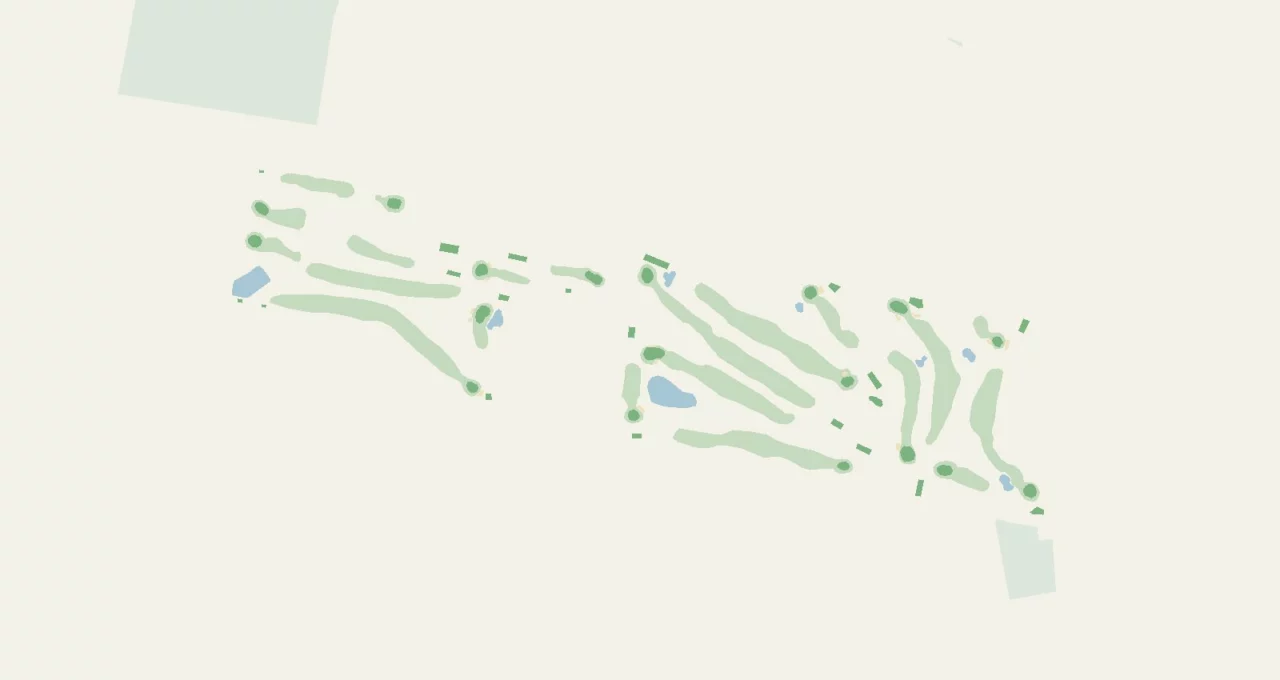
Layout of Forster Tuncurry Golf Club, Forster Course from OpenStreetMap survey data (ODbL licence).
Forster Tuncurry Golf Club, Forster Course
Holes
18 (club; VisitNSW; Top 100 Golf Courses; OpenStreetMap counts 18 hole lines); the club also runs the 18-hole Tuncurry course about 7 km away by road (Australian Golf Digest)
By
66 for men, 68 for women, the 9th and 12th playing as par 5s for women (club; VisitNSW; GolfNow)
Length
4,868 metres (club; VisitNSW; GolfNow; Australian Golf Digest); the club's hole-by-hole men's figures add up to 4,669 metres; women's card 4,674 metres (GolfNow), 4,625 metres on the club's hole figures
Green fee
—
Best season
All year (GolfNow; club); humid subtropical climate, warm summers and mild winters (Wikipedia)
Forster Tuncurry Golf Club runs two eighteen-hole courses on the Mid North Coast of New South Wales, and this page is about the older and shorter of the two: the Forster course, on Strand Street in the centre of Forster, a short walk from One Mile Beach. The club gives its address as Strand Street, Forster NSW 2428, and the clubhouse there serves as the club’s main base. The coordinates we use for the course place it on the edge of town, between the main street grid and the beach, and the OpenStreetMap record for it counts 18 hole lines, which matches the eighteen holes described by the club and every directory we read.
The club’s other course, the Tuncurry course, lies on the northern side of Wallis Lake, about seven kilometres away by road according to Australian Golf Digest. It is a par 72 of 6,203 metres from the men’s tees according to the club, designed by Kel Nagle and Mike Cooper and later adjusted by Craig Parry, and it is the course the club promotes as one of Australia’s Top 100 public access layouts. It deserves its own page. Here, it comes up only where it helps to place the Forster course.
The club is active in 2026. On 5 November 2026 its public booking page offered visitor tee times on the Forster course for the following days, and its booking system carries a 2026 copyright notice. Rounds on the Forster course have been logged by users of the Hole19 app through 2026, the most recent in August. The club’s site lists weekly competitions on both courses, a bistro open seven days, a café, a golf shop and lessons.
A town course since 1950
The Forster course is the original home of the club. According to the Top 100 Golf Courses guide, the club began in 1950 with nine holes laid out by A. W. East of Sydney, added two more holes in 1952 and, after acquiring more land, extended the layout to eighteen holes in 1970. Australian Golf Digest, in a course review published in January 2024, also gives 1950 for the opening and 1970 for the full eighteen holes, but does not name the designer. We found no other source on A. W. East’s part in the course, so the credit rests on the Top 100 guide alone.
The story of the second course is less tidy. The Top 100 guide and other sources describe a group linked to the Forster club setting up a separate venture, the Great Lakes club, on land near Tuncurry, and that course later became part of Forster Tuncurry Golf Club. The club’s own page on the Tuncurry course says it was designed in 1984, and Australian Golf Digest says it was completed that year. The details of how the two came together, whether by merger or after the first owners ran into financial trouble, are told differently from one secondary source to another, and we have not found a primary record to settle them.
More recent history is better documented. A new clubhouse and golf museum were built at the Tuncurry course with state government funding; the Great Lakes Advocate reported the sod turning in July 2020 and Golf Industry Central reported the building nearing completion in August 2021. The Forster course had its own works: Australian Golf Digest reports that it received a new irrigation system in 2023, along with a reworked water storage dam and reshaped fairways around it, with Craig Parry advising on the design and the superintendent Ben Norton-Smith in charge of the course. The club’s hole-by-hole guide notes that its videos were filmed during the major New South Wales floods of 2022 and that new ones are to come.
The course in figures
The club describes the Forster course as 4,868 metres long, par 66 for men and par 68 for women. VisitNSW, GolfNow, Australian Golf Digest and the Top 100 guide repeat par 66 and the same length, or round it to nearly 4,900 metres. GolfNow adds a women’s card of par 68 over 4,674 metres. None of the sources we could read publishes a course rating or slope for the Forster course; GolfNow shows zeros in those fields. We give none.
The club’s hole-by-hole guide gives a par and a men’s and women’s length for each hole, and that is the card we follow. From the men’s tees, the front nine is 2,158 metres and par 32, and the back nine 2,511 metres and par 34. The holes run: a par 3 of 170 metres at the 1st, par 4s of 299 and 291 metres, a par 3 of 142 metres at the 4th, a par 4 of 305 metres at the 5th, a par 3 of 160 metres at the 6th, a par 4 of 361 metres at the 7th, the shortest hole on the course, a par 3 of 104 metres, at the 8th, and a par 4 of 326 metres at the 9th. The back nine opens with a par 4 of 376 metres, then a par 3 of 144 metres, a par 4 of 397 metres at the 12th, the only par 5 on the course, 418 metres, at the 13th, a par 3 of 127 metres, par 4s of 326 and 251 metres, a par 3 of 117 metres at the 17th and a par 4 of 355 metres to finish.
That makes seven par 3s, ten par 4s and one par 5, which is where the par of 66 comes from. For women, the 9th and the 12th are played as par 5s, which gives the par of 68. The Top 100 guide also counts seven par 3s and a single par 5 at the 13th.
The figures do not all agree. The men’s hole lengths on the club’s guide add up to 4,669 metres, about 200 metres less than the 4,868 metres the club and every directory give for the course. The women’s lengths add up to 4,625 metres, against 4,674 on GolfNow. Most of the club’s hole pages also quote a longer distance in their description than in the tee figures above it: 179 metres for the 1st, 147 for the 4th, 166 for the 6th, 374 for the 7th, 381 for the 10th, 403 for the 12th and 439 for the 13th, among others. These look like older measurements left in the text, and the headline 4,868 metres may date from the same card. The Top 100 guide gives the 1st as 197 metres and the 14th as the shortest par 3 at 143 metres, where the club’s current figures make the 8th the shortest at 104 metres. One online scorecard site lists the course as a par 72 of about 5,700 units with a rating and slope; its card does not match the club’s pars at all and we have set it aside.
The club’s guide gives a stroke index only for the 12th, which it names index 1 and the hardest hole on the course. We could not find the full index for the other holes.
What it asks of you
Short, but not open everywhere
The club sells the Forster course as a seaside layout for social golfers, with generous fairways and forgiving rough, and says the short par 4s, small greens, sea breeze, bunkers and water hazards provide the challenge. Australian Golf Digest calls it short and largely open, a fun and playable course that will not excite architecture enthusiasts. The Top 100 guide’s reviewer describes an easy walk with tree-lined fairways and low-profile greens, but finds holes 11 to 17, squeezed onto a small parcel of land across the road from the main property, claustrophobically tight, with tall trees asking for accuracy off the tee. Australian Golf Digest also places the 11th to the 17th across the road, with the 1st to the 10th and the 18th on the main property.
Water and out of bounds
For a short course, the club’s hole notes mention water on a surprising number of holes: left of the 1st green, hidden behind trees on the 3rd, across the fairway and to the right of the green on the 4th, near the 5th green and beyond it, on both sides of the 7th, down the left of the 10th and in front of its green, on the 11th, across and alongside the 12th, short of the 13th green, to the right of the 14th, across and down the left of the 15th, and across the 16th about 200 metres from the tee. Out of bounds runs down the right of the 2nd and the 13th, down the left of the 16th and over its green, and behind the 10th and 15th greens. The site is hemmed in by housing and roads, and the Top 100 guide puts it at about 70 acres.
Wind off the sea
The front nine is the beach side of the course. The club says holes 1 to 6 run on the beach side of the clubhouse, and its notes describe the 4th as heading straight out to sea and the 5th as doglegging along the beach. The club mentions an easterly sea breeze on the 2nd, a hole that often plays into the wind at the 17th, and an 18th that can play long into it. On a windy day the short card is not as short as it looks.
Holes to know
The 1st is an unusual opener, a par 3 of 170 metres with water left and a bunker short right, to a green that slopes from back to front. The 2nd, a par 4 of 299 metres, doglegs uphill to the right with out of bounds all along the right, and the club suggests that long hitters can carry the corner while everyone else drives to the corner and plays an uphill approach to a green with a large tier. The 5th, a par 4 of 305 metres along the beach, is the hole the Top 100 reviewer calls the best on the course; the club advises against trying to drive close to the green because of the water near it, and suggests leaving 100 to 120 metres in. The 12th, 397 metres and index 1, bends slightly right with water down the right, across the fairway about 110 metres from the green and along the left; the club says a 4 is a good score. The 13th, the only par 5, doglegs right around the Memorial Services Club with out of bounds the whole way down the right, and the club notes that it gives up birdies and a fair number of eagles. The 16th, a par 4 of 251 metres, tempts big hitters, but water crosses about 200 metres out and out of bounds runs down the left and over the green; the club says going for it has ruined many good rounds. The 17th, a par 3 of 117 metres, has a narrow green on three levels.
What that means for your game
On a card with ten par 4s under 400 metres, the driver is often the wrong club. The club’s own notes say that placement matters more than distance on most of the shorter holes, and several of them invite a long iron or hybrid to a corner rather than a drive over trouble. Many greens slope from back to front, and the club repeatedly advises leaving an uphill putt. Bring enough balls for the water, and keep something in reserve for the tighter stretch across the road.
What golfers say
Written comment on the Forster course is scarce. Most reviews of the club are about the Tuncurry course or about the bistro, and the Forster course draws few detailed comments. We read the Top 100 Golf Courses guide, which has one review of the course dated July 2021, the Australian Golf Digest review of January 2024, the Hole19 app page, where 31 rounds are rated but only one carries a written comment, the directory descriptions on VisitNSW and GolfNow, and a summary of Google and Tripadvisor reviews on the travel site Wanderlog, which puts the club at 4.3 out of 5 from 334 Google reviews and 3.9 from 109 Tripadvisor reviews. Those last ratings cover the whole club, food included, not the course alone. The GolfPass review page refused our requests. The points below are what we found; they are other people’s opinions, not ours, and we name and quote no one.
What comes up in its favour
- The course is easy to walk, with gently rolling ground on the front nine.
- The beach holes, and above all the 5th along One Mile Beach, are the highlight.
- Reviewers describe it as a relaxed, holiday-style course that members clearly enjoy, and a playable complement to the much harder Tuncurry course.
- The tree-lined holes across the road are described as memorable and fun, as well as tight.
- Its central position in town, close to the beach and the clubhouse, makes it easy to fit in a round.
- The bistro’s seafood and its value for money come up often in reviews of the club.
What comes up against, or should be weighed
- It is a short course, par 66, and Australian Golf Digest says it is unlikely to win over architecture enthusiasts; golfers who want a long test usually head to Tuncurry.
- Holes 11 to 17, on a small block across the road, feel cramped to at least one reviewer.
- The site is small and surrounded by housing and roads, with out of bounds close on several holes.
- One app reviewer in 2024 complained about the state of green repairs, and the Wanderlog summary mentions visitors disappointed with course conditions.
- Food quality at the club is described as uneven by some reviewers.
Eating, practising and staying
The club’s restaurant, Buko’s Bistro, serves Thai and Australian dishes with an emphasis on seafood, and the club says it is open seven days for lunch, from 11.30am to 2pm, and for dinner from 5.30pm. Its seafood platter must be ordered in advance. The club also runs Sinny’s Café and a function room. The club’s contact page lists separate telephone extensions for a bistro at Forster and one at Tuncurry, and its stay-and-play page refers to the Forster clubhouse restaurant. A courtesy bus, for up to 11 people according to the stay-and-play page, runs every half hour from 4.30pm and picks up and drops off door to door; it must be booked by phone.
The club has golf shops at both courses, with PGA professionals offering individual, group and playing lessons, clinics, club fitting, repairs and regripping; lessons are booked through an online scheduler. GolfNow lists a driving range and a chipping area for the Forster course; we could not confirm on the club’s site where those practice facilities are. A separate, privately run driving range with mini golf operates in the middle of the Tuncurry racecourse, according to VisitNSW; it is not part of the club.
For a golf break, the club offers stay-and-play arrangements covering both courses, with accommodation from cabins to motels and higher-end options organised through its golf administration office. It does not name partner properties. Groups of 20 or more receive a free members card giving a discount at the bars of both courses, the club says.
Who it suits
The Forster course suits holiday golfers, beginners, juniors, seniors and anyone who wants a short, walkable round in town, close to the beach and the clubhouse, without the length or the bush of Tuncurry. Its short par 4s give mid and high handicappers real birdie chances, and its seven par 3s give a fair workout to the short game. Better players will find it a light round, made harder mainly by the wind, the water and the tight holes across the road; for them, the natural plan is a round at each course, with Tuncurry as the main event. Visitors with a valid handicap are welcome in the club’s competitions, which run on the Forster course every day of the week, according to the club.
Getting there and when to go
The course is in the centre of Forster, off Strand Street, a short walk from One Mile Beach; GolfNow gives The Northern Parkway as its address, while the club, VisitNSW and OpenStreetMap give Strand Street. The club says the area is about three hours’ drive north of Sydney. Wikipedia puts Forster 308 kilometres north-north-east of Sydney and 166 kilometres from Newcastle in a straight line, and Taree 37 kilometres to the south. Forster is joined to Tuncurry by a bridge over the entrance to Wallis Lake, built in 1959 according to the same article. We have not checked train, coach or air connections and give none.
Visitors book tee times online through the club’s website, which links to a public booking page where non-members first register; there are separate calendars for the Forster and Tuncurry courses, and the online options for the Forster course include nine-hole rounds and rounds with a cart. The golf shop can also be reached on 02 6554 6799, option 1 for Forster. Groups can contact the club’s golf administration by email. Visitors may not bring their own motorised carts onto either course without prior approval. The club publishes dress regulations, and GolfNow states that metal spikes are not allowed and neat dress is required. Competition and social tee times vary by day and may change at short notice for tournaments, weather, holidays or large groups. Golfers from reciprocal clubs may play up to six times a year if they live outside the local area, the club says.
GolfNow lists the course as open all year, and the club says it draws social golfers year round. Wikipedia describes Forster’s climate as humid subtropical, with warm summers, mild winters and about 1,176 millimetres of rain a year. The club warns that tee times can change at short notice for events and large groups, so it is worth booking ahead.
How this page was made
The factual frame comes from public sources consulted on 5 November 2026. The club’s website provided the address, telephone and extensions, the course description, the hole-by-hole pars, lengths and notes, the women’s pars, the competition days, the visitor and reciprocal rules, the cart restriction, the bistro, café, golf shop, lessons, courtesy bus and stay-and-play details, and the Tuncurry course figures. The club’s public booking page showed tee times on offer for November 2026. The Top 100 Golf Courses guide provided the history from 1950 to 1970, the A. W. East credit, the site area, the par 3 and par 5 count and its one published review. Australian Golf Digest’s January 2024 review provided the opening dates, the layout across the road, the 2023 irrigation and dam works and its assessment of both courses. The Great Lakes Advocate and Golf Industry Central provided the Tuncurry clubhouse and museum project. VisitNSW and GolfNow provided the length, pars, women’s card, season, facilities and dress rules; Hole19 the 2026 activity and its review; Wanderlog the summary of Google and Tripadvisor reviews; Wikipedia the distances, climate and bridge. OpenStreetMap provided the coordinates and the 18 hole lines.
Several sources disagree, and we have said so in the text. The club’s hole lengths add up to 4,669 metres from the men’s tees, against the 4,868 metres the club and the directories give for the course; the women’s lengths add up to 4,625 metres, against 4,674 on GolfNow. Most hole descriptions on the club’s site quote longer distances than the tee figures beside them. The Top 100 guide gives the 1st as 197 metres and the 14th as the shortest par 3 at 143 metres, where the club’s figures give 170 metres and the 8th at 104 metres. One scorecard site lists a par 72 card for the course that matches nothing else, and we have not used it. GolfNow gives The Northern Parkway as the address, the other sources Strand Street. The history of the Tuncurry course and how it joined the club is told in different ways.
The GolfPass review pages and a regional tourism directory refused our requests. We found no course rating or slope, no full stroke index and no confirmed location for a practice range at Forster. The club’s results and events pages were empty when we read them. We give no green fees or membership prices.
We have not played this course, and this page is no substitute for a round. The club has not paid for this page, has not seen it before publication and has no say over its content. If you know the course and something here is wrong or out of date, write to us and we will correct it.
Other courses nearby
Closest to this one in our Australian directory:
- Hawks Nest Golf Club — 62 km
- The Vintage Golf Club — 129 km
- Breakers Country Club — 172 km
- Avalon Golf Course — 197 km
The hole to know
A par 4 of 305 metres doglegging left along One Mile Beach, with water near the green, where the club advises laying up to 100 to 120 metres (club hole guide); the Top 100 Golf Courses reviewer calls it the best hole on the course.