Snakes, dams and native bush: the penalty area options Australian golfers forget
A ball in the dam does not have to mean a nervy drop on the bank. The Rules give you up to four options, and on an Australian course the right one depends on how the club has marked its dams, creeks and native bush, and on whether a snake is sitting near your ball.

In brief
- In a penalty area you can play the ball as it lies at no cost: ground your club, take practice swings and move loose impediments.
- Back-on-the-line relief has no distance limit: walk back to a full wedge instead of pitching over the creek from the bank.
- Lateral relief (red only) is measured from where the ball last crossed the edge, which can be the green side of a creek.
- Red or yellow stakes with green tops mark a no play zone: at The Coast Golf Club's 17th and at The Vines Golf Club of Reynella's dams you must take penalty relief even if you find the ball.
Stand beside the dam on any par 3 on a Saturday morning and you will see the same thing over and over. A ball splashes, someone walks to the bank, drops a couple of club-lengths from the water and hits a nervy half shot they never wanted to hit. Nobody asks whether there was a better choice. There usually was.
The Rules give you up to four ways out of a penalty area, and most of us only ever use one. They are written into Rule 17 for the moments when the obvious drop is the wrong one.
First, is your ball really in the penalty area?
A ball is in a penalty area when any part of it touches the ground or anything else inside the edge, or sits above it. A ball resting on the line is in. When a line is painted, the line itself is part of the penalty area.
To take penalty area relief without finding your ball, it must be known or virtually certain that the ball is in the penalty area. Seeing a splash counts. Thinking it probably rolled into the long grass beside the creek does not. Without that near certainty the ball is lost, and lost means stroke and distance, which is why a provisional ball is often the smart play when you are not sure.
Red stakes or lines give you every option, yellow ones all of them except lateral relief. A penalty area that has not been marked at all is treated as red.
Option one: play it as it lies, at no cost
A ball in a penalty area is now played under the same Rules as a ball in the general area. You can ground your club, take practice swings that brush the grass or the water, and move loose impediments such as leaves, bark and gum nuts, all without penalty.
That changes the maths on a lot of old “hazard” lies. A ball sitting up in dry grass inside the red stakes, on the bed of a creek that has not run since winter, or in shallow water with the top half showing, can often be played back to the fairway for nothing. A clean chip out costs one stroke; a drop costs a penalty stroke plus the next shot. If the ball is under water or hard against a rock, it is not a shot, it is a gamble with a sore wrist attached.
Option two: stroke and distance, the one that feels like giving up
For one penalty stroke, you can always play again from where you hit your last shot. On some holes it is the best one.
Take a par 3 over water. Your tee shot comes up short and splashes. The crossing point is just in front of the tee, so back-on-the-line relief puts you behind the tee or on an awkward slope, and lateral relief leaves you on the bank facing the full carry anyway. Going back to the teeing area gives you the same shot from the same distance, and the Rules let you tee the ball up again. After a 130 metre approach from a flat lie finds the lake, going back beats an awkward 55 metres over the edge from a downslope.
Option three: back on the line, as far as you like
Find the point where your ball last crossed the edge of the penalty area and picture a straight line from the hole back through that point. You may take relief anywhere on that line, with no limit on how far back you go.
Since 2023 you drop the ball on the line itself. The spot where it first touches the ground becomes the centre of a relief area one club-length in any direction, and the ball must come to rest inside it, no nearer the hole than the point where the original ball crossed the edge.
“As far as you like” is where the shots are saved. Say your ball crossed into a creek 40 metres from the green. A drop at the bank leaves a 40 metre pitch over the water, the shot most club golfers dread. Walk back another 45 metres along the line and you have a full wedge from 85, with the creek out of the picture. It costs the same one stroke.
Option four: lateral relief, measured from the right place
For red penalty areas only, you may drop within two club-lengths of the point where the ball last crossed the edge, no nearer the hole and outside the penalty area. Plenty of golfers take it from the wrong spot.
The reference point is where the ball crossed the edge, not where it finished. On a ball that curves into a lake down the right of a fairway, that point can be 30 or 35 metres behind the splash. And it often works in your favour: if your approach carries a creek, lands on the far bank and rolls back in, the ball last crossed the edge on the green side. You drop on the green side and chip on, instead of pitching over the water again.
Relief on the opposite side of the water is not a standard option. It exists only when the committee adopts a Local Rule for it (Model Local Rule B-2).
Dropping zones, no play zones and one rare extra option
A dropping zone is an extra choice, not an obligation, unless the local rules say it is the only relief allowed. Some penalty areas contain a no play zone, often protected wetland or bushland marked with green tops on the stakes: there you must take relief, however playable the ball looks.
If you play from a penalty area and the ball ends up in the same penalty area, out of bounds or lost, Rule 17.2 adds one more option: for another penalty stroke, go back to where you last played from outside the penalty area.
What you cannot do in a penalty area is declare the ball unplayable, or take free relief from ground under repair, temporary water or an embedded ball. The one exception is a dangerous animal condition, which on an Australian course deserves its own paragraph.
A thirty second decision at the edge of the dam
- Confirm the facts. Known or virtually certain? Red, yellow, green tops? Where did it last cross the edge?
- Look at the ball. Solid contact and a clear way out means playing it costs nothing.
- Price each drop. What shot does each option leave, from what distance and off what lie?
- Take the boring choice. A penalty stroke plus a routine shot beats a penalty stroke plus a hero shot.
Where Australian golfers meet penalty areas: snakes, dams and native bush
On plenty of Australian courses the water is a dam or a creek rather than a lake, and the edge is not always a row of stakes. At Burleigh Golf Club on the Gold Coast, the local rules define the dam on the 2nd as a red penalty area whose edge is the edge of the closely mown grass along the rock embankment. A ball on those rocks is in the penalty area with no stake near it, and every option above applies. The colour can also change with the hole. At Spring Valley Golf Club in Melbourne’s south-east, the same pond is a red penalty area while you play the 12th and a yellow one while you play the 13th: lateral relief on one hole, none on the next.
Then there are snakes. They become more active as the weather warms in spring, and the long grass and reeds around dams and creeks are exactly where golfers go looking for balls. The Rules list poisonous snakes as a dangerous animal condition, the one situation where relief is possible from inside a penalty area: free relief inside the penalty area, or the usual penalty relief outside it. Better still, do not search. If you did not see the ball go in, it is not known or virtually certain to be in the penalty area, so hit a provisional and walk on. No ball is worth putting your hand into a clump of tussock in October.
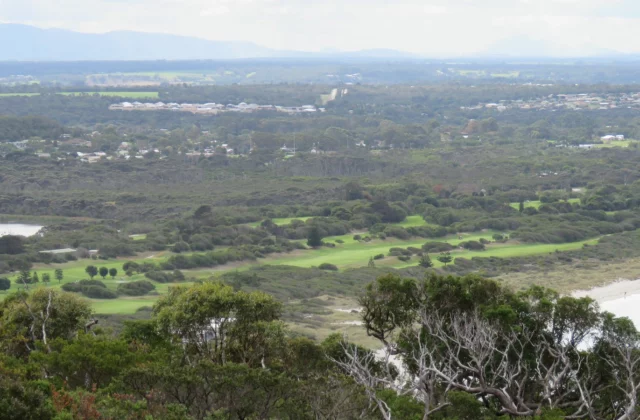
Native bush is the third Australian twist. Clubs protect bushland, wetland and revegetation areas as no play zones, and inside a penalty area those are marked with red or yellow stakes with green tops. The Coast Golf Club in Sydney changed the markings on the left of its 17th from red to red with green tops, and its local rules spell it out: a ball that comes to rest there must not be played, even if found, and you take penalty relief as for a red penalty area. The Vines Golf Club of Reynella, south of Adelaide, lists all its dams, defined by red and green stakes, as no play zones. The moment you see green on the stakes, the free option disappears. Take your drop and do not go in after the ball, even to look.
Not every native planting is protected. The same Vines local rules treat gardens and plantings of native grasses in the general area as integral objects unless marked as a no play zone. Unmarked bush beside a fairway is usually general area: play it as it lies or declare it unplayable, and the penalty area options do not apply.
Stake colours are not national either. Burleigh uses orange stakes for dropping zones and white with green tops for no play zones in the general area, where relief is free. Read the club’s local rules online the night before, or on the noticeboard before your first comp of the season.
Take this to your next round
Before you tee off, check the local rules for penalty areas, dropping zones and green-topped stakes. When a ball gets wet, find the crossing point and ask what each of the four options leaves you. Most days the answer will still be the ordinary drop. On the few holes a month where it is not, you will be the one walking back 45 metres to a full wedge while your playing partners hack out of the mud.
For the other rules that catch out weekend golfers, read eight rules of golf almost everyone gets wrong on a Saturday. To keep the ball dry in the first place, see five course management shots for firm Australian fairways and how to read an Australian course map. Panxis Golf has no commercial relationship with any club mentioned here.