Build a pre-shot routine this winter: four beats to rehearse in the dome, simulator or basement
A routine needs hundreds of repetitions to run on its own, and a Canadian winter gives you five months to collect them. Choose, feel, aim, go: learn the sequence in a dome bay, a simulator or a basement now, so it holds up on the first tee in spring.

In brief
- Four beats in the same order every time: choose the club and a small target, one rehearsal swing for this shot, aim the clubface first, then a trigger and swing.
- Rule 5.6b recommends 40 seconds at most per stroke; what matters more is that your routine lasts about the same on an easy shot and over water.
- In a University of Exeter study, 22 low-handicap golfers trained a quiet eye putting routine and averaged 1.9 fewer putts per round over 10 competitive rounds.
- Indoors, run the full routine on one ball in three in the dome and on every shot in the simulator, and never let the screen's numbers turn into a swing thought.
The clubs are in the basement, the course is under frost, and for the next five months most of your golf will happen in a dome bay, a simulator booth or a net hung from the floor joists. That sounds like a lost season for your swing. It is a very good season for something else: the half minute before the swing. A pre-shot routine needs hundreds of repetitions to become automatic, it costs nothing, and unlike a new move it can be learned properly indoors. Build it this winter and it will be waiting for you on the first tee in spring, when your swing is rusty and your nerves are not.
Why the half minute before the swing counts
Ask a weekend golfer why a shot went wrong and the answer is almost always about the swing. Watch the same golfer for nine holes and you notice something else. One shot gets two practice swings, the next gets none. The tight tee shot gets a long, frozen stare. The approach after a three-putt gets slapped before the playing partners have stopped walking. The swing has not changed between those shots. What changed is everything that came before it.
A routine fixes that by sending every shot, the easy wedge and the forced carry over the pond, through the same sequence. It has three jobs. It makes you decide before you stand over the ball, so you are not still choosing a club once your hands are on the grip. It gives the body a familiar run-up, so tempo and set-up start from the same place. And it gives your attention a task at the exact moment when a bad memory or a hazard would like to take it over.
Researchers have looked mostly at that last job. At the University of Exeter, Samuel Vine, Lee Moore and Mark Wilson worked with 22 low-handicap golfers and built a “quiet eye” drill into their putting routine: a steady final look at the back of the ball before the stroke. Published in Frontiers in Psychology in 2011, the study found that under pressure the trained players kept that look and holed more putts. Over the next 10 competitive rounds they averaged 1.9 fewer putts per round, while the control group did not change. Separately, work by Christopher Mesagno and Thomas Mullane-Grant at the University of Ballarat, published in 2010 in the Journal of Applied Sport Psychology, is summarized in a later review as showing that a complete routine, with a breath, a cue word and consistent timing, helped more than any one of those pieces alone. Those athletes were not golfers, and the Exeter work covers putting by good players only. Neither study promises that your 7-iron will improve. What both support is the principle: a planned sequence of attention holds up under pressure better than improvising, and the whole package beats a single trick.
Four beats you can say out loud
Every useful routine has the same frame. What you put inside it is personal, but the order is not up for debate. Give each beat a one-word name, because a word is easy to remember in April.
Choose. Standing behind the ball, settle the club, a small target and the shape or height of the shot. “The fairway” is not a target. The right edge of a bunker or a single pine on the skyline is. Check the lie and the wind, then commit. If you are caught between two clubs, pick one and say it. This is the only beat where you are allowed to think.
Feel. Make one rehearsal swing that matches the shot you chose: a short, soft motion for a knockdown wedge, a full turn with a high finish for a drive you want to carry. If you would rather see the ball flight in your mind than swing, do that. Either way, the body gets a picture of this shot, not a generic loosener.
Aim. Walk in from behind the ball on the same side every time. Point the clubface first, at a spot a foot or two ahead of the ball on your line, then set your feet to it. Look at the target once or twice, and keep the same count on every shot.
Go. Use a trigger that starts the swing: a waggle, a small forward press, a long breath out. Once the trigger happens, the deciding is finished. Let your eyes rest on the back of the ball and swing.
Pia Nilsson and Lynn Marriott, the coaches behind Vision54, describe the same split with two zones. The “Think Box” is behind the ball, where all the decisions are made. The “Play Box” is beside it, where you only play. Picture a line on the ground between the two. Once you step over it, you do not go back to deciding unless you step all the way out and start again.
How long is long enough
The Rules of Golf, which Golf Canada administers in this country, set a soft ceiling. Rule 5.6b recommends taking no more than 40 seconds per stroke once it is your turn and you can play without interference, and says you should usually be quicker. There is no penalty for 45 seconds in an ordinary club game unless the Committee has adopted a pace of play policy, but a good routine sits well inside the limit anyway. For the wider picture on keeping a group moving, see our guide to pace of play.
The number that matters is not the total, it is how much it varies. Time yourself from the moment you step in behind the ball to the moment the club starts back. If you take 18 seconds on a wide-open par 4 and 35 seconds over water, those extra seconds are not care. They are doubt, and they tend to produce a tight, steering swing.
Much of the work can be done before your turn: read the yardage, feel the wind and pull a club while others play, as long as you are not moving in someone’s line. In stroke play, Rule 5.6b also encourages ready golf when it is safe. That leaves the routine itself for the part that belongs to the shot.
Where to build it during a Canadian winter
Across most of the country the handicap posting season is already over. British Columbia is the exception, with an active season that runs from March 1 to November 15, and some West Coast golfers keep playing into the winter. For everyone else, the routine gets built indoors, and each indoor setting has a trap worth knowing.
The dome. A heated dome gives you real turf or a good mat, targets at various yardages and, usually, a net or ceiling that hides the end of the ball flight. That is fine for a routine, because the routine finishes when the swing starts. Pick a flag at 150 yards, run all four beats, and judge only one thing: did you do the sequence the same way? The trap is the bucket. With 80 balls at your feet and a heater above your head, it is easy to rake and hit one every eight seconds. Do the full routine on one ball in three and use the others for technique.
The simulator. A simulator bay is the closest thing to a round you will get before April, so use it as one. Play nine virtual holes with the full routine on every shot, including the “Choose” beat behind the ball even though the screen gives you the yardage. The trap here is the numbers. After every swing a carry distance and a spin figure appear, and the temptation is to turn the next shot into a swing experiment. Keep one rule: during the simulated round, the screen informs the next decision, never the next swing thought.
The basement or garage. A net, a mat and a ceiling high enough for a 7-iron are enough to rehearse the whole routine without even hitting a ball. Put a strip of tape on the wall as a target, stand behind your mat, and walk in. Ten slow routines a night, three nights a week, will add up to several hundred by spring. Our piece on basement golf through a Canadian winter covers the set-up.
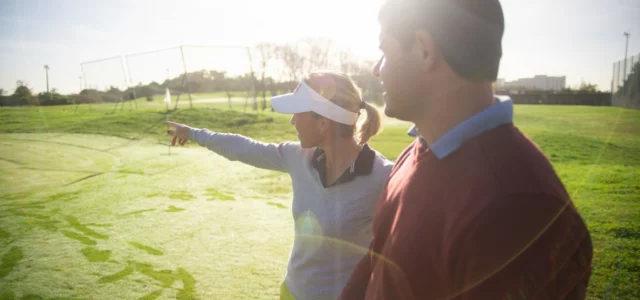
With a pro. If you take a winter lesson package with a PGA of Canada professional, ask for ten minutes on the routine. A coach watching from behind can tell you in a few balls whether your look at the target or your walk-in changes when you are trying hard, which you will never see yourself.
A three-week indoor plan
Week one: notice and write. Hit 10 balls as you normally would and pay attention to what you already do. Keep what helps, cut the rest, and write the four beats on a card in a few words each.
Week two: time it. Ask a friend in the next bay to time 15 shots, changing club and target every ball. Aim to land within a few seconds of your average on every one.
Week three: add a little pressure. Play a simulator nine or a points game in the dome: a drive, an approach and a pitch, a point for every target hit, and a small bet with a friend if that helps. A shot that matters even slightly is harder to treat the same way, which is the whole point of the exercise.
When the round starts to slip
The routine earns its keep on the shot after a bad one, which is exactly when it tends to vanish. Three patterns to watch in spring.
Rushing. After a double bogey, many golfers hurry the next tee shot to be done with it. If you find yourself over the ball before you have picked a target, step out and go back to “Choose”.
Freezing. Out of bounds or a carry over water invites a longer stare at the ball. Keep the same number of looks at the target. More seconds add tension, not accuracy.
Skipping the decision. Most shots you feel unsure about are decisions that were never made. If you are still debating the club with your feet set, the routine broke at the first beat. Back behind the ball and start over. The same applies on the first tee, where our article on first-tee nerves takes it further, and around the greens, where the lag putting routine is shorter but follows the same order.
One more thing. Do not copy a tour player you saw on TV. The 2010 study by Stewart Cotterill, Ross Sanders and Dave Collins, which interviewed six male international golfers, put the lesson in its title: “Why don’t we ask the golfer?” A routine built around your needs, a breath if you rush, a second look if you tend to aim right, lasts longer than one borrowed from someone else.
The card for your bag
- Choose: club, small target, shot shape. Think only here.
- Feel: one rehearsal swing that matches this shot.
- Aim: same side, clubface first, same number of looks.
- Go: trigger, eyes on the back of the ball, swing.
- Same length every time, well under the 40 seconds of Rule 5.6b.
- Anything interrupts you: step out and restart from “Choose”.
- Indoors: full routine on one ball in three; in the simulator, on every shot.
- Ten dry routines a night in the basement until the courses reopen.