Winter golf in Canada: simulators, domes and where to book
Five months without a course is the most reliable period to improve a handicap, because indoors only one variable works at a time.
In brief
- Mats forgive fat shots: plan the first spring sessions on grass.
- Almost no indoor facility covers the short game; a putting mat closes the gap.
- A swing change in January costs nothing because no score is at risk.
- Bays are billed by the bay, not the person: four people share the hour.
- One hour a week from November to March is twenty deliberate sessions.
Five months without a course is the Canadian golfer’s central problem, and it is now the easiest one to solve. Simulator venues and domes have multiplied in every major city, and an hour a week through the winter is the difference between starting spring where you left off and starting from scratch.
What winter practice actually does
On a course you play eighteen different shots and learn from none. In a simulator you hit sixty balls with the same club and see the numbers every time: club speed, launch, spin, dispersion. It is the only environment in which a swing change becomes measurable.
Domes add what simulators cannot: real ball flight over distance, which is how you keep your feel for a 7-iron rather than your memory of one.
Simulator, dome or indoor range
- Simulators are best for technical work and for playing virtual rounds socially. Book by the hour, usually with food and drink attached, which is why they fill on Friday nights and are empty on Tuesday mornings.
- Domes are heated inflatable structures over a range, offering full ball flight in winter. They are the closest thing to real practice and they exist in most large Canadian cities.
- Indoor ranges and academies attached to golf facilities offer lessons through the winter, which is when a swing change has time to bed in before it matters.
How to build the hour
Set the simulator to real targets: a flag at 150 yards, then one at 175 yards, rather than hitting into open space.
Ten minutes warming up with a wedge. Twenty minutes on one technical point, not three. Twenty minutes hitting to targets with varied clubs. Ten minutes playing a simulated hole where every shot counts.
What does not work: an hour of driver to watch the number on the screen. You will hit a good driver in April and everything else worse than in October.
What a simulator does not cover
Two things are missing from every indoor bay, and a golfer who does not cover them elsewhere comes back in May with half a game.
The first is the lie. A mat forgives a fat shot because the club skids, and that is precisely the miss that costs twenty yards on grass. The strike quality a simulator reports is therefore routinely better than the real thing. Plan the first two sessions of the spring on grass and expect an honest number.
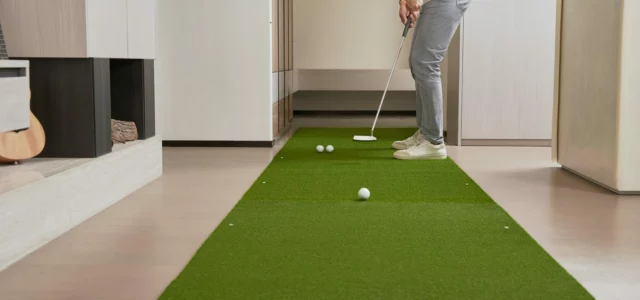
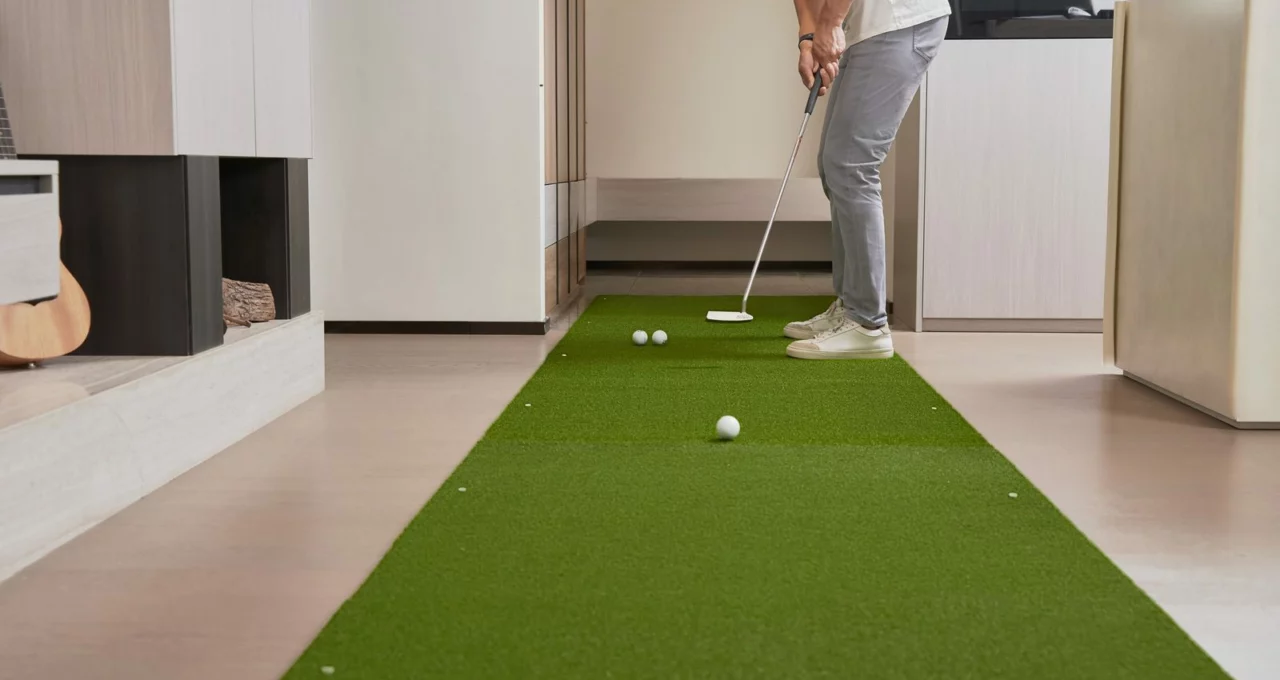
The second is the short game. Of a hundred shots in an amateur round, roughly fifty-five are played inside fifty yards or on the green, and almost no indoor facility has a usable chipping and putting area. A putting mat at home and ten minutes three evenings a week closes that gap for very little money.
What the body contributes over the winter
The cheapest improvement available in a Canadian winter involves no club at all. Golf asks for rotation through the upper back and mobility in the hips, and a winter spent sitting removes both. Two short sessions a week return more swing arc in May than any technical lesson can produce.
This is not a training programme and it is not medical advice: anyone with pain should have it looked at before starting. But the most common cause of a shortened backswing in spring is a winter without movement, not a fault in the swing.
The winter is when you should take lessons
A swing change takes weeks to become automatic and gets worse before it gets better. Making that change in July, mid-season, costs you the season. Making it in January costs you nothing, because there is no score to protect.
Book a block of lessons for the winter and use the simulator between them to do the homework.
What to book, and when
Simulator bays in the cities book out from December through February, particularly evenings and weekends. The available hours are weekday mornings and early afternoons, which are also usually cheaper.
Most venues sell packages, and they generally become cheaper than hourly rates from around ten sessions, which is one a week for a Canadian winter. Compare against your realistic frequency, not your intended one.
What an indoor season costs
Simulator time in Canada is usually billed by the bay rather than by the person, and that is the biggest lever on the price: four people share the same hour for a quarter each, which turns an expensive practice session into an affordable evening.
The second lever is the time of day. Friday and Saturday evenings are the dearest and hardest to book, because that is when the social bookings go. Weekday mornings and early afternoons are consistently cheaper and nearly always free, and for focused technical work they are the better slot anyway.
The third is the membership. Ten-session cards and winter memberships pay off from about ten visits, which is roughly one session every two weeks between November and March. If you are unsure you will keep it up, buy single hours at two different facilities first and decide afterwards.
The transition in April
The move from the bay to the course is where a good winter gets lost. Three things help: the first two sessions on grass rather than mats, the first round over nine holes and without a card, and the expectation that your simulator distance chart loses close to a full club in cold air on soft ground.
Do those three and you arrive in May with what the winter was for: the same motion, more confidence, and numbers you can believe.
The alternative: go south
Florida, Arizona and Mexico absorb a large share of Canadian winter golf, and a week there in February is a legitimate substitute for two months of indoor practice. The mistake is to plan a round every day: two rounds, two practice mornings and a rest day return more than seven consecutive rounds.
Block practice builds, random practice keeps
Twenty repetitions make a change comfortable, and that is exactly why it disappears on the first tee: a course never gives the same shot twice. Spend two thirds of the hour on repetition and the last third changing club and target on every ball. It feels worse and it transfers better.
One session a week is enough
Sixty minutes a week from November to March is roughly twenty sessions, which is more deliberate practice than most golfers manage in a whole summer. The point is the consistency rather than the volume, and two hours once a month achieves considerably less.
Keep a notebook
Write three lines after every session: the point you worked on, the number that moved, and what comes next. Without it, the twelfth session of the winter is the same as the first.
One more use for the winter
Read your own scorecards. Ten minutes with last season’s numbers, sorted into fairways, greens, putts, up-and-downs and penalties, tells you what to work on more accurately than any feeling you have about your game.
Where to look
- Search for simulator venues and domes in your city, and try one hour before committing to a package.
- Ask your local course whether its teaching professional runs winter lessons indoors; many do, and their winter rates are lower.
- Post scores from any simulated rounds only if the venue is set up for it; otherwise keep your Handicap Factor for the real season.
Panxis Golf has no commercial relationship with any venue and earns nothing from your bookings.