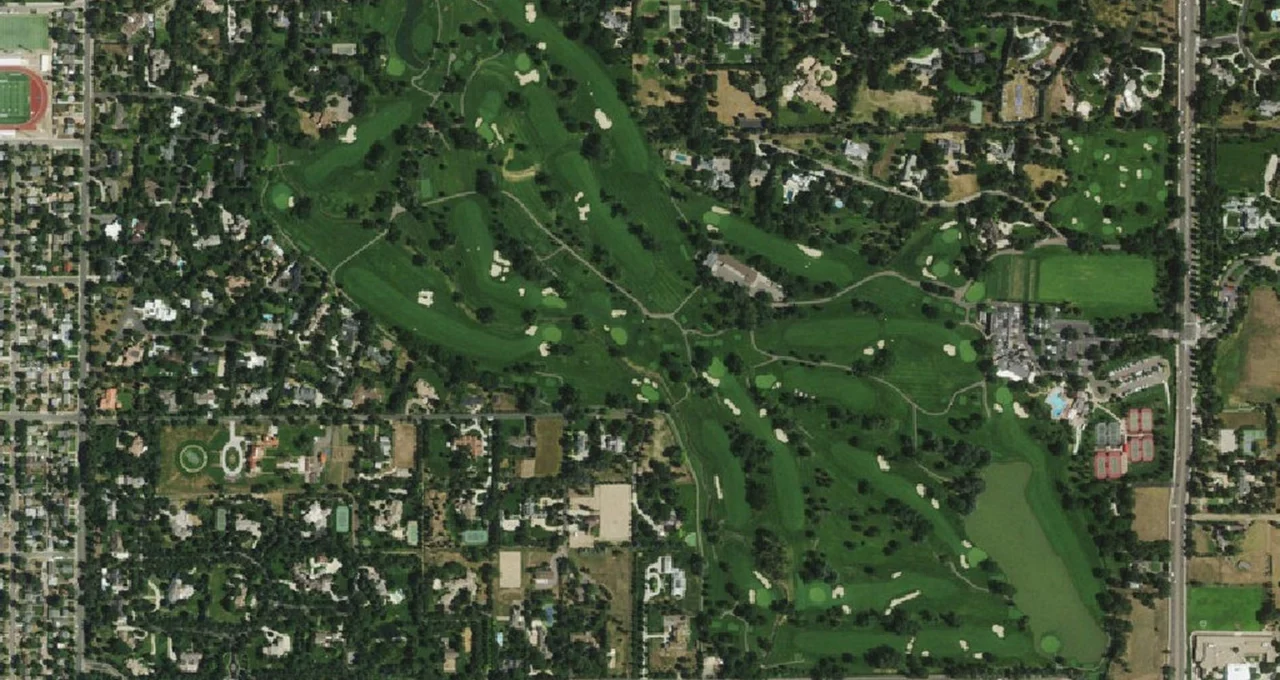
Cherry Hills Country Club from the air. Aerial imagery USGS, domaine public.
Cherry Hills Country Club
Holes
18, plus a nine-hole par-3 course
By
72 for members (73 on the women's card, according to Wikipedia); played as a par 71 for the 2023 U.S. Amateur, with the 18th as a par 4
Length
7,316 yards from the Red tees in course directories (rating 75.5, slope 145 in one, 74.7 and 139 in another); Wikipedia gives 7,379 yards (75.8/145); set at 7,394 yards for the 2023 U.S. Amateur
Green fee
—
Best season
—
Cherry Hills Country Club is a private club in Cherry Hills Village, Colorado, a suburb on the south side of Denver. Its entrance is on South University Boulevard, and the club gives its address as 4125 S. University Blvd. It was founded in 1922, and its championship course was designed by William S. Flynn, the Philadelphia architect best known for his work in the East. The club says it sits on 272 acres, and Wikipedia puts the elevation at about 5,300 feet, which matters for anyone trying to judge how far a ball will fly.
Few American clubs have a championship record to match it. Cherry Hills has staged three U.S. Opens (1938, 1960 and 1978), two PGA Championships (1941 and 1985), the 1993 U.S. Senior Open, the 2005 U.S. Women’s Open, three U.S. Amateurs (1990, 2012 and 2023), the PGA Tour’s BMW Championship in 2014 and several other national events. It is where Arnold Palmer won his only U.S. Open, coming from seven strokes behind on the last day of the 1960 championship with a round of 65. Golf Digest placed the course 63rd in its 2025 list of America’s 100 Greatest Golf Courses, according to a Colorado golf publication.
The championship course is an 18-hole par 72 for members. Course directories give its longest set of tees, the Red, at 7,316 yards, while Wikipedia gives 7,379 yards; the ratings and slopes differ too, as explained below. The club also has a nine-hole par-3 course, the Rip Arnold Course, named for its head professional from 1939 to 1962, which Wikipedia lists at 665 yards for a par of 27. Tennis courts and a pool complete the facilities. Because Cherry Hills is private, this page is a portrait of a course that most readers will only ever see on television or as a member’s guest.
A golf club for Denver, founded in 1922
According to the club’s own history, Cherry Hills was founded in 1922 by prominent members of Denver Country Club who wanted a club devoted to golf. It was first called The Cherry Hills Club, after a cherry orchard on the grounds. The members hired William Flynn, whom the club describes as one of the premier course architects of his time. A 2022 press release from the club, issued for its centennial, notes that 2023 marked the hundredth anniversary of the first round played on the course, which is consistent with the 1923 opening date given by the USGA and by Tom Doak’s firm.
Flynn did very little work in the West. GOLF.com describes Cherry Hills as one of the few designs he did west of the Mississippi River, and Renaissance Golf Design, the firm that restored it, calls it his only design west of the Mississippi. We could not settle that point, so we report both formulations. What is not in doubt is the influence of Pine Valley, the New Jersey course on which Flynn worked: The Fried Egg, a golf architecture site, compares the 7th to Pine Valley’s 12th and the 14th to its 13th, and the club’s press release says the interrupted fairways on several holes were inspired by Flynn’s work there.
The routing is unusual. In the USGA’s description, the front nine weaves a figure eight across the inside of the property while the back nine runs counterclockwise around its perimeter; the club calls this the “Muirfield Plan,” after the Scottish links whose two nines also turn in opposite directions. The course starts on the high ground around the clubhouse, with views of the Front Range of the Rocky Mountains, and works its way down the hillside to the banks of Little Dry Creek, which runs through the property and shapes many of the holes.
Three U.S. Opens and a famous drive
The first big championship came early. The 1938 U.S. Open was, in the club’s words and those of LINKS Magazine, the first held west of Minneapolis. Ralph Guldahl, the defending champion, won it by six strokes. The same week produced a record that still stands, according to the club: Ray Ainsley, a professional from California, took 19 strokes on the 16th hole in the second round, the highest score on a single hole in U.S. Open history. Three years later the PGA Championship, then played at match play, came to Denver for the first time; Vic Ghezzi beat Byron Nelson in the final.
The 1960 U.S. Open is the event that made Cherry Hills famous. Palmer began the final round seven strokes behind the leader. The club tells the story of his exchange with the writer Bob Drum before the round: Palmer asked what a 65 would do for his chances, and Drum told him it would do nothing, because he was too far back. Palmer then drove the green of the 1st, a par 4 of 346 yards at the time, birdied the first four holes and six of the first seven, shot 65 and finished at 280, four under par. It was his only U.S. Open title. Two strokes behind him was Jack Nicklaus, a 20-year-old amateur from Ohio State, whose second place was, according to the club, the best finish by an amateur since 1933. Ben Hogan, aged 47 and chasing a fifth Open, was in contention until the par-5 17th, where his third shot spun back off the front of the island green into the water; he then made a triple bogey at the 18th and finished four strokes behind.
The 1st hole has a story of its own. Wikipedia says Palmer had failed to drive the green in his three earlier attempts that week, including a double bogey in the first round, before he finally reached it on Sunday. A Colorado golf publication writes instead that he drove it in every round. A new tee was later built to lengthen the hole; Wikipedia says the USGA added it before the 1978 Open, while the same Colorado publication dates the change to a 1976 remodel. For the 2023 U.S. Amateur, the USGA used what it calls the Palmer tee on the 1st only in match play.
The Open returned in 1978. By then, according to The Fried Egg, Palmer’s own design firm had remodeled the course, including the bunkers. Andy North won at 285, one over par, by one stroke, and the club notes that no player broke 68 all week. Until 2006, according to Wikipedia, it was the most recent U.S. Open won with a score over par. In 1985 the PGA Championship came back after a 44-year gap, and Hubert Green won at 278, two strokes ahead of the defending champion, Lee Trevino.
From Mickelson to Dunlap
Cherry Hills has been a regular host of the USGA’s other championships. The USGA’s list includes the 1976 U.S. Senior Amateur (Lewis Oehmig), the 1983 U.S. Mid-Amateur (Jay Sigel, who won the U.S. Amateur the same year), the 1990 U.S. Amateur (Phil Mickelson), the 1993 U.S. Senior Open (Jack Nicklaus), the 2005 U.S. Women’s Open (Birdie Kim) and the 2012 U.S. Amateur (Steven Fox). Nicklaus’s victory in 1993 came on the course where he had finished second as an amateur 33 years earlier; the club says it was his eighth and last USGA title. Kim won the 2005 Women’s Open by holing a bunker shot on the 72nd hole for a total of 287, three over par.
The club also hosted the 1950 Women’s Western Open, won by Babe Zaharias, and a Denver Open in 1947. In 2014 the BMW Championship, a PGA Tour playoff event, brought the world’s leading professionals back to Cherry Hills for the first time since 1985. Billy Horschel won at 14 under par, and Morgan Hoffman set the course record with a 62 in the third round, according to the club.
The most recent national championship was the 123rd U.S. Amateur, in August 2023, with Colorado Golf Club in nearby Parker as the stroke-play co-host. Nick Dunlap beat Neal Shipley 4 and 3 in the 36-hole final, becoming, as the club notes, only the second player after Tiger Woods to win both the U.S. Junior Amateur and the U.S. Amateur. The USGA counted it as the club’s tenth USGA championship. The club itself speaks of 14 national championships before 2023, a count that includes the PGA Championships, the BMW Championship and other events not run by the USGA. On its home page the club also says it is the only course in the United States other than Augusta National where both Palmer and Nicklaus won a major; that claim counts the 1993 U.S. Senior Open, a senior major.
A decade of restoration
Like many classic courses, Cherry Hills drifted away from its original design over the years. The Fried Egg describes hundreds of trees planted over the decades and Flynn’s rugged bunkers and mounding softened into something closer to a standard parkland look, partly through the 1970s remodel. According to The Fried Egg, the 17th also lost a massive cross hazard, inspired by Pine Valley’s “Hell’s Half Acre,” before 1960.
In 2007 the club commissioned Tom Doak and his firm, Renaissance Golf Design, to restore Flynn’s design and to lengthen the course; Renaissance associate Eric Iverson directed much of the work over the following decade. Some sources date Doak’s arrival to 2008, and Wikipedia says the first major phase opened in spring 2009. According to the club’s 2022 press release and trade press reports, the work included a major tree management program, strategic bunker work on holes 1, 2, 4, 5, 7, 9, 14 and 16, the full restoration of the greens on the 3rd and 13th, a return of other greens to their original shapes based on Flynn’s plans, and new tees on holes 5, 9, 10, 11, 13, 14 and 16. LINKS Magazine adds that almost half the greens were expanded and some fairways and greens returned to their original locations. Cross bunkers were reintroduced on the 17th; a 2014 post by the golf writer Geoff Shackelford noted that trees and mounds around the island green had been removed before the BMW Championship, leaving it looking like an island again.
The final phase, completed in spring 2022, dealt with Little Dry Creek. According to LINKS Magazine, thousands of boulders placed in the mid-1980s to control erosion were removed, and the creek, which averages about 12 feet wide, was moved closer to the greens and fairways following Flynn’s hole drawings. The club says it now runs near the 14th green, beside the 7th green, tight along the 8th, closer to the 15th green and down the 16th fairway. The project was also designed to reduce the risk of flooding. The club also renovated and expanded its clubhouse for the centennial.
What it asks of the player
For most golfers the first thing to reckon with is the altitude. At around 5,300 feet the ball flies farther than at sea level, and reviewers on a course-ranking site describe the opening holes as playing short and the distances as hard to judge. The ground itself is mostly gentle. The Fried Egg describes rolling land with the main climbs near the clubhouse, and names the 2nd, 3rd, 4th, 8th, 12th, 13th and 17th as holes on very flat ground, where the defense comes from rough or water rather than from the terrain.
The par of 72 for members includes a pair of par 5s to finish. For championships the 18th becomes a long par 4 and the course plays to a par of 71, as it did at the 2023 U.S. Amateur. The USGA set the course up at 7,394 yards for that event, with green speeds in the 11 to 12 range on the Stimpmeter and rough of at least four inches; its rating for that setup was 76.3, with a slope of 149. The hole-by-hole card the USGA published for the championship gives a good idea of the shape of the round:
- 1st: par 4, 395 yards.
- 2nd: par 4, 415 yards.
- 3rd: par 4, 323 yards.
- 4th: par 4, 436 yards.
- 5th: par 5, 554 yards.
- 6th: par 3, 165 yards.
- 7th: par 4, 417 yards.
- 8th: par 3, 222 yards.
- 9th: par 4, 488 yards.
- 10th: par 4, 449 yards.
- 11th: par 5, 633 yards.
- 12th: par 3, 201 yards.
- 13th: par 4, 429 yards.
- 14th: par 4, 522 yards.
- 15th: par 3, 245 yards.
- 16th: par 4, 466 yards.
- 17th: par 5, 547 yards.
- 18th: par 4, 487 yards (a par 5 for members).
That gives a front nine of 3,415 yards and a back nine of 3,979 yards. The two nines are different in character: the front, inside the property, has the short par 4s, including the 3rd, a hole of little more than 300 yards with a cross bunker and a domed green that The Fried Egg compares to those of Pinehurst No. 2. The back nine, around the perimeter, is longer and is where championships are decided. The club’s centennial release says the 14th, 16th and 17th appear in GOLF Magazine’s list of the 500 World’s Greatest Golf Holes, and Iverson has said that the creek now makes the approaches to the 14th and 16th, both par 4s, among the most demanding in the country. A reviewer on a ranking site recalls that Ben Hogan is said to have named the 14th one of the finest holes in America; we could not trace that remark to a primary source.
The 17th is the hole most people know. It is a par 5 whose green sits on an island, which the club describes as the first island green on a par 5 built in the United States. Its length varies with the source and the tees: 547 yards on the USGA’s 2023 card, 555 yards for Shackelford and LINKS Magazine, 544 yards in a Denver newspaper. Shackelford wrote in 2014 that a drive of about 345 yards was needed to carry the first set of reintroduced cross bunkers. The hole has decided championships: Hogan’s ball spun into the water here in 1960, and the club recalls that Mickelson hit into the water at the 17th in the 1990 U.S. Amateur final and said afterward he would do it again, because he does not lay up.
For a club golfer, the shorter tees bring the course within reach. Course directories list eleven sets of tees, from 4,034 to 7,316 yards. From the Blue member tees, at 6,694 yards, they give a rating of 72.3 and a slope of 142, and from the White tees, at 6,278 yards, 70.2 and 136 for men (Wikipedia gives 139). Those slopes say the course is well above average in difficulty for a mid-handicapper. A reviewer on a course-ranking site singles out the 5th, a par 5 he lists as the hardest hole on the stroke index, for its elevated green fronted by a swale and hard to hold.
What players say
Cherry Hills is private, so the usual sources of public opinion are thin. Booking platforms and golf apps, which supply most reviews of public courses, carry little or nothing for a club that sells no tee times to the public. The opinions summarized here come from the reviews posted by players on Top100GolfCourses.com, a course-ranking site (nine reviews when we read them in October 2026, with individual scores from 3 to 5 out of 5), from The Fried Egg’s architectural review, and from the descriptions published with national rankings. Most of these reviewers played as guests or as panelists for ranking publications. They are other people’s opinions, not ours; nobody from Panxis has played the course, and we name no one.
What comes up in its favor
- The history is the first thing reviewers mention, from the 1938 Open to Palmer’s 1960 win, and several describe an invitation to play here as a coveted one.
- Flynn’s routing is praised for its variety of holes and its use of the natural undulations, and reviewers credit Doak and Iverson’s restoration with staying close to the original design. One reviewer ranks it among Flynn’s three best courses.
- The closing stretch draws admiration: The Fried Egg says par is a good score on each of the last five holes, and several reviewers find the back nine much more demanding than the front.
- Reviewers describe the course as fun, fair and very playable for a championship venue, with many risk and reward decisions.
- Conditions are praised, and the views of the Rockies, especially from the 10th tee, are often mentioned.
- The Fried Egg singles out the eighteen Flynn hole drawings displayed in the clubhouse.
What comes up against
- The site itself: The Fried Egg finds the land lackluster, and argues that the championship history is more interesting than the course.
- Several holes on flat ground rely on wide expanses of irrigated rough or on water, which The Fried Egg finds monotonous, and it judges that the creek sits too far from the line of play on some holes to add much strategy.
- Trees and surrounding houses still block some of the mountain views, and the course has more trees than Flynn intended, despite the restoration.
- The fast greens reduce the interest of the hole locations, in The Fried Egg’s view.
- One experienced reviewer, who says he has played it about a dozen times, calls the course better than average but oversold, and another finds parts of the layout “a bit pedestrian.”
Who can play
Cherry Hills is a private club. Play is generally limited to members and their guests, and the club publishes no public tee-time booking. Its website includes guest rules, which members are asked to pass on to their guests before they arrive. They set out a detailed dress code for the championship course, the par-3 course and the practice areas: for men, tucked-in golf shirts, golf slacks or shorts of a set length, and no denim, cargo shorts or T-shirts; for women, golf slacks, culottes or shorts of a set length, with leggings and halter tops not allowed. Players may not change clothes or shoes in the parking lot, and temporary lockers are available. Phones must be silent and can be used for calls only in designated areas, and the rules forbid publishing photos or videos taken on the club’s grounds.
The club does not publish a season. Like other Front Range courses, it is exposed to winter weather, so play depends on conditions and on the club’s decisions. A course directory says walking is permitted; the club does not publish its policy on carts or caddies.
Getting there
The club is at 4125 S. University Blvd., in Cherry Hills Village, a residential suburb in Arapahoe County. In a straight line, it lies about 5 miles south of Denver Country Club, about 7 miles south of downtown Denver, about 17 miles northwest of Colorado Golf Club in Parker, its co-host for the 2023 U.S. Amateur, and about 21 miles southwest of Denver International Airport. These distances are measured on the map, not by road. Access to the grounds is for members and their guests; there is nothing to visit for the public outside championship weeks.
Green fees
As a private club, Cherry Hills publishes no green fees and no membership rates, and we do not report any. Guests should ask their host.
How this page was made
The factual frame comes from public sources: OpenStreetMap for the location; the club’s website, chcc.com, for its history, its account of each championship, its address and its guest rules; the club’s centennial press release of October 2022 for the restoration, the routing and the championship count; the USGA’s fact sheet for the 2023 U.S. Amateur for the hole-by-hole card, the championship rating and slope, the 272 acres, the 1923 opening and the list of USGA championships; Wikipedia and Wikidata for the elevation, the par-3 course, the tournament results and the identifiers; Renaissance Golf Design for the restoration; Golfdom, LINKS Magazine, the Colorado Golf Association’s magazine and the Colorado Golf Journal for details of the work and the rankings; GOLF.com for its ranking; Geoff Shackelford’s site for the 17th; and the Stymie and GolfPass directories and OpenGolfAPI for the tee ratings.
Where sources disagree, we say so. The founding year is 1922 for the club and Wikipedia; the USGA, Renaissance and Stymie give 1923 as the opening year, which matches the club’s own reference to the centennial of its first round in 2023, while GolfPass gives 1932 and Renaissance’s data box 1918. The longest tees measure 7,316 yards in directories and 7,379 in Wikipedia, with a rating of 75.5 or 75.8 and a slope of 145 for the Red tees; GolfPass gives 74.7 and 139 for the same 7,316 yards, and Wikidata also records a slope of 139. Wikipedia mentions, without a source, a championship length of 7,466 yards at par 71, and its text says the restoration took the course past 7,500 yards; the USGA used 7,394 yards in 2023, after announcing 7,405. The club’s home page calls the 1938 Open the first west of the Mississippi, while its history page and LINKS Magazine say west of Minneapolis; we follow the latter. Wikipedia records Ghezzi’s 1941 win as 1 up, the club says on the 38th hole. Accounts of Palmer’s drives on the 1st in 1960 and of the date of the new tee differ, as explained above. Golf Digest’s 2025 position is 63rd in one Colorado publication and 68th in another; we follow the first, which quotes the list directly. We could not open Golf Digest’s own course page.
Some details will age: the rankings, the review count read in October 2026, the tee ratings, which are revised periodically, and the guest rules. The opinion section reports recurring themes rather than individual voices. Nobody from Panxis has played or visited this course, and this page is no substitute for a round.
The club has not paid for this page, has not seen it before publication and has no say over its content. This page contains no commercial link and earns us no commission. If you know the club and something here is wrong or out of date, write to us and we will correct it. The club’s own history page tells the championship stories in more detail.
Other courses nearby
Closest to this one in our United States directory:
- Kansas City Country Club — 554 mi
- Indian Hills Country Club — 554 mi
- Mission Hills Country Club — 555 mi
- Desert Forest Golf Club — 556 mi
The hole to know
A par 5 of 547 yards at the 2023 U.S. Amateur (555 or 544 in other sources) ending at an island green, described by the club as the first island green on a par 5 built in the United States. Ben Hogan's third shot spun back into the water here in the final round of the 1960 U.S. Open.