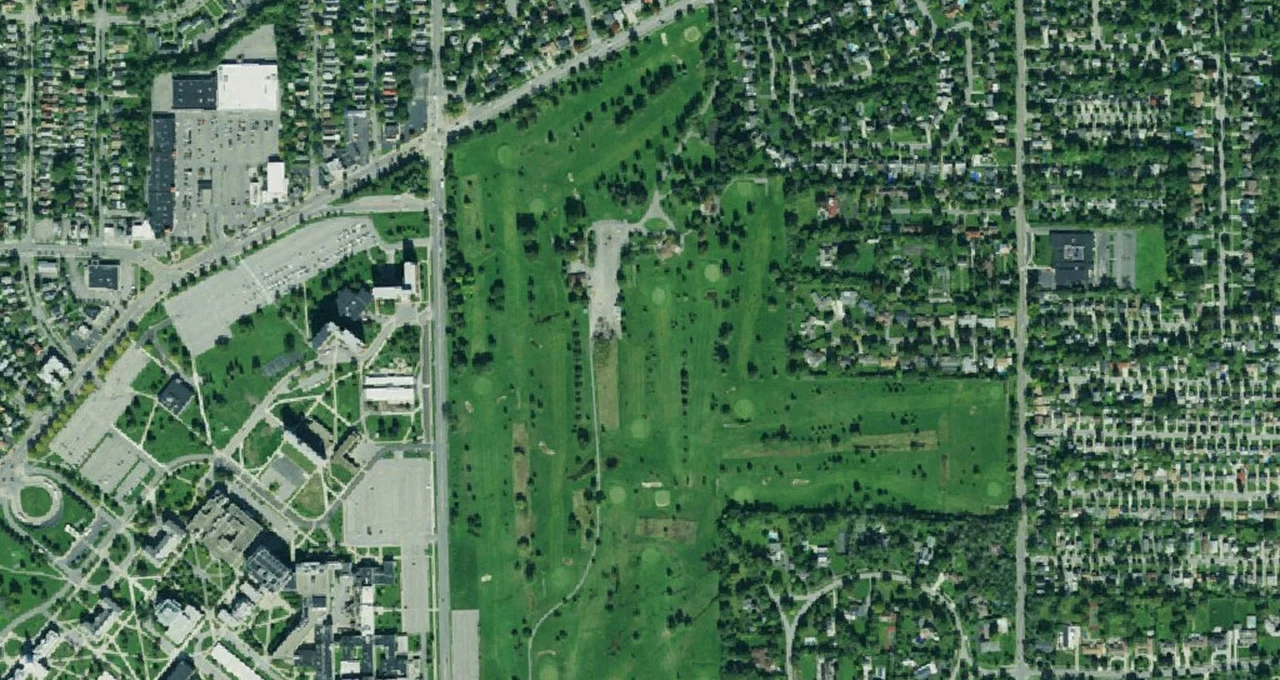
Grover Cleveland Golf Course from the air. Aerial imagery USGS, domaine public.
Grover Cleveland Golf Course
Holes
18
By
—
Length
—
Green fee
—
Best season
Roughly April to November
This was the Country Club of Buffalo, and in 1912 it staged the U.S. Open: the twenty-year-old John McDermott successfully defended his title, two strokes clear of Tom McNamara. Walter J. Travis had contributed to the design in the run-up to that championship, and Donald Ross redesigned the course in 1917 and 1918. It is the only public golf facility in North America laid out by both.
In 1925 the Country Club of Buffalo sold the property to the City of Buffalo, which turned it into a public course and named it for Grover Cleveland, mayor of Buffalo, governor of New York and twice president of the United States. Erie County took over the running of it in the 1970s.
What it asks of you
Considerably less than it did in 1912. The course was shortened when Main Street took land and later development took more, and it now plays as a par 69 at around 5,600 yards. Nobody should come here expecting the examination that decided a U.S. Open.
What is here instead is the bones: Travis and Ross green sites, a routing laid out before earth-moving equipment existed, and the knowledge that a national championship was decided on this ground. Walking it is a lesson in how much American golf history sits underneath courses nobody visits. The greens still ask the questions the length no longer does.
What players say about it
This is a county course with a modest but real review record. The notes below summarize recurring themes across specialist golf sites, traveler review pages and player discussion threads. They are other people’s opinions, not ours: we have not played the course. We report what comes back repeatedly rather than isolated remarks, and we do not name or quote individual reviewers.
What comes up in its favor
- Conditioning is well rated, and a recent drainage project is credited with a clear improvement to both greens and fairways.
- The history is the reason most visitors give for coming, and reviewers who know what Travis and Ross did here treat the round as a pilgrimage at municipal prices.
- The course is short and walkable, which suits older players and beginners, and several accounts recommend it on exactly that basis.
- Value is consistently praised for a county course kept in this condition.
What comes up against
- The back nine draws the most criticism. Overlapping holes make the routing confusing to a first-time visitor, and more than one account says so.
- Cart fees are called high relative to the green fee, which is a recurring complaint at this course specifically.
- Better players find it too short to be interesting, and the par 69 at under 5,700 yards is not a serious test from any tee.
- Reviews are genuinely mixed rather than uniformly good, and expectations set by the U.S. Open history are part of why.
Getting there and when to go
The course is on Main Street in Amherst, on the north-eastern edge of Buffalo, twenty minutes from downtown and around half an hour from Buffalo Niagara airport. Niagara Falls is forty minutes north, which makes this an easy stop on a trip that is not primarily about golf.
The season runs from roughly April to November, and western New York weather decides the edges of it. Late spring and early autumn are the best of it. Booking goes through the county system.
Green fees
Rates and tee times are handled by the county at municipal levels, with cart fees charged separately. See the course’s own site.
How this page was made
The factual frame comes from public sources: OpenStreetMap for the location, Wikipedia and published architecture and local history coverage for the championship, the architects and the sale to the city, and the county’s own site for access and booking. The opinion section summarizes public reviews and player discussions read in September 2026; we report recurring themes rather than individual voices, and we do not reproduce or attribute quotes.
We have not played this course, and nothing here is a substitute for that. The course has not paid for this page, has not seen it before publication and has no say in what it says. If you know the course and something here is wrong or out of date, write to us and we will correct it.