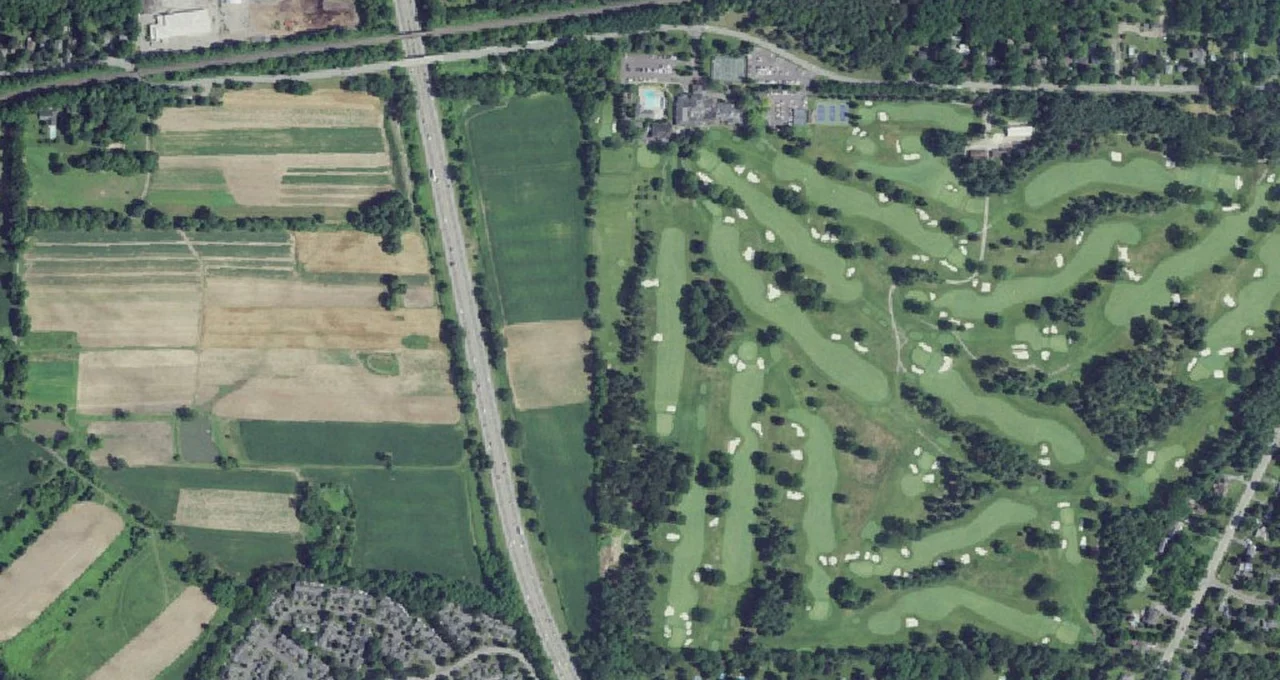
Monroe Golf Club from the air. Aerial imagery USGS, domaine public.
Monroe Golf Club
Holes
18
By
70 in championship play (35 out, 35 in) on the Monroe Invitational card; the club marks the 3rd and 14th as par 4 or 5, which gives 72 for members. The 2014 LPGA Championship was played as a par 72
Length
6,980 yards from the Black tees, adding up the hole yardages on the club's website; the Monroe Invitational card adds up to 6,971. Stymie (March 2026) lists 6,946 yards (rating 73.9, slope 142), Wikipedia 6,915 (73.5, slope 130, 2013 data) and Foretee 6,787 (72.3, slope 122)
Green fee
—
Best season
—
Monroe Golf Club is a private 18-hole club at 155 Golf Avenue in Pittsford, New York, a suburb southeast of Rochester. Its course was designed by Donald Ross and opened for play on July 4, 1924. The hole yardages on the club’s website add up to 6,980 yards from the Black tees, played as a par 70 in championship play, with two holes that the club’s card marks as a par 4 or 5 for members.
The club is best known outside Rochester for the Monroe Invitational, a men’s amateur tournament played here since 1937, and for one week in August 2014, when it hosted the Wegmans LPGA Championship, a major won by Inbee Park in a playoff. The course is not open to the public. This page describes it from published sources: nobody from Panxis has played it.
History: a farm, a lost lease and a Ross commission
According to the club’s history page, Monroe began in 1920 with members of the Genundewah Golf Club of East Rochester, who had to find a new site when their lease could not be renewed. A committee narrowed the search to four properties: one in Penfield, the Harris farm in East Rochester and two in Pittsford, including the Stoutenberg, Brizee and Palmateer farms, 214 acres in all. The club says that an outside consultant, Gordon Kellogg, who had chaired Oak Hill’s relocation task force, took one look at the Stoutenberg land and said, “Here’s something that Donald Ross would rave about.” A committee member who knew Ross then brought him in to survey it.
On October 20, 1922, the founders voted at the Rochester Club to reorganize as Monroe Golf Club and buy the farms. The club then says that Ross was told in December 1923 that he had the job of designing and building the course, with 150 of the 214 acres to choose from.
Play began on July 4, 1924, with little ceremony: the club describes two foursomes teeing off in front of members. The dates do not quite line up. The club speaks of its “inception in 1923” while dating the reorganization to 1922, and an article on the tournament’s website says Ross designed and supervised the construction in 1923, which is hard to square with a commission in December of that year. We report the dates as the club gives them and have not seen the original documents.
Tom Doak, in a passage of his Confidential Guide reproduced by Top 100 Golf Courses, says Monroe was built at the same time as the two Oak Hill courses nearby and calls it “the best piece of ground for golf in Rochester.” Foretee says the course was cut from an apple orchard, and two local and trade articles mention sandy soil that drains well.
Silva, Hanse and the trees
Top 100 Golf Courses reports that thousands of trees were planted over the years, including several thousand pines under a New York State program in the 1950s. It says Brian Silva was hired in the late 1980s to upgrade and recontour the fairways. The club adds that Silva redesigned the 11th green in 1994.
The largest recent project was led by Gil Hanse. The Rochester District Golf Association dates it to 2007 and 2008, while the club’s hole notes and Top 100 Golf Courses speak of 2008. According to a 2012 article in Club + Resort Business, the club worked from original blueprints for all 18 greens and Ross’s drawings, because tree planting and mowing had shrunk the greens. Crews dug back to native soil and rebuilt bunkers to their original design. The article counts 110 bunkers on 150 acres. The club’s notes show that this was not only a return to the past: several bunkers were added in 2008, including pot bunkers on the 1st and 2nd, and others were moved or deepened.
The work has continued. A public review dated July 2026 says that Hanse was followed more recently by Tyler Rae, that greens were restored to Ross’s specifications and that pines were taken out because they blocked air flow and their exposed roots damaged mowers. A Top 100 Golf Courses travel guide from June 2026 describes a multi-year restoration still under way, and a review dated October 2026 mentions recent tree removal. The club’s own website does not name Rae or describe this phase, so we cannot say what was done or when.
The club also has a four-hole par 3 course by Hanse for its members. The club dates its design to 2008; Club + Resort Business says it opened in 2003.
Championships
The Monroe Invitational was first played in 1937, and the 2026 edition was the 85th. It began as a match play event and became a 72-hole stroke play tournament in 1998. Past winners include Fred Ridley in 1976, Jeff Sluman in 1981, Dustin Johnson in 2007, Thomas Pieters in 2012 and Andy Ogletree in 2019.
Its best-known story is a loss. In the 1993 semi-finals, the 17-year-old Tiger Woods lost 3 and 2 to Tom Creavy, who went on to win the title. Wikipedia and the club both call it Woods’s only match play defeat in a five-year period. The club’s note on the 3rd describes a low cut four-iron he hit around the maples in that match, 210 yards to 8 feet from the hole. Its note on the 2nd places another Woods episode in the 1995 tournament while calling him 17 and beaten by Creavy, which points to a misprint for 1993.
The most recent edition was played from July 22 to 25, 2026. Rudy Sautron of France won by seven shots at 19 under par, according to the tournament’s website, and WHEC reports that this broke the record of 14 under, set a year earlier by Oscar Couilleau. The win gave him an exemption into the PGA Tour’s Butterfield Bermuda Championship.
In 2014 the Wegmans LPGA Championship moved here from Locust Hill Country Club for one year, from August 14 to 17. The course played as a par 72 of 6,717 yards, with the 3rd and 14th as par 5s and the 18th at 422 yards, according to the tournament card on Wikipedia. Inbee Park and Brittany Lincicome tied at 277, 11 under par, and Park won on the first playoff hole, the 18th, when Lincicome missed a par putt.
The card
The club’s website lists five yardages for each hole, without naming the columns, and we added them up: 6,980, 6,556, 6,012, 5,397 and 4,377 yards. The first column is the Black tees, as the note on the 9th confirms. The last column includes a 13th hole of 66 yards; it may be a family tee, but the page does not say. The club’s link to a 2026 scorecard file returned a web page and not a card when we tried it, so we could not read tee names or ratings from the club itself.
From the Black tees, with the men’s stroke index in parentheses, the front nine reads: 1st, par 4, 423 yards (5); 2nd, par 4, 385 (9); 3rd, par 4 or 5, 460 (17); 4th, par 4, 441 (7); 5th, par 4, 487 (1); 6th, par 3, 205 (11); 7th, par 4, 386 (3); 8th, par 3, 149 (15); 9th, par 5, 600 (13). That is 3,536 yards. The back nine reads: 10th, par 4, 426 (8); 11th, par 4, 419 (10); 12th, par 5, 538 (14); 13th, par 3, 192 (16); 14th, par 4 or 5, 483 (18); 15th, par 4, 363 (2); 16th, par 3, 190 (12); 17th, par 4, 407 (6); 18th, par 4, 426 (4). That is 3,444 yards.
Par is 70 when the 3rd and 14th are par 4s, as in the Monroe Invitational, whose site calls them converted members’ par 5s. Counted as par 5s, they bring the total to 72, the par that Foretee lists. The shape is unusual: at par 70 there are four par 3s, two par 5s and twelve par 4s, nine of those at 400 yards or more. The men’s index puts the 5th first, then the 15th, a 363-yard hole, and the 7th, a 386-yard hole, so length alone does not set the order. The women’s index has the 5th, the 12th and the 1st as the three hardest.
Other sources give other numbers. The Monroe Invitational’s card adds up to 6,971 yards, with the 2nd at 381 and the 9th at 595, although the same page’s text puts the 9th at 601. Stymie, updated in March 2026, shows Black at 6,946 yards (rating 73.9, slope 142), Blue at 6,538 (71.9, slope 135), Green at 5,987 (men 69.4, slope 128; women 75.5, slope 137) and White at 5,389 (men 66.1, slope 119; women 71.8, slope 130), plus two hybrid sets. Wikipedia, citing the club and the USGA in 2013, and the Rochester District Golf Association in 2018 give 6,915 yards; Wikipedia adds a rating of 73.5 and a slope of 130. Foretee gives 6,787 yards at par 72 (72.3, slope 122). These probably reflect different years and tee sets, but no source explains them. We use the club’s yardages and treat Stymie’s ratings as the latest listing we found, without being able to check them against the USGA’s database.
The club’s hole notes have not kept up with its own numbers. They call the 18th the longest par 4 and the 5th the second longest, while the listed yardages make the 5th the longest, then the 14th and the 3rd, with the 18th at 426. The Rochester District Golf Association article gives the 18th as both 428 and 434.
What it asks of the golfer
The accounts agree on one thing above all: the examination comes on and around the greens. Golf Channel described them in 2014 as smallish, crowned and undulating. Morgan Pressel called it “a second shot course” that was “about keeping it below the hole.” AmateurGolf.com’s 2014 review says they generally slope from back to front and are among the fastest in the Northeast. Foretee also calls them small, while a reviewer on Top 100 Golf Courses speaks of “huge Ross green complexes,” so the sources differ on size.
The club’s hole notes show how the targets shrink. The 7th green is terraced from side to side, leaving a target only 20 feet wide when the hole is on the right, with bunkers the club says sit 12 feet below the surface. The 10th green narrows from 45 feet at the front to 24 just past the center. The 12th is only 10 paces wide. The 18th is a two-tier green over 100 feet long with a diagonal swale, and the club quotes Ross on approaches that make possible “an infinite variety of nasty short shots.”
Second comes the ground. A local golf blogger who walked the course during the 2014 practice days wrote about blind tee shots, hard-to-judge rises and falls, and steep shaved approaches that return short shots 15 to 25 yards. A reviewer in July 2026 wrote that the fairways “heave like Lake Superior on an angry day.” On the 5th, the club says the fairway dips sharply toward pines on the right, leaving most players a sidehill lie, while a long hitter who gets the bounce down the right may have only a wedge left.
Third come the bunkers, placed along natural ridges according to the club, and the rough, which the club repeatedly calls thick; Paula Creamer spoke of “nasty rough” around the greens in 2014. Off the tee, opinions differ: tour players in 2014 found the fairways generous compared with Locust Hill, while the local blogger called them typically narrow. There are no water hazards, as AmateurGolf.com and Foretee both note.
The club refers to a prevailing northwesterly wind that lengthens the 7th, holds up the uphill drive on the 9th and usually faces the player on the 16th and 18th. The par 3s are not a respite: three of the four measure 190 yards or more from the back, and the club says shots landing short of the 13th and 16th roll well back down the approach. The 13th is, according to the club, the hole Monroe Invitational players have found hardest. The 8th, at 149 yards, is the smallest target, with five bunkers around it.
One hole: the 14th
The club says the 14th is often considered Monroe’s signature hole, and a public reviewer in October 2026 listed it among the best on the course along with the 5th and 11th. It measures 483 yards from the Black tees, then 466, 436, 407 and 307 on the club’s other columns. The card marks it as a par 4 or 5. The men’s stroke index of 18 makes it the easiest hole on the card, and the 3rd, the other par 4 or 5, is 17th. Our reading is that both are indexed as members’ par 5s, but the club does not say so. In the 2014 LPGA event it played as a 488-yard par 5; the Rochester District Golf Association gave it as a 493-yard par 4 in 2018.
Trees define the hole. The club describes its oldest and tallest oak on the right and a large black oak on the left, with more oaks overhanging the green from both sides. The 2014 blog puts the left fairway bunker about 220 yards from the tee and the right one about 260, with a large tree on the right about 100 yards short of the green. Those distances were the blogger’s estimates from a set of tees used that week, so they are only a guide.
The approach is the difficult part. The club calls for an extremely accurate second shot and says a steep rise in front of the green and a severe slope from left to right make pitching and putting a real test. The blog describes a small, roughly rectangular green with a false front. The club also says the hole was converted from a members’ par 5, so what a golfer faces here depends on which game is being played: a demanding par 4 in the Invitational, a shorter third shot for a member playing it as a par 5.
What golfers say
Public reviews are few, as is usual for a private club. We read the seven reviews on Top 100 Golf Courses, dated from May 2018 to October 2026, AmateurGolf.com’s 2014 review, press reports of player comments from 2014 and the local blog from the same week. We read GolfClubAtlas forum threads only as search excerpts. Top 100 Golf Courses shows a mean of 4.5 out of 5 from seven ratings, although the ratings displayed run from 4 to 5.5 and appear to average higher, which we cannot explain.
On the plus side. The greens and their surrounds are praised first. Pressel called the green complexes spectacular, Stacy Lewis, then ranked first in the world, put Monroe behind only Pinehurst No. 2 among the courses she had played on tour that year, and Karrie Webb called it “one of the best golf courses I’ve played in a long time.” Reviewers praise the routing and the use of the land, and two compare it favorably or evenly with the better-known Oak Hill East, one calling it a more faithful Ross design. Holes singled out include the 5th, 7th, 11th and 14th. A 2018 reviewer calls it enjoyable for all abilities. Silva and Hanse both rank it among the very best Ross courses, but they worked here and are not disinterested witnesses.
On the minus side. Clear complaints are rare in what we could read, which may partly reflect who gets to play here. The October 2026 reviewer, otherwise full of praise, says the recent tree removal has opened things up “perhaps even a little too much in spots.” Trees have long been disputed: in the forum excerpts, one poster reports extensive removal with fine results, another says there are too many trees, and a 2005 post describes older members resisting the restoration. The same excerpts include a poster who does not rate Monroe above Oak Hill. On Top 100 Golf Courses, tee shot strategy has the lowest detailed rating, 4 out of 5, on only two reviews. Difficulty is the other caution: Lewis said it would be hard, the blog warned of illusions that need studying, and the October 2026 reviewer describes a challenge that rewards familiarity, which is of limited use to a guest playing once. The July 2026 reviewer finds the fairway bunkering overwhelming at times.
Who can play
Monroe is private. The club says its golf and social memberships require sponsorship by current members, and it directs membership questions to its staff. privateIQ lists membership as invitation only and describes the club as member-owned. Foretee says guests may play only when accompanied by a member. Stymie lists the course as public with daily-fee play, which contradicts the club and every other source we read, so ignore it. We do not publish prices.
The club has a page for guests. It explains the bag drop off Golf Avenue, asks that shoes be changed in the locker room, sets a pace-of-play goal of 4 hours or less for 18 holes and describes the expected attire.
privateIQ lists motor carts, pull carts and caddie service. The 2012 trade article says members had taken to walking more, that the club had removed long stretches of cart path and that its fleet of wheeled caddies had grown past 250. Stymie says walking is permitted. We found no policy on this from the club and no published golf season.
For skilled amateurs there is another way in. The Monroe Invitational’s website describes applications for non-exempt players and a Monday qualifier, with four places for the 2026 edition; check the conditions on that site. The tournament may also be the way for others to see the course: its website mentions families and patrons spectating at the 2026 final, though we found nothing on admission.
Getting there
The address is 155 Golf Avenue, Pittsford, NY 14534, which is also the address recorded on the OpenStreetMap outline used for the map on this page. The club gives these directions. From the east, take Interstate 490 west to the Pittsford exit, turn right onto Route 31 west, turn right on Marsh Road at the first light and then left onto Golf Avenue; the club is on the left. From the west, take 490 east to the Fairport/East Rochester exit and head toward East Rochester, turn right onto Washington Avenue at the first light and then left onto Golf Avenue; the club is on the right. The main number is (585) 586-3440 and the golf shop is (585) 586-3608. Stymie shows the older 716 area code for the shop.
How this page was made
This page is based on the club’s own website, read on November 6, 2026: its home, history, golf, guest, membership, amenities and contact pages. We also used the Monroe Invitational’s website (course page with card and hole notes, a club history article on Ross, the 2026 result and qualifier pages); Wikipedia’s articles on the club, the tournament and the 2014 LPGA Championship; Wikidata (item Q6902202); WHEC’s report on the 2026 final; two Golf Channel reports from August 2014; AmateurGolf.com’s 2014 course review; the Rochester District Golf Association’s 2018 article; the 2012 Club + Resort Business article; the Top 100 Golf Courses listing, reviews and June 2026 guide; a three-part preview on the Mostly Harmless blog from August 2014; and the listings of Stymie, Foretee and privateIQ. OpenStreetMap (way 134231347, tagged with the club’s name, address and website) gives the map position and confirms the place.
Some sources could not be read in full. GolfClubAtlas, the Rochester Business Journal and GolfPass refused our automated requests, so we used search excerpts of the first and third and nothing from the second. GolfLink was seen only in a search excerpt, and the New York State Golf Association’s directory returned an error. The club’s 2026 scorecard link did not return a card. We did not read the USGA’s course rating database. Hole19’s page under a similar name belongs to a club in Michigan, and a Golf Digest listing seen in search results under the name Monroe Country Club, with a different address, seems to mix up clubs; we used neither.
Where sources disagree, we say so above: on the total yardage (6,980, 6,971, 6,946, 6,915 or 6,787 yards) and the slope (142, 130 or 122); on individual holes; on the par (70 or 72); on the founding dates and the timing of Ross’s commission; on the year of the Woods episode on the 2nd; on the date of the Hanse restoration and of the short course; on the size of the greens and the width of the fairways; and on the club’s status, which Stymie alone gets wrong. Rankings age quickly: Top 100 Golf Courses placed Monroe 20th in New York when we read it, and the club cites No. 80 on Golfweek’s 2013 classic list (Wikipedia gives No. 96 in 2011) and No. 24 on a 2012 Golf Digest list of the most fun private courses.
Several details will age, in particular the card, as restoration work seems to be continuing. Nobody from Panxis has played or visited this course, and this page is no substitute for a round.
Monroe Golf Club has not paid for this page, has not seen it before publication and has no say over its content. This page contains no commercial link and earns us no commission. If you know the club and something here is wrong or out of date, write to us and we will correct it.
Other courses nearby
Closest to this one in our United States directory:
- Locust Hill Country Club — 4 mi
- Grover Cleveland Golf Course — 67 mi
- Dinsmore Golf Course — 201 mi
- Longue Vue Club — 218 mi
The hole to know
Often considered the club's signature hole: 483 yards from the Black tees, marked as a par 4 or 5 on the card, with large oaks on both sides of the fairway, more oaks overhanging the green, a steep rise in front of it and a severe slope from left to right.