Kids and golf in Australia: MyGolf, holiday camps, the right clubs and SunSmart habits
Spring school holidays are when many Australian children try golf. Whether they keep playing comes down to a handful of decisions: a group program such as MyGolf, clubs that fit, short outings that succeed, sun protection, and a parent who cheers contact instead of analysing shots.
In brief
- MyGolf, run by Golf Australia and the PGA of Australia, is the national junior program.
- Moore Park Golf charged A$216 to A$360 for a nine-week junior term in Term 3 2026; Oakleigh charges A$30 a group lesson.
- Never cut down an adult club; junior packages started at A$149.95 at an Australian golf retailer in September 2026.
- Follow Cancer Council's five SunSmart steps whenever the UV Index is 3 or above.
- Putting and chipping first, three holes on a short course later, no score kept.
The September school holidays are when a lot of Australian kids first pick up a golf club. Moore Park Golf in Sydney, for example, advertised school holiday camps for September and October 2026, from one-hour Joeys sessions for three- to six-year-olds at A$45 to parent-and-child lessons at A$75 a pair. Spring weather, longer afternoons and a term break line up nicely. Whether the first try becomes a hobby depends less on talent than on a few choices parents make in the first months: which program, which clubs, how much golf and how much sun.
Start with a program, not with Dad’s old 7-iron
Australia has a national framework for this. MyGolf, the national junior participation program, is run jointly by Golf Australia and the PGA of Australia and delivered through clubs and MyGolf centres around the country. Blackwood Golf Club in the Adelaide Hills describes it as a way for children aged 7 to 16 to learn through clinics and holiday sessions covering technique and etiquette, with time on the course.
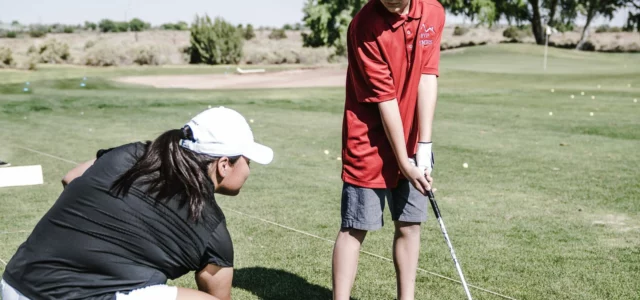
Group programs beat private lessons at the start for a reason that has nothing to do with swing technique: children stay in sports where they have friends. A good junior class has games, noise, targets and small wins every few minutes. Formal technical coaching can come later.
What group programs cost varies widely, so compare. At Moore Park Golf, a nine-week term in Term 3 2026 cost A$216 for Joeys (ages 3 to 6, 30-minute sessions, six children maximum), A$306 for 7- to 9-year-olds and A$360 for ages 10 to 12 and 13-plus, with one-hour sessions. At Oakleigh Golf Course in Melbourne’s south-east, group clinics for ages 5 to 10 and 11 to 16 run on Tuesday afternoons in eight-week terms at A$30 a lesson, with nine-hole events built into each term.
Clubs that fit, or no clubs at all
Cutting down an adult club is the most common mistake. A shortened adult 7-iron still has an adult head and a stiff adult shaft, and it is far too heavy for a child. The child copes by heaving it with the arms, and that movement can outlast the club by years.
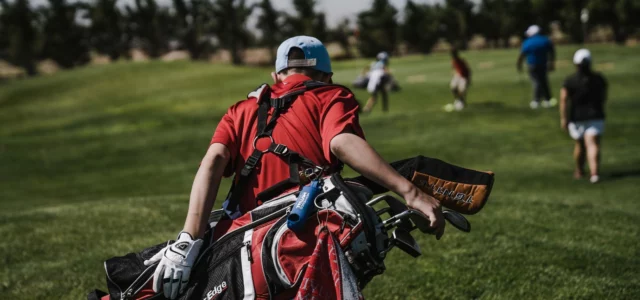
Junior sets are sized by height and built light. A beginner needs only a few clubs, and it is worth asking whether your program lends equipment for the first term. When you do buy, the Australian market covers every budget. In September 2026, an Australian golf retailer listed a Cougar Junior three-piece starter package at A$149.95, Cougar packages for ages 5 to 8 and 9 to 12 at A$269.95 and A$319.95, and Callaway’s 2026 XJ junior packages from A$499 for five pieces to A$799 for eight.
Children grow out of sets quickly, so a good used set sized for your child’s height is usually the smarter first purchase. Measure your child standing in their golf shoes, and buy for their height now, not for next year.
Short game first, full swings later
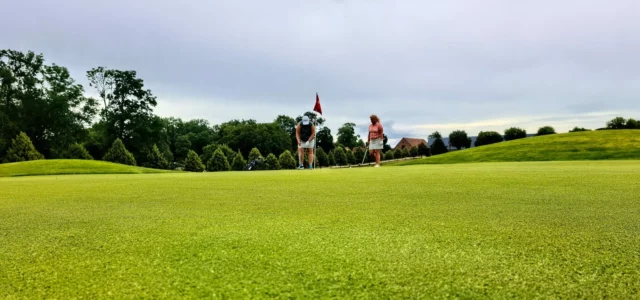
A full swing rarely succeeds early on. A putt that drops does, and a young child who holes three putts has had a great afternoon.
Start on the practice green. Then add chipping to targets: a hoop, a towel, a bucket. Only then move to a driving range, with half swings and a small number of balls.
The course comes after that, and it should be a short one. A par-3 or nine-hole course, or three or four holes of a quiet public course in the late afternoon, is plenty. Let the child tee off from wherever the hole feels achievable, even if that is 100 metres from the green. Skip the scorecard for the first few rounds. Let them rake a bunker, hold the flag and mark a ball: to a child, those jobs are part of being a golfer.
Sun safety is part of junior golf in Australia
A round of golf means hours outside, often in the middle of the day. Cancer Council Australia recommends sun protection whenever the UV Index is 3 or above, and its five SunSmart steps map neatly onto a golf bag:
- Slip on covering clothing, such as a collared shirt with sleeves.
- Slop on SPF50 or SPF50+ broad-spectrum, water-resistant sunscreen, 20 minutes before going out, and reapply every two hours or after heavy sweating.
- Slap on a broad-brimmed hat; Cancer Council suggests a brim of at least 7.5 cm. A cap leaves ears and neck exposed.
- Seek shade, especially in peak UV hours, usually 10am to 4pm.
- Slide on sunglasses.
Check the UV forecast on the free SunSmart app or the Bureau of Meteorology website before you go. In summer, book early morning or late afternoon sessions, and put a full water bottle in the junior bag. A hot, thirsty child will not enjoy golf, however good the coaching.
Where to find junior golf in Australia
MyGolf. Search for a MyGolf program near you through Golf Australia. Clubs such as Blackwood link directly to the program search from their junior pages.
Public and council facilities. City ranges and municipal courses often run junior terms and holiday camps, as at Moore Park Golf in Sydney and Oakleigh Golf Course in Melbourne. They are usually relaxed about beginners and have short-game areas.
Your club. Many clubs have junior memberships at modest prices. Blackwood, for example, lists annual junior membership at A$150 for 15 and under and A$250 for 16- to 18-year-olds, plus a A$50 application fee, and accepts sports vouchers towards the cost. Check whether your state has a sports voucher scheme for children, as it can cut the cost of a program or membership.
For girls. The Australian Golf Foundation runs a Junior Girls Scholarship program. Golf Australia has said it would support at least 200 girls across 40 MyGolf centres, and Blackwood notes the scholarship helps girls attain a handicap to take part in club events.
Junior green fees are generally low. At Oakleigh, a junior nine-hole round on weekends and public holidays is listed at A$22.25 for 2026/27. Panxis Golf has no commercial relationship with any club, program or retailer mentioned here.
What parents should and should not say
The fastest way to end a child’s golf is to coach every shot from the side of the tee.
Leave technique to the coach. Your job is snacks, water, sunscreen and enthusiasm for good contact, not for results. A ball struck cleanly that goes 30 metres sideways is a success. Avoid two habits in particular: commenting on bad shots, and asking “what did you get?” Both turn play into a test.
Keep outings short. Three holes can be a complete round for a six-year-old. Stop while they still want to keep going, and they will ask to come back.
When a child wants to compete
Some kids get hooked on competition early. Australian clubs have ways in that do not require a low handicap: Blackwood, for instance, fields junior teams in MyGolf Junior League events and in a Division 3 pennant team. Team formats are a friendly first step, because a bad hole matters less when teammates share the result.
A handicap comes next, through a club membership. Keep it proportionate. The goal is a teenager who still loves the game, not a ranked twelve-year-old who quits at fifteen.
A first term, week by week
- Week 1: book a MyGolf or club junior class; putting games only at home.
- Week 2: chipping to targets, thirty minutes, with a borrowed or correctly sized club.
- Week 3: half swings at the range, a small bucket, sunscreen and hat on.
- Week 4: three holes on a short course late in the afternoon, no score kept.
- Weeks 5 to 9: keep attending the class; add one short family outing a fortnight.
At the end of the term, ask one question: do they want to do another? If the answer is yes, everything worked.
How this page was put together
Junior package prices were recorded in September 2026 at Drummond Golf (Australia). Panxis has no commercial link with this retailer.