Getting children into golf in the UK: Rookies, junior hubs and clubs sized by height
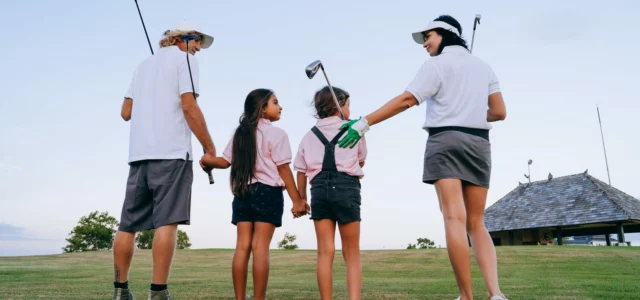
British juniors mostly quit for avoidable reasons: sawn-off adult clubs, a full round too soon and a parent commentating on every swing. Start with a six-week Rookies or Girls Golf Rocks course, buy a set that matches their height, and let team golf come before a medal card.
In brief
- Get into Golf Rookies and Girls Golf Rocks run six one-hour sessions for ages 5 to 18, the last one on the course.
- Junior Hub clubs, an England Golf and Golf Foundation award, are set up to welcome children.
- Buy junior clubs by height band; a shortened adult club stays too heavy and too stiff.
- The GolfSixes League plays six-hole scrambles in 75 to 90 minutes, with a pick-up at ten shots.
- Let the coach coach: skip comments on bad shots and never ask for the score.
Most British children who give up golf do so within a few months, and rarely because they lack talent. They quit because the clubs were Dad’s old irons with a hacksaw taken to them, because the first outing was eighteen holes on a busy Saturday, or because an adult narrated every swing. None of that is hard to avoid, and the structures that help are already in place at clubs across the country.
There is one test worth applying after each outing: does the child ask when they can go back? A good first year is built around getting a yes to that question, not around a swing that looks tidy.
Six one-hour sessions built for beginners
England Golf’s own advice through its Get into Golf platform is that children can start from around the age of five, in sessions matched to their age and stage. The two national starter programmes are Get into Golf Rookies, for children and young people aged 5 to 18, and Girls Golf Rocks, for beginner girls in the same age range.
Both follow the same shape: six sessions of an hour each, hosted at a club or facility, with basics taught through games and the final hour played out on the course. Children get a participant booklet to set small goals, and clubs are encouraged to leave time for socialising at the start or the end. That last detail matters more than it looks. A child who has made a friend in week two is far more likely to be there in week six.
Parents tend to worry about kit before the first session. Get into Golf is plain that many junior sessions lend clubs and balls, and that comfortable clothes and trainers are usually all a beginner needs. Ring the club first and ask.
Picking a club that actually wants juniors
Not every golf club is equally pleased to see a nine-year-old on the practice putting green. Two things tell you quickly which ones are.
The first is the Junior Hub award, created jointly by England Golf and the Golf Foundation to identify clubs that are the right place for young people to try, learn and love golf. To apply, a club has to be affiliated to England Golf, have its SafeGolf and Respect in Golf requirements in date, and show evidence of what it offers juniors at each stage. The Golf Foundation runs an online locator for hubs near you.
The second is SafeGolf, the partnership of UK golf bodies behind safeguarding in the sport. Every affiliated club listed on Get into Golf holds SafeGolf accreditation, and a club that runs junior coaching should be able to tell you who its welfare officer is without looking it up.
In Wales, Wales Golf keeps a juniors section on its site, and in Scotland the national body is Scottish Golf. Whichever nation you live in, the club’s PGA coach is often the person behind the junior programme, and The PGA’s PGA Play directory lists around 8,000 PGA Professionals searchable by location.
Clubs measured with a tape, not a birthday
Cutting down an adult club is the most common mistake in junior golf, and the most damaging. Shortening the shaft does nothing to the head, which stays far too heavy, or to the shaft, which stays far too stiff for a child’s speed. The only way a small body can move that club is by heaving it with the arms, and the compensations it learns tend to outlast the club by years.
Proper junior sets are built around height. At a large UK golf chain in mid-September, the Benross Junior Aero range was sold in three bands: 43 to 49 inches tall (roughly five to seven years old) and 50 to 54 inches (eight to ten) at £159 each, and 55 to 61 inches (eleven to thirteen) at £169, each a five-piece set with a stand bag. Cheaper options existed too, such as a four-piece Fazer CTRX set for ages six to eight at £109 against a list price of £139.
Measure your child in socks, buy the band they are in now rather than the one they will grow into, and expect to change up every year or two. Five clubs are plenty for any child under twelve. Because every family faces the same annual swap, second-hand junior sets are easy to find and sell on without losing much.
Start where the ball drops into the hole
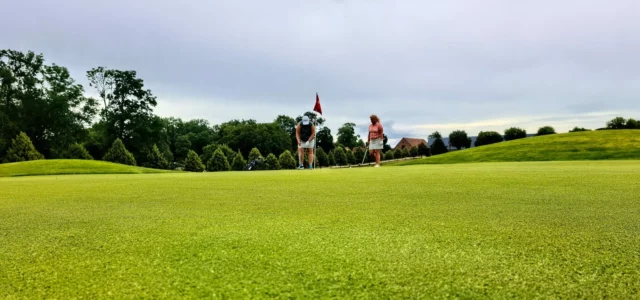
A full swing rarely rewards a beginner. A putt does. Holing one from across the practice green gives a seven-year-old the whole point of golf in about four seconds, which is why the first sessions of any good programme spend so much time close to the hole.
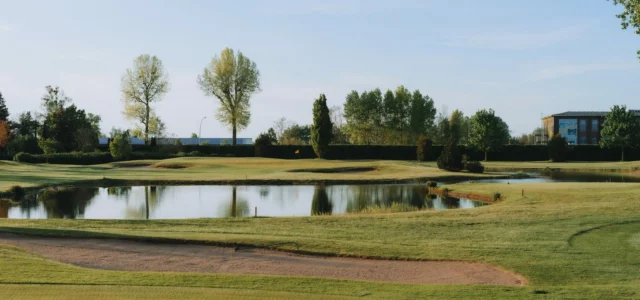
From there, move out gradually: short chip shots onto the green, then half swings on the range, then a handful of short holes. A par-3 or short course is the natural first course for a child. A full-length parkland layout on a Saturday morning, with a four-ball behind you, is not.
On the course, let them tee the ball up well forward of any marker if that keeps it moving. Hand them the flagstick, let them smooth a bunker. These jobs make a child feel like a golfer long before the scores do.
Team golf before a medal card
Counting every shot is a fine way to tell a beginner that they are bad at something. The Golf Foundation’s GolfSixes League is built to avoid that. Squads of twelve juniors, six per fixture with mixed teams encouraged, play a Texas Scramble over six shortened holes in about 75 to 90 minutes. Scoring runs on a simple one-to-ten system, and a player who reaches ten shots picks up and moves on.
The league is aimed at players without a handicap or with a handicap of 37 and above, and clubs are grouped into local leagues of four to six so that families are not driving across the county on a Sunday. Leagues were listed across English regions from Cheshire and Lancashire to Yorkshire and the South West, plus north, mid and south Wales, when this page was updated.
Schools can get a taste too: the Golf Foundation supplies School Games formats, including an eight-game skills festival for primary pupils and a GolfSixes mini league for both primary and secondary schools.
The adult’s job, which is mostly silence
The quickest way to lose a junior is a parent who coaches from the side of the tee. A running commentary after each shot turns an afternoon of play into an assessment, and children notice at once.
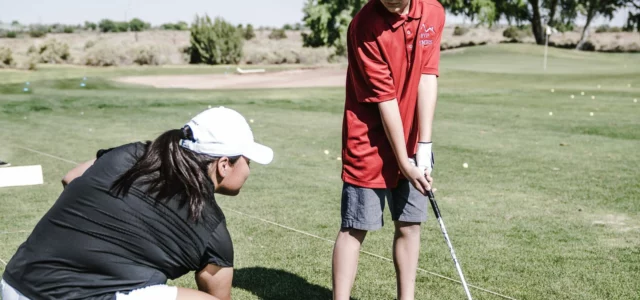
Leave the coaching to the coach. On the course, carry the water, keep things moving, and react to solid contact rather than to where the ball finished. Two habits are worth dropping entirely: remarking on a poor shot, and asking what they scored. If they want to know their score, they will ask you.
What a first year costs
Get into Golf describes junior sessions as typically priced to be accessible for families, with costs varying by area. In practice, the first year can be done cheaply if you avoid expensive equipment too early.
- A starter programme where clubs are lent: often the only outlay for the first six weeks.
- A height-fitted junior set: about £109 to £169 new from a national golf retailer in September, less second-hand.
- Junior green fees: ask for the concession rate. Hoebridge Golf Centre in Surrey, for example, offers junior rates but does not publish them online and asks you to ring the pro shop.
- A waterproof suit, for a British autumn: a UK golf chain listed a junior waterproof set at £89.
Private lessons, travel and junior county squads are the costs that escalate. None of them belongs in the first two years.
Where to start in Britain
The quickest route is the search on getintogolf.co.uk, which lists junior and family sessions at affiliated clubs and venues in England. The Golf Foundation junior hub locator finds clubs that hold the Junior Hub award.
Driving-range centres are often the easiest first step. Hoebridge, near Woking, runs junior group lessons, individual lessons and school-holiday camps with PGA professionals for anyone under 18, and its Trackman range includes game modes designed with children in mind.
For clubs and clothing, larger golf retailers sell junior package sets by age and height, and local marketplaces carry plenty of outgrown sets.
Panxis Golf has no commercial relationship with any programme, retailer or association mentioned here.
When the competitive itch arrives
Some children are content to play for fun indefinitely; others start asking about competitions. Get into Golf describes both as legitimate paths. For the second group, the next step is joining a club as a junior member, submitting scores for a Handicap Index, and entering junior club competitions before anything at county level.
Keep perspective. The aim at ten is a game they will still want at forty. A teenager who still enjoys golf at eighteen has done better than one who was top of a junior order of merit at thirteen and never touched a club again at fifteen.
A first term, week by week
- Weeks 1 and 2: putting green games, thirty minutes, no full swings.
- Weeks 3 and 4: add chipping, and book a six-week Rookies or Girls Golf Rocks course.
- Week 5: range session with half swings, twenty balls at most.
- Week 6: three short holes on a quiet weekday evening, with no card in anyone’s pocket.
Pick the quietest slot you can find for those first holes, and stop while they still want another. A visitor’s tee time late on a weekday, with nobody pushing behind, is worth more than any lesson.
How this page was put together
Junior club and clothing prices were taken from American Golf in September 2026. Panxis has no commercial link with this retailer.