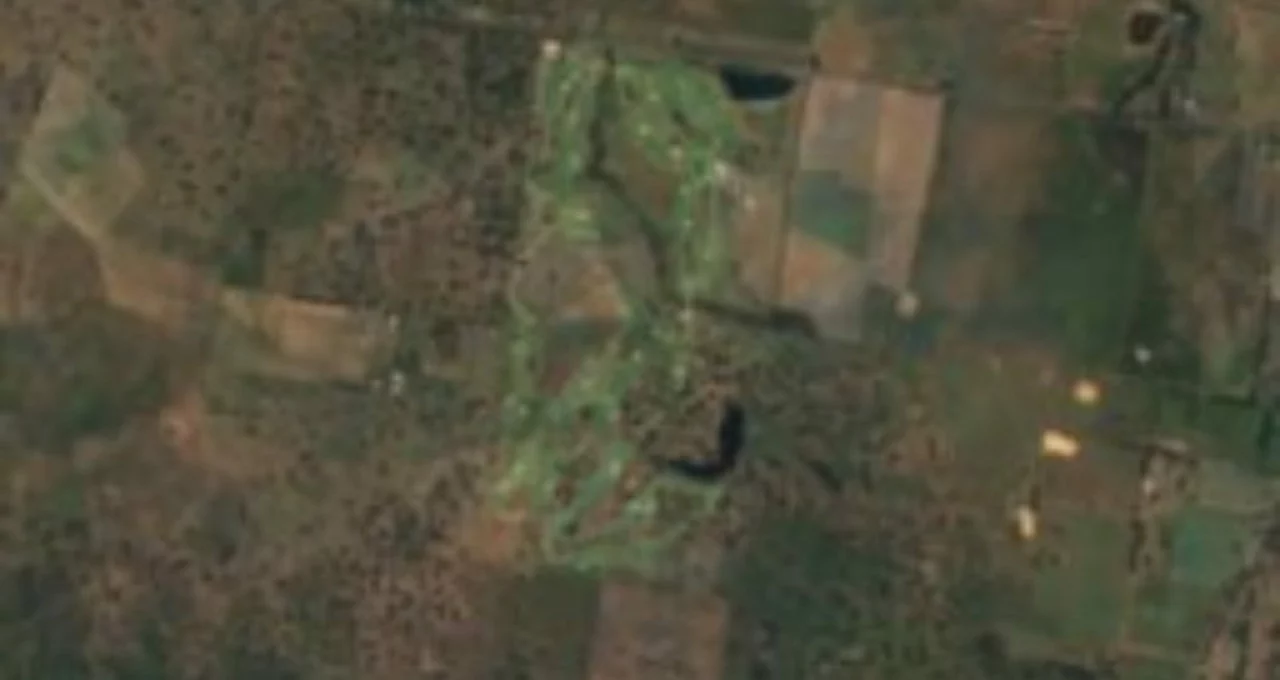
Growling Frog Golf Course from space. Sentinel-2 cloudless 2016 by EOX IT Services GmbH (contains modified Copernicus Sentinel data 2016), CC BY 4.0.
Growling Frog Golf Course
Holes
18 (course website, official scorecard, City of Whittlesea, Golf Australia)
By
72, 36 out and 36 in, four par 3s and four par 5s (official scorecard)
Length
6,185 metres Blue (slope 136), 5,565 Yellow (slope 129), 5,328 Red (slope 130) (official scorecard); course rating 73 for the Blue on 18Birdies and Drills.golf, not on the card; Hole19 labels the Blue card in yards, 18Birdies gives 6,764 yards
Green fee
—
Best season
All year, season passes with year-round access (course website); players off the course by 7.15pm for recycled watering (course website); one reviewer calls it unplayable in winter (Top100golfcourses, 2021)
Growling Frog Golf Course is a public 18-hole course at 1910 Donnybrook Road, Yan Yean, in the City of Whittlesea on the northern fringe of Melbourne. It was designed by the Australian tour player turned architect Graham Marsh and opened in September 2004, according to Golf Australia magazine; the club’s own scorecard carries the line “Est. 2004”. The course belongs to the City of Whittlesea and has been run since 2019 by Golf Services Management, known as GSM Golf, whose lease now runs until at least 30 June 2029. The official scorecard gives a par of 72 and three sets of tees, from 6,185 metres on the Blue to 5,328 metres on the Red.
This page sets out what the public record says about the course: which place it is, how it came to be built, what it asks of a golfer, what published reviews and golfer ratings report, and how a visitor gets a game. It draws on the course website and its scorecard, the City of Whittlesea, Golf Australia magazine, Planet Golf, Golf Industry Central, Top100golfcourses, 18Birdies, Hole19 and OpenStreetMap, all read in November 2026.
Which course is this?
There is only one Growling Frog in Australian golf, but the name turns up in a few forms. The course website and the scorecard say Growling Frog Golf Course; Golf Australia’s 2017 Club of the Month feature and the national federation’s directory say Growling Frog Golf Club; the council lists “Growling Frog Golf Course and Restaurant”. Regulars, according to Golf Australia magazine, simply call it “The Frog”. The distinction is not just cosmetic. The course is a council facility run by GSM Golf, while the Growling Frog Golf Club Incorporated and the Growling Frog Ladies Golf Club are the members’ clubs that hold their competitions on it, with their own pages and a separate club website. Golf Australia’s 2017 feature describes how this works: members of the two clubs pay an annual fee to the club for affiliation, insurance and administration, and pay to play like anyone else.
Two practical points for anyone searching. The web address recorded in OpenStreetMap and printed in older articles, growlingfroggolfcourse.com.au, no longer answered in November 2026; the current site is growlingfroggolf.com.au, which is the address the council links to and which appears on the scorecard. And search results for “The Frog” golf course also bring up The Frog at The Georgian, a course in Ontario, Canada, which has nothing to do with this one.
The course is active. Golf Australia magazine published a fresh review of it on 15 April 2026, the council’s own page carried a 2026 copyright and current contact details, and golfers kept posting ratings on 18Birdies through 2026, the latest on 8 November 2026. The tee sheet is open for online bookings through the club’s MiClub system.
History: a council course in the green wedge
The course takes its name from the Growling Grass Frog, a protected species that lives in the wetlands and along the creek that run through the property. Golf Australia magazine, in 2017 and again in 2026, tells the same story of the name; the council’s twentieth anniversary article of October 2025 adds that locals linked it to the frog’s call, “a rare and ancient creature whose voice once ruled the bushland”.
The land itself has a longer council history than the course, though sources tell it differently. Golf Australia’s 2017 feature says the City of Whittlesea had owned the land for nearly three decades before developing it as a public golf course. Planet Golf, reporting in June 2017, says the council bought the course site in 2001 with a loan. Golf Australia’s April 2026 review says the council began investigating the site in 2000. What all agree on is that this was a council project from the start, with no housing, hotel or resort attached, a point Golf Australia makes in both its 2017 and 2026 pieces. The council’s page classes the site as a conservation reserve within Melbourne’s green wedge.
Graham Marsh and his team took the commission in 2001, which Golf Australia describes as their first in Victoria; Top100golfcourses also calls it Marsh’s first Victorian design. The construction drew attention for its method. According to both the course website and Golf Australia, Growling Frog was the first course in Australia built using 3D and GPS tracking technology, with shaping around greens and bunkers accurate to within about 5 to 10 millimetres. Golf Australia adds that the GPS-guided machines let the builders work around environmentally sensitive areas, and that no River Red Gum was removed. Some of those trees are more than 300 years old, according to the same magazine. Marsh himself, quoted in both Golf Australia pieces, called the property “a classic piece of land that truly reflects the unique beauty and character of the Australian countryside”.
The course opened in September 2004. Its early years were a financial strain on the council. In June 2017 Planet Golf reported that the City of Whittlesea was reviewing every aspect of the course, including whether to keep running it, with a council officer, Nick Mann, describing the exercise as “weighing up the cost to council of running the course against the community benefit derived from the course”. The council had by then taken over the restaurant as well. In October 2018 it advertised a lease of up to 30 years on the 129-hectare property, describing the course as “one of Melbourne’s most-loved public access golf courses”. In March 2019, Planet Golf reported, councillors rejected selling the course and voted instead for a five-year management lease with GSM Golf, which also runs St Andrews Beach and Ranfurlie. One councillor, Caz Monteleone, had said the course was “bleeding us dry”.
Under GSM the picture changed. Golf Australia’s 2021 Club of the Month feature, republished on the course website, credited “new management and passionate staff” with dramatic improvements. When GSM’s lease was extended in July 2024 to run until at least 30 June 2029, Golf Industry Central listed what had been done in the first term: a new fleet of GPS golf carts and cart path upgrades, about 40 per cent of the bunkers rebuilt, an expanded driving range with a new hitting pad, an upgraded café and restaurant furniture, and programs run with the council for older adults, women and new golfers. Planned works included a clubhouse refresh and further drainage and irrigation. The same article reported an improvement in financial performance without giving figures. GSM’s general manager Scott Eduati spoke of “significant strides in enhancing the facility and services”. In October 2025 the council marked the course’s twenty years with an article on its tourism site.
On rankings, the sources agree on the direction but not on the exact number. Golf Industry Central said in July 2024 that the course had climbed 20 places to 75th in Golf Australia’s list of the best public access courses. The course website and the council’s page give 74th, and the course website shows a 2025 badge. Golf Australia’s April 2026 review says the course has appeared in its Top 100 public access list every year since opening and has risen under GSM from 95th to 74th. Top100golfcourses, a separate ranking site, placed it 71st in Victoria in November 2026.
What it asks of you
The official scorecard, a PDF on the course website, lists three tees. All lengths are in metres, and the card notes that distance markers on the course measure to the middle of the green.
- Blue: 6,185 metres, par 72 (3,061 out, 3,124 in), slope 136
- Yellow: 5,565 metres, par 72 (2,755 out, 2,810 in), slope 129
- Red: 5,328 metres, par 72 (2,662 out, 2,666 in), slope 130
Each nine has two par 3s, two par 5s and five par 4s. The card gives slope ratings but no course ratings. 18Birdies and Drills.golf give a course rating of 73 with the slope of 136, which matches the Blue tee, but we could not find that figure on the club’s own documents. Golfify, read only through a search excerpt, gives a rating of 70 and a slope of 129 for a 5,565 tee, which matches the Yellow. Hole19 reproduces the Blue card hole by hole but labels the lengths as yards, and 18Birdies gives 6,764 yards, which is simply the 6,185 metres converted. Golf Australia, Planet Golf and the council all agree on 18 holes and par 72.
The setting is open, gently rolling farmland and bush rather than tight parkland. The course website speaks of 280 acres of bush and wetland, as does the council; Golf Australia gives about 300 acres, and the 2018 lease notice 129 hectares, which is closer to 320 acres. Fairways are Santa Ana couch and greens A1 bentgrass, according to Golf Australia in 2017 and 2026. The course runs on recycled water, which Planet Golf says keeps it maintained year-round; one consequence, on the course website, is that players must be off the course by 7.15pm, or as staff direct, so the watering can start. The clubhouse sits on the highest point of the property, and the course is laid out in two loops, both starting from it.
The main variable is the wind. Both Golf Australia pieces come back to it: a southerly makes the approach to the 1st hard to judge, and the 6th is exposed to the south-westerly. Width is the course’s other theme. Golf Australia describes generous fairways for higher handicappers and strategic choices for better players, especially around the wetlands. The card’s hardest holes by stroke index are the 18th (400 metres, index 1), the 6th (421 metres, index 2) and the 15th (511 metres, index 3), all from the Blue.
Hole by hole, Golf Australia’s two reviews pick out the following, with lengths from the Blue tee on the scorecard:
- 1st, par 4, 330 metres: a wide, forgiving opener with a single bunker on the right and a steep downslope that helps longer hitters toward a green guarded on both sides by sand (Golf Australia, 2026).
- 4th, par 4, 349 metres: the start of a hairpin loop through the wetlands; a drive down the left sets up an easier approach past a fairway bunker and a pond to a kidney-shaped green (Golf Australia, 2017 and 2026).
- 6th, par 4, 421 metres: called one of the hardest holes, a dogleg right past big gums with a bunker at the corner and a deep bunker left of the green, open to the south-westerly (Golf Australia, 2017 and 2026).
- 8th, par 5, 506 metres: reachable in two for long hitters with a southerly behind, the approach past River Red Gums (Golf Australia, 2026).
- 9th, par 4, 346 metres: an approach that has to avoid sand and rough (Golf Australia, 2017).
- 10th, par 4, 360 metres: a dogleg right from an elevated tee (Golf Australia, 2017 and 2026).
- 15th, par 5, 511 metres: the best of the closing stretch for the 2026 review, with bunkers, water and a three-tier green at the foot of a rocky bank locals call “the graveyard”, and views to the Kinglake Ranges and Mt Disappointment.
- 16th, par 3, 188 metres: a big green with subtle slopes that cause misread putts (Golf Australia, 2026).
- 17th, par 4, 332 metres: named the best hole in 2017, a dogleg right with a deceptive driving zone, a large bunker for the missed tee shot, three bunkers around the green and out of bounds on the left by the maintenance compound (Golf Australia, 2017 and 2026).
A few local rules on the scorecard tell you about the place. Kangaroos are common on the course, and if your ball comes to rest in kangaroo marks in a bunker you may take free relief. Firmly embedded stones in the general area are treated as ground under repair. Garden beds marked with white stakes are no-play zones, staked trees and shrubs give mandatory relief, and the maintenance compound is out of bounds. The card also asks players to give way to ground staff at all times.
What golfers say
On aggregate the ratings are good. 18Birdies showed 4.5 out of 5 from 120 reviews in November 2026, with sub-scores of 4.2 for value and 4.3 for course condition, and labels of “hard” for difficulty, “fast” for green speed and “medium” for pace of play. Hole19 showed 4.5 from more than 100 reviews. Planet Golf’s user score is lower at 5.6 out of 10 from 68 ratings, and Top100golfcourses has only two reviews, averaging 3 out of 5.
For. Most of the praise is about the setting and the playing surfaces. Golf Australia’s 2026 reviewer, Brendan James, calls it “a council-owned public golf course of high quality” and names the couch fairways and bentgrass greens “a definite highlight”. On 18Birdies, Dean Par (January 2026) found it “extremely forgiving and fun to play” and mentioned the kangaroos; Michael Vissenjoux (January 2026) wrote that the course was “in fantastic condition, the best in a few years”; Luke Rowlands (November 2025) called it “very fun, very well kept and beautiful” and said it “feels like a private links course”. Jason McCann (October 2026) described the fairways as “beautiful”. On Top100golfcourses, Thomas Jones (March 2022) “thoroughly enjoyed the scenery and the layout”, and Andrew Leonard (June 2021) called it a very good public access course for the north of Melbourne in summer.
Against. The criticism centres on the greens at certain times and on winter conditions. Jason McCann’s otherwise positive October 2026 review on 18Birdies noted that the greens had been cored about a month earlier and were “still experiencing big jumps”. A March 2025 reviewer on the same app, quoted in search results, called the greens terrible and the pace of play on a 34-degree day just as bad, and said they would not be back. Andrew Leonard on Top100golfcourses rated it 2.5 and called it “unplayable in winter”. Thomas Jones, giving 3.5, wrote that it “has some outstanding elements” but “also has some really poor ones”, and wondered whether it was “just ok, a missed opportunity”. The low Planet Golf user score suggests that not every visitor has been won over, although those ratings are undated and may predate the GSM years.
Read together, the reviews describe a course whose land and layout are widely admired, whose condition has improved in recent years, and whose greens and winter fairways are the things golfers watch most closely.
Playing as a visitor
This is a fully public course: anyone can book. Tee times are taken online through the club’s MiClub booking calendar, linked from the course website, or through the golf shop on 03 9716 3477. Groups of 13 or more must prepay. The course website lists rates for visitors, a weekday rate for City of Whittlesea residents with photo ID and proof of residency, seniors rates on weekdays, season passes and GSM memberships; see the green fees page for current figures, which the course says are reviewed every October. We give no prices here.
Competition days for the members’ clubs are Wednesday, Friday, Saturday, Sunday and public holidays, according to the course website, so those are the busiest mornings for a visitor to plan around.
Carts are available. GSM introduced a new fleet of GPS carts during its first lease term, according to Golf Industry Central. The course website sets the conditions: you must be over 18 to hire and drive one, a cash or card pre-authorisation is required, private motorised vehicles need prior approval from management, and two- and three-wheeled vehicles are not allowed. Holders of a disability card can ask the golf shop about bringing their own four-wheeled vehicle.
Practice facilities are good for a public course. The driving range is open seven days, in daylight hours, with last balls sold 30 minutes before closing, and it is closed until 10am on Tuesdays for maintenance. It has synthetic mats and grass tees, used in rotation, plus a practice green and a chipping area, according to the course website; Planet Golf and the council also list a practice bunker. PGA professionals give lessons and clinics. The restaurant and café, with its own number on the scorecard (03 9716 3728), takes functions.
Getting there and when to play
Yan Yean lies north of Melbourne, in the City of Whittlesea. Distances vary with who is measuring and from where: the council and Golf Australia’s 2017 feature say about 30 kilometres north of the CBD, Golf Australia’s 2026 review says about 45 kilometres, the course website says about half an hour’s drive from the Northern Ring Road, and the 2018 lease notice said about 45 minutes from the CBD. The entrance is on Donnybrook Road, and the council lists a car park, toilets and accessible access. Most visitors will come by car.
The course is open all year; the course website sells season passes with “year round access”. As everywhere in southern Victoria, the main season runs from spring to autumn, roughly October to April. Winter is the weak point according to at least one reviewer, and summer brings heat: the March 2025 complaint about pace of play came on a 34-degree day. Wind is a feature in any season, particularly from the south. Book early on summer weekends, bring water and sunscreen, and keep in mind the 7.15pm cut-off on long evenings.
For views, the course website mentions the southern edge of the Great Dividing Range, and Golf Australia names the Kinglake Ranges and Mt Disappointment from the 15th. The 2018 lease notice also mentioned historic bluestone walls and Ghost Gums on the property, and kangaroos still come up in golfers’ reviews in 2026.
How this page was made
This page was written in November 2026 from public sources. The course website (growlingfroggolf.com.au) provided the address, contacts, designer, manager, the competition days, the booking link, the cart rules, the driving range details and the 7.15pm rule; its scorecard PDF (uploaded in 2023) provided the tees, lengths, pars, stroke indexes, slopes and local rules. Golf Australia magazine provided the 2017 Club of the Month feature and the April 2026 review by Brendan James, including the opening in September 2004, the turf, the construction method, the hole descriptions and the ranking history. Planet Golf provided the 2017 review by the council, the 2018 lease notice and the 2019 decision to appoint GSM, as well as its user rating. Golf Industry Central provided the 2024 lease extension and the works carried out. The City of Whittlesea provided the facilities, the 74th ranking and the twentieth anniversary article of October 2025. 18Birdies, Hole19 and Top100golfcourses provided ratings and the reviews quoted; Drills.golf and a Golfify search excerpt the course ratings. OpenStreetMap provided the coordinates.
Several sources disagree, and we have said so in the text. The land is 280 acres for the course and the council, about or more than 300 acres for Golf Australia, and 129 hectares in the lease notice. The council’s ownership of the land is given as nearly three decades before the course in one source and as a 2001 purchase in another. The national ranking is 75th in the 2024 report and 74th on the course and council pages. Hole19 labels the metric card in yards. The distance from Melbourne ranges from 30 to 45 kilometres. The course rating of 73 for the Blue tee comes from third-party apps, not the club.
We could not read GolfPass, Wikinorthia or Golfify directly, as they refused our requests, and Inside Golf’s review was unavailable. We give no green fees or membership prices: they change, and the course publishes its own. We did not find course ratings on the official card, a dress code, or exact opening hours for the course itself, and give none of them as fact.
We have not played this course, and this page is no substitute for a round. The course has not paid for this page, has not seen it before publication and has no say over its content. If you know the course and something here is wrong or out of date, write to us and we will correct it.
Other courses nearby
Closest to this one in our Australian directory:
- Box Hill Golf Club — 31 km
- Ringwood Golf — 33 km
- The Metropolitan Golf Club — 39 km
- Huntingdale Golf Club — 40 km
The hole to know
Par 5 of 511 metres from the Blue, 435 Yellow, 432 Red, stroke index 3 (official scorecard); for Golf Australia (2026) the best of the closing holes, with bunkers, water and a three-tier green at the foot of a rocky bank locals call "the graveyard", and views to the Kinglake Ranges and Mt Disappointment.