Six habits that cost beginners golf balls, plus fall leaves, Shield granite, rattlesnakes and elk
If a round regularly eats half a dozen balls, the swing is rarely the whole story. Six habits, from club choice on the tee to the missing provisional, decide most of the losses, and each one can change on your next nine. Here are the fixes, the Rules of Golf that make them cheaper, and the places Canadian courses hide balls in the fall.
In brief
- On a tee where your usual miss finds water or out of bounds, hit your straightest club: the 25 or 30 yards a driver adds are not worth the ball.
- In a penalty area you do not have to re-tee: Rule 17 lets you drop back on the line for one stroke or, at red stakes, within two club-lengths.
- Say "provisional" before hitting a second ball; without a clear announcement it becomes your ball in play and the first one is lost.
- In October, ask whether the course has adopted the leaf rule (Model Local Rule F-14); in BC, Alberta, Saskatchewan and Ontario rattlesnake areas and near elk in Banff, leave the ball.
Keep a tally on your scorecard next time you play: one column for strokes, one for balls that left your bag and never came back. For most new golfers the second column tells the more useful story. A first season in Canada is short, and if a round regularly eats half a dozen balls, the problem is rarely the swing alone. It is a handful of decisions made before and after the swing: what you pull out of the bag, where you look, what you say before you hit again and what you do when the ball lands somewhere unpleasant. Each of those decisions can be changed on your next round, long before a lesson fixes your slice. This guide walks through six of them in the order they tend to happen on a hole, explains the Rules of Golf that make each one cheaper, and then looks at the Canadian twists, from October leaves to Shield granite, rattlesnake country and elk in the mountain parks.
The real price of a lost ball
A poor shot that stays in play costs one stroke. A ball that disappears costs that stroke, a penalty stroke and very often a walk back to where you started, plus the ball itself. String two of those together on a par 4 and an honest bogey turns into a triple before you have reached the green. That is why the holes that wreck a beginner’s card are nearly always the holes where a ball went missing, not the holes where the swing was ugly.
None of the fixes below asks you to change your mechanics. They work with the swing you own today, and they are as much about time as about money: a group that stops losing balls also stops searching, and a group that stops searching keeps pace with the course.
Habit one: grabbing the driver because it is a tee box
The driver lives at the front of the bag, so it feels like the default club for every par 4 and par 5. It is also the club a beginner hits least straight. On an open hole that does not matter much. On a hole with a pond along the right or out-of-bounds stakes along the left, the extra 25 or 30 yards are not worth the ball they put at risk.
Ask one question on every tee: where does my usual miss end up? If the answer is water, a fence line or thick bush, put the driver back and hit the club you trust most. For many new players that is a hybrid or a 7-iron. You will be playing your second shot from further back, but from short grass and with the same ball. Our guide to hitting more fairways covers how to pick a target that favours the safe side of the hole, and choosing the right set of tees often takes the longest forced carry off the table altogether.
Habit two: looking away before the ball comes down
Ask a beginner where their tee shot went and the answer is often a wave toward a general area. They watched the ball leave, lost it against a grey sky, and turned to put the club away. Arriving at that general area, they search, and after three minutes the Rules say the ball is lost (Rule 18.2a), however sure they are that it is in there somewhere.
Keep your eyes on the ball until it stops moving, then anchor its position to something you will still recognize from 200 yards closer: a birch with a broken top, the far lip of a bunker, a 150-yard post, a cart path bend. “Somewhere left” will not help you. “Level with the second birch, just short of the path” will.
Make it a group rule as well. Nobody talks, tees up or checks a phone while someone else is swinging. Four sets of eyes on one shot find balls a single player never would, and saying aloud what you saw (“it kicked off the hill and rolled into the long grass by the white post”) settles the search before it begins.
Habit three: forcing the shot through the gap
Your ball has come to rest among the spruces. Between two trunks there is an opening about the width of a car door, pointing straight at the flag. It looks possible. Realistically, you would thread that gap perhaps one time in ten, and the other nine times the ball clips a branch and drops further into the woods or squirts off at an angle into the next fairway or the bush.
The shot that saves balls and strokes is the boring one: a low punch with a 7- or 8-iron along the shortest route back to the short grass, even if that means playing sideways. It feels like conceding a shot. In practice it saves one, because the bold option so often costs two or three more swings from the same trees, and very often the ball as well.
The same reasoning applies to the long carry over a lake from 180 yards. If you would not confidently make that shot five times in a row on the range, lay up to a comfortable distance and play a short pitch over instead.
Habit four: re-teeing into the same pond
Here is a scene repeated on every public course in the country: a tee shot splashes into the pond in front of the tee, the player tees up another ball, makes the same swing and watches the second one follow the first. Nothing in the Rules requires that second attempt from the tee.
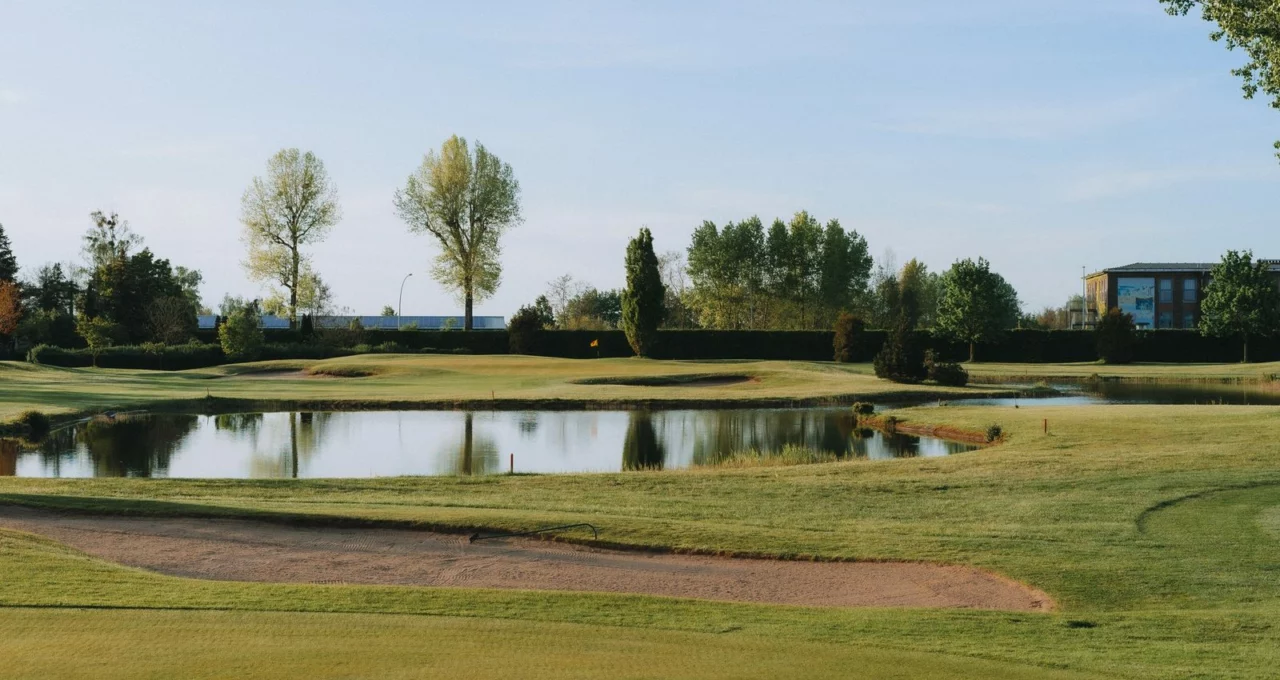
Ponds, creeks and lakes are penalty areas (Rule 17). When it is known or virtually certain that your ball is in one, you have choices, each for one penalty stroke. Stroke and distance from the tee is one. Back-on-the-line relief is another: you take the point where your ball last crossed the edge of the penalty area, keep that point between you and the hole, and drop as far back on that line as you like. If the penalty area is marked red, you also get lateral relief, a drop within two club-lengths of where the ball crossed the edge, no nearer the hole. For a beginner, either of the last two usually means the water is behind you on the very next swing. Our article on penalty area options walks through each of them in more detail.
A practical addition: carry a couple of scuffed or second-hand balls for the water holes. You may change balls between holes, and losing a ball you picked up for very little stings far less than losing a premium one. Our piece on used and lake balls explains which grades are good enough for that job.
Habit five: walking off without a provisional
Your drive drifts toward the tree line. It might have stayed out, it might not. You decide it is probably fine, walk 220 yards, search, and come up empty. The Rules now send you back to the tee to play again under stroke and distance (Rule 18.1), and with a group waiting behind you, that walk feels impossible. So the ball gets dropped somewhere convenient and the score on the card stops meaning much.
The fix is the provisional ball (Rule 18.3). If your ball might be lost outside a penalty area or might be out of bounds, you may play a second ball before you go forward to look. You have to announce it first, and the safest way is to use the word itself: “I’m hitting a provisional.” Saying “I’ll hit another” or simply teeing up a second ball is not enough, and without a clear announcement the second ball becomes your ball in play, with the first one counted as lost. If you find the original within three minutes, you play it and pick up the provisional. If not, the provisional becomes your ball with the same penalty you were facing anyway, minus the walk.
Many courses have also adopted Model Local Rule E-5, the alternative to stroke and distance that came in with the 2019 Rules. For two penalty strokes you drop in a zone between where the ball was lost or went out and the edge of the fairway, without going back. It only exists where the course has put it into effect, some clubs keep it out of their competitions, and it cannot be used for a ball in a penalty area or once you have played a provisional. For these and other rules new golfers often get backward, see our guide to the rules of golf you probably get wrong.
Habit six: a ball nobody can tell apart
You find a ball right where yours ought to be. Same brand, same number, and your playing partner is using the identical model. Under Rule 7.2 you can only treat it as yours if you can identify it, and a ball you cannot identify within the three-minute search is lost. Play the wrong ball and you take two penalty strokes in stroke play (Rule 6.3c), and you still have to go back and play your own.
The Rules recommend that every player put an identifying mark on their ball (Rule 6.3a). Use a permanent marker and the same mark every time: a pair of dots, a short line, your initials, a maple leaf if you are feeling patriotic. On the first tee, tell the group what brand and number you are playing and what your mark looks like. Ten seconds, and the argument never happens.
Where Canadian beginners lose their balls
The six habits are the same everywhere, but Canadian courses hide balls in their own ways, and October adds a few more.
- Fall leaves, coast to coast. In October the rough under maples and oaks fills with leaves, and a white ball vanishes in seconds. Leaves are loose impediments, not an abnormal course condition, so there is no free relief by default. Some committees adopt Model Local Rule F-14, which treats temporary accumulations of leaves as ground under repair on the holes where they are a problem. If it is known or virtually certain that your ball is in those leaves, you take free relief instead of a lost-ball penalty. It cannot be used in penalty areas and it is withdrawn when conditions allow, so ask at the counter whether it is in effect. A yellow or orange ball helps more than any rule this month.
- Granite in cottage country. In Muskoka and much of central Ontario, courses are laid out across Canadian Shield rock, with pink granite outcrops framing fairways at clubs such as Lake Joseph Club and Rocky Crest. A ball that catches a rock face can bounce almost anywhere, including into the bush. On those holes the straightest club matters more than ever, and a provisional is cheap insurance.
- Rattlesnake country. Canada’s rattlesnakes live in a few small pockets of the country. The western rattlesnake lives in the dry lower valleys of BC’s southern Interior, including the Okanagan, Thompson, Similkameen and Nicola. The prairie rattlesnake is found in southeastern Alberta and southwestern Saskatchewan, often on the dry coulee slopes of river valleys such as those around Lethbridge. The massasauga lives in Ontario, mainly along eastern Georgian Bay and the Bruce Peninsula. Parks Canada describes the massasauga as shy and notes that handling snakes is the most common cause of bites. On courses in these regions, play a ball that has gone into rocks or tall dry grass as lost, take your penalty and keep your hands out of places you cannot see.
- Elk in the mountain parks. Elk have long been part of the fall scenery on the fairways at Banff Springs, and in the mountain parks the rut lasts into mid-October. Parks Canada asks people to stay at least 30 metres from all elk and never to get between a bull and the females. If your ball finishes near a herd, leave it, and let the course staff or your group decide how to continue. No ball is worth a charge from a bull.
- Water you cannot see from the tee. Many Canadian courses are routed around lakes, rivers and creeks that cut across fairways at a distance a beginner might reach with a good drive. Read the hole map on the scorecard before you choose a club; a creek 230 yards out may be a problem only for your driver.
If you are new to the game altogether, NGCOA Canada, the association of golf course owners, runs Welcome to Golf, a program of open houses at participating courses for adults who have never played, covering everything from checking in to using the practice area and on-course etiquette. A course with fewer hazards also makes the learning cheaper: our guide to nine-hole courses in Canada explains what to look for in a shorter layout.
Your checklist before the next round
- Mark every ball in your bag with the same symbol and tell your group what you are playing.
- Count your balls on the first tee; count them again on the last green.
- Keep two or three scuffed balls in a separate pocket for the water holes.
- Read the local rules on the scorecard: red or yellow stakes, out of bounds, E-5, and whether a leaf rule is in effect this month.
- Watch every shot until it stops, and name a landmark out loud.
- On tight holes, tee off with your straightest club, not your longest.
- If a ball might be lost or out of bounds, say “provisional” before you hit again.
- From the trees, punch out sideways. From the pond, take a drop rather than re-teeing.
- Near rocks, tall grass or wildlife, accept the penalty and leave the ball.
The difference between those two counts on your scorecard is a better progress report than your score. A swing takes months to rebuild; this number can improve on your very next nine.