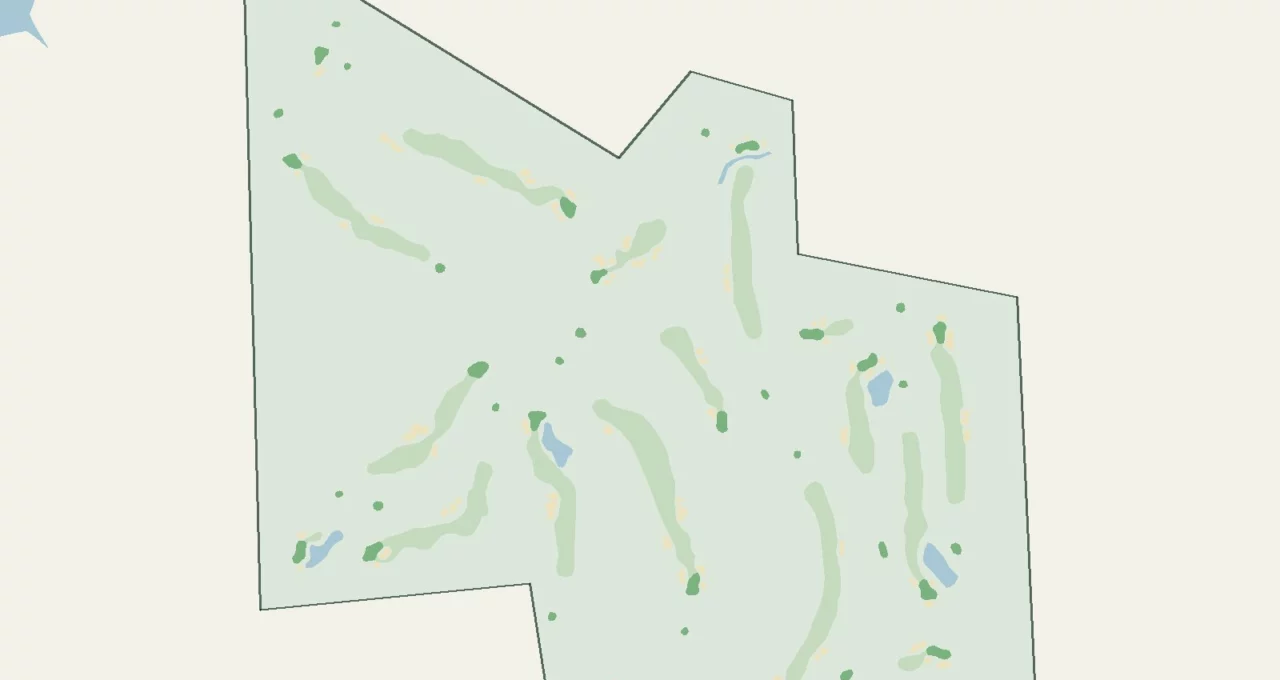
Layout of Crimson Ridge from OpenStreetMap survey data (ODbL licence).
Crimson Ridge
Holes
18
By
72: 36 out, 36 in; four par 3s, ten par 4s, four par 5s (club website, Golf Canada, published scorecards)
Length
6,827 yards from the gold tees (GolfPass, 18Birdies) or 6,810 (Golf Canada, hole-by-hole card), 6,449 blue, 5,950 white, 5,274 red; rating and slope 72.4/138 gold, 70.4/136 blue, 67.8/130 white, 65.1/118 red (GolfPass), 18Birdies gives 73.7/142 gold for men
Green fee
—
Best season
Spring to autumn, depending on snow; last day of golf 12 October in 2026 (club calendar); winter snowshoe and fat bike trails and indoor simulator (club website)
Crimson Ridge is an 18-hole golf course on the northern edge of Sault Ste. Marie, Ontario, at 418 Fourth Line West, on a wooded ridge above the city and the St. Marys River. The club describes it as a par-72 course set on 335 acres of Canadian Shield, designed by Kevin Holmes, with dramatic elevation changes, waterfalls and a 17th hole that plays over a cascading stream. From the back (gold) tees the course measures 6,827 yards according to most published cards, or 6,810 yards according to Golf Canada; the shortest (red) tees play 5,274 yards. Golf Canada lists it as a semi-private facility, and visitors can book tee times. The clubhouse holds a restaurant, Embers on the Ridge, and in winter the property becomes a network of snowshoe and fat bike trails. The club’s website is crimsonridge.com.
The course opened in 2002 after a period of construction that began in 2000, and in its first seasons it was nominated in Golf Digest’s 2003 Best New Course category. It has since been through a receivership, a sale in 2012 and a change of ownership in 2019, after which the clubhouse was renovated. Its reputation rests largely on its terrain: granite outcrops, creeks, ravines and long views from the high tees towards the city, the St. Marys River and Michigan beyond.
Which club is this?
This page is about the course in Sault Ste. Marie, Ontario, at the coordinates shown on the map below. Several online golf databases confuse it with the American city of the same name across the river. OpenGolfAPI, for example, files Crimson Ridge under Sault Ste. Marie, Michigan, while giving the Ontario course’s coordinates and scorecard, and Stymie has a listing under Michigan as well as one under Ontario. We found no separate Crimson Ridge golf course in Michigan: the scorecards, the designer and the coordinates in those listings all point to the Ontario course. Note also that the club has used more than one web address over the years; some directories still give an older domain, and the club’s email addresses use crimsonridgegolf.com while the website is crimsonridge.com.
History: from a 27-hole plan to an 18-hole course
Northern Ontario Business reported in March 2001 that a group of private investors led by Don Missere, a Sault Ste. Marie chartered accountant with BDO Dunwoody and a local tournament golfer, was developing what it called the city’s first public 18-hole course, on a 335-acre wooded property along a ridgeline overlooking the city and the St. Marys River a few kilometres to the south. The same report named the NHL goaltender John Vanbiesbrouck among the investors and put the group’s investment at C$5 million. It was one of three public courses then planned or under construction in the Sault area.
The architect, Kevin Holmes, grew up in Sault Ste. Marie and worked for the Toronto landscape architecture firm MBTW. The firm’s portfolio lists the project from 1999 to 2002 for the client Crimson Ridge Incorporated, with a construction cost of C$5 million, 18 holes and about 6,800 yards, and describes MBTW’s role as routing, construction drawings, approvals, construction supervision and contract administration. Canadian Golf Traveller, in a 2017 profile by Brian Kendall, gives the cost as C$5.5 million and reports that Holmes felt considerable pressure designing a course in his home town, where many friends and relatives would play it.
The original plan was larger than what exists today. A report from 2003 in the Sault Star, which we could read only as a search-engine excerpt reproduced by SooToday, describes a 27-hole complex: a nine called the Valley Course had opened the previous July, a second nine called the Falls Course had followed soon after, and construction of a third nine, the Ridge Course, was expected to start as early as the autumn of 2003. Combined, the two open nines played from 5,274 to 6,827 yards at par 72, figures that still match today’s card. We found no source saying the Ridge nine was ever built, and every current source describes an 18-hole course.
The opening year is given differently. MBTW’s dates (1999 to 2002), the Sault Star excerpt, The Globe and Mail in 2011 (which called it a nine-year-old layout) and Canadian Golf Traveller all point to 2002. A 2018 travel article on Northern Ontario Travel, by Rick Parnham, places the opening in 2000, and some directories give 2000 or 2001. Since the investors were still developing the course in March 2001, we follow 2002 for the opening, with construction from late 2000.
The early reception was strong. MBTW reports that Ontario Golf magazine named Crimson Ridge the third-best new course in Ontario and that it was nominated in the Best New Course category of Golf Digest’s 2003 awards. A later sale notice, quoted in search excerpts, says Ontario Golf magazine ranked it the 13th-best public course in the province, without giving a year. Top 100 Golf Courses currently places it 67th in its Central Canada list.
The business side was harder. In March 2012 the course was offered for sale by a receiver through a sealed-bid process run by RE/MAX Sault Ste. Marie, with an asking price reported at C$1.95 million. A RE/MAX release of 9 May 2012, as reproduced by SooToday, announced that the course had been sold, that the new owners would take possession in July and that they intended to keep and improve the course; it did not name them.
In 2019, SooToday reported that Mario Palumbo, dealer principal of Northside Toyota, and Paul Jobst, president of Jobst Construction, had taken over the course on 1 August and planned about C$600,000 of work: a new restaurant and bar in the clubhouse, a stand-alone pro shop and new winter activities, with the stated aim of making Crimson Ridge a year-round destination. The restaurant was taken on by Embers Grill and Smokehouse, which moved from downtown and now operates as Embers on the Ridge. We could not open the SooToday articles on the 2012 sale or the 2019 purchase directly, and this paragraph relies on the excerpts we could read.
What it asks of you
The published scorecards agree on the structure: par 72, split 36 and 36, with four par 3s (the 3rd, 7th, 14th and 17th), four par 5s (the 2nd, 8th, 10th and 18th) and ten par 4s. There are four sets of tees: gold, blue, white and red. GolfPass and 18Birdies give 6,827 yards from the gold tees, 6,449 from the blue, 5,950 from the white and 5,274 from the red. Golf Canada’s facility page gives a total of 6,810 yards, which is also what the hole-by-hole gold card reproduced by OpenGolfAPI adds up to. The 17-yard difference is unexplained; we use the hole-by-hole figures below.
The ratings and slopes are published in two different sets, and we could not establish which is current. GolfPass, the German directory 1golf.eu, GolfingRecord and the 2018 Northern Ontario Travel article give 72.4 and 138 from the gold tees, 70.4 and 136 from the blue, 67.8 and 130 from the white and 65.1 and 118 from the red. 18Birdies gives markedly higher figures: 73.7 and 142 from the gold tees for men, 71.9 and 137 from the blue, 69.5 and 133 from the white and 66.4 and 124 from the red, with women’s ratings from 71.2 and 129 (red) to 78.2 and 139 (gold). Either way the slope is high for every set of tees, which matches what the course’s descriptions say about it: this is a demanding layout. Ask the pro shop for the current card if you need the figures for handicap purposes.
The terrain does most of the work. Northern Ontario Travel describes a course built on a high bluff in the city’s north-western ridges, with some holes across flat tableland and others dropping into a rugged river valley, and says the edges of the playing corridors are unforgiving, so the player who keeps the ball in play is rewarded. It also mentions forced carries, a drivable par 4 and greens with sharp ridges and hollows. Top 100 Golf Courses describes densely forested ground, bluegrass fairways crossing several creeks and ravines, and large, gently contoured bentgrass greens. The 2003 Sault Star excerpt mentions granite rock, two waterfalls and a cold-water creek on the property, and Fairways magazine, in an undated piece by Ted McIntyre written soon after the opening, reports that about 5,000 cubic metres of granite had to be blasted to build the 18th hole alone.
The gold-tee card shows a course that is long rather than extreme, with the difficulty concentrated in particular holes. The front nine measures 3,438 yards and the back nine 3,372. Four par 4s are shorter than 360 yards, including the 11th at 285 and the 9th at 351, while the longest par 5, the 18th, measures 583 yards.
The course in sequences
Holes 1 to 5
The opening hole is the hardest on the card: a par 4 of 390 yards from the gold tees, stroke index 1. Top 100 Golf Courses describes it as a tough dogleg right to a fairway that narrows towards an offset green, and a reviewer on the same site called it quirky. GolfingRecord, which aggregates scores entered by its users, also records the 1st as the hole played furthest over par, though on a small sample of 38 rounds. The 2nd is a par 5 of 568 yards, stroke index 13, and the 3rd a par 3 of 195 yards, stroke index 5. The 4th and 5th are par 4s of 430 and 412 yards.
Holes 6 to 9
The 6th is a par 4 of 380 yards and the easiest hole on the outward nine by stroke index (17). The 7th is the longest par 3 on the course at 201 yards. The 8th, a par 5 of 511 yards, is stroke index 3, and one reviewer on Top 100 Golf Courses singled it out among the course’s par 5s. The 9th is a short par 4 of 351 yards; Top 100 Golf Courses notes three bunkers guarding the right side of the green, and the same reviewer counts it among two risk-and-reward par 4s that can tempt a long hitter.
Holes 10 to 14
The back nine opens with a par 5 of 515 yards, stroke index 16, which the Top 100 reviewer also praised. The 11th is the shortest par 4 on the course, 285 yards from the gold tees and stroke index 18; Top 100 Golf Courses describes large bunkers on both sides of the fairway and around the green and calls it a good birdie chance. The 12th and 13th are par 4s of 391 and 433 yards, the 13th ranked stroke index 2. The 14th is a par 3 of 191 yards.
Holes 15 to 18
The 15th and 16th are par 4s of 415 and 408 yards, stroke indexes 8 and 6. The finish is the part of the course every source mentions. The 17th is the shortest hole, a par 3 of 151 yards from the gold tees, stroke index 12. Canadian Golf Traveller describes it as crossing a steep ravine past a waterfall of about 18 metres, to a green set against a large granite outcrop, and Northern Ontario Travel calls it one of the most scenic par 3s in the province. The 18th is the longest hole, a par 5 of 583 yards on the gold card; Canadian Golf Traveller gave it 577 yards in 2017. It plays from an elevated tee in the north-west of the property, over rocky outcrops, and bends left towards a heavily bunkered green, according to Top 100 Golf Courses. Several sources describe the view from that tee across downtown Sault Ste. Marie and the shipping channel to northern Michigan.
The order of the nines has not always been the same. The Globe and Mail wrote in 2011 that the most memorable hole was the par-5 9th, formerly the 18th, with that view from its elevated tee: the nines were then played in reverse. By 2017 Canadian Golf Traveller again described the waterfall par 3 and the long par 5 as the 17th and 18th, as the current card does, and a 2020 review on Top 100 Golf Courses notes that members often start on the 10th tee. If you are handed a card with a different numbering, that is the likely reason.
What golfers say
Crimson Ridge is reviewed mainly on general and golf apps rather than in the golf press. Wanderlog shows about 4.5 out of 5 from more than 250 Google ratings, 18Birdies 4.6 from 64 reviews, and Hole19 4.9 from a small number; Tripadvisor showed an average of 4.1 from 18 reviews in a search excerpt, and GolfPass 4.0 from three. Top 100 Golf Courses has two reader ratings and one written review, from 2020. The points below are recurring themes from what we could read in October 2026. They are other golfers’ opinions, not ours, and we quote and name no one.
What comes up in its favour
- The scenery is the most frequent compliment: the elevation changes, the waterfall on the 17th and the view from the 18th tee over the city.
- Course condition is usually described as very good, and 18Birdies’ category scores rate condition highly and the greens as fast.
- Staff are often described as friendly and helpful, and several reviewers mention the pro shop’s range of brands.
- Golfers who like a test describe the course as challenging but fair, with strong par 5s and short par 4s that tempt a big drive.
- The restaurant, the drink cart on hot days and the ease of booking tee times online are mentioned as part of a good day out.
What comes up against
- The course is hard: reviewers mention many bunkers, difficult greens and corridors that punish a wayward shot, and 18Birdies’ users rate its difficulty as hard.
- Some reviewers find prices have risen and the round expensive for the area.
- One detailed Tripadvisor review from 2022 complained that a non-member visitor was poorly treated and overcharged; it is an isolated account among mostly positive reviews.
- Pace of play, signage on the course and the flow around the clubhouse each drew occasional criticism.
- Its remoteness is the point raised by golf writers: the course is roughly eight hours’ drive north of Toronto, and Canadian Golf Traveller noted that it had faded from national attention because of its location.
Playing as a visitor
Golf Canada lists Crimson Ridge as semi-private, while directories such as Wanderlog and Stymie describe it as public. In practice it is a members’ club that takes green-fee players: the club’s membership page lists priority booking ahead of the public among member benefits, and the club’s contact page gives the golf shop, on 705-254-4653, extension 1, as the number for tee times; reviewers describe booking online as easy, and the club’s online sales run through the Tee-On system. The club also sells ten-round packs and corporate passes. Walking is allowed according to Stymie.
Every golfer must complete the club’s golf cart and golfer liability waiver before the first round; it only needs to be done once, and the confirmation email serves as proof on later visits. The club runs golf carts, and Golf Canada lists rental clubs among the facilities. The club asks for proper golf footwear on the course and practice areas.
Golf Canada also lists a driving range and lessons, and the club offers 40-minute private lessons, semi-private lessons for two to four players, on-course playing lessons after at least one swing lesson, junior lessons for players 16 and under, a Ladies Learn to Golf program and a junior golf camp. The teaching staff are PGA of Canada professionals. The pro shop offers club fitting on a GCQuad launch monitor and regripping. Leagues include a ladies’ league, a men’s night with nine-hole play and a senior men’s league for players 55 and over, launched in 2026.
Embers on the Ridge, the clubhouse restaurant, is open from 11 a.m. to 10 p.m., seven days a week, with a main dining room, a bar and lounge, private dining spaces and a patio with a fire pit overlooking the course. The club hosts weddings, charity and corporate tournaments and other events, and its calendar shows the course closed on some event days.
Getting there and when to go
The course is at 418 Fourth Line West, Sault Ste. Marie, ON P6A 0B5, on the northern edge of the city. By our measurement on the map it lies about 7 km in a straight line north-north-west of downtown and of the Canadian end of the International Bridge to Sault Ste. Marie, Michigan, and about 14 km north-east of Sault Ste. Marie Airport. Canadian Golf Traveller notes that the city sits on the Trans-Canada Highway, where Lake Superior and Lake Huron almost meet.
The season is short and depends on the snow. The club’s 2026 events calendar marked 12 October as the last day of golf, and an undated SooToday report describes a planned spring opening pushed back to 12 April by snowfall. Autumn is the season the course is best known for: The Globe and Mail picked it in 2011 as a place to see the fall colours, and in October 2026 the club ran guided fall colour tours of the course.
In winter Crimson Ridge stays open. The club grooms more than 20 km of marked trails around the course for snowshoeing and fat biking, with snowshoe rentals and night access with headlamps, and runs an indoor golf simulator in the pro shop, with a winter indoor league starting on 9 November 2026.
Green fees
Daily rates, ten-round packs and memberships are published by the club: see the club’s website for current prices.
How this page was made
The factual frame comes from public sources read in October 2026: OpenStreetMap for the location, name and address; the club’s website for the description of the course, the designer, the acreage, the restaurant, leagues, lessons, fitting, the cart waiver, membership terms, winter activities, the simulator and the 2026 calendar; Golf Canada’s facility page for the club type, total yardage and facilities; MBTW’s portfolio for the project dates, client, cost, scope and awards; Northern Ontario Business (March 2001) for the investors and the site; The Globe and Mail (2011) for the age of the course and the former numbering of the holes; Canadian Golf Traveller (2017) for the cost, the designer’s background, the 17th and 18th holes and the location; Northern Ontario Travel (2018) for the setting and character of the course and the ratings; Top 100 Golf Courses for its ranking, its hole notes and its 2020 reader review; Fairways magazine for the rock blasting on the 18th; GolfPass, 18Birdies, OpenGolfAPI, GolfingRecord and 1golf.eu for the scorecard, yardages and ratings; and Wanderlog, 18Birdies, Hole19, Tripadvisor and GolfPass for ratings and review themes. SooToday, Tripadvisor, GolfPass, GolfLink, 1golf.eu and the Toronto Golf Nuts forum could not be opened directly, so their contribution is limited to what search excerpts showed; that applies in particular to the 2003 Sault Star report, the 2005 statement, the 2012 receivership and sale, and the 2019 purchase.
Where sources disagree, we say so. The opening is dated 2002 by MBTW, the Sault Star excerpt, The Globe and Mail and Canadian Golf Traveller, and 2000 by Northern Ontario Travel and some directories. The cost is C$5 million for MBTW and Northern Ontario Business and C$5.5 million for Canadian Golf Traveller. The gold tees measure 6,827 yards for GolfPass and 18Birdies and 6,810 for Golf Canada and OpenGolfAPI; the blue tees 6,449 yards for GolfPass and 18Birdies and 6,460 for GolfingRecord. Two different sets of ratings and slopes circulate. The 18th measured 577 yards for Canadian Golf Traveller and measures 583 on the gold card. Hole19 shows a single set of tees labelled blue at 5,890 yards, which matches none of the other cards, and we do not use it. OpenGolfAPI and Stymie place the course in Michigan, which is wrong.
What we did not find: the name of the 2012 buyer, whether the third nine was ever begun, the per-hole yardages for the blue, white and red tees in a source we could verify, and the club’s current season opening date. The opinion section summarises reviews and descriptions read in October 2026. We report recurring themes rather than individual voices, and we reproduce no quotations. Nobody from Panxis has played or visited this course, and this page is no substitute for a round.
The club has not paid for this page, has not seen it before publication and has no say over its content. This page contains no commercial link and earns us no commission. If you know the course and something here is wrong or out of date, write to us and we will correct it.
Other courses nearby
Closest to this one in our Canadian directory:
- Cobble Beach Golf Resort — 341 km
- Settlers’ Ghost Golf Club — 428 km
- Westmount Golf & Country Club — 460 km
- Greystone Golf Club — 483 km
The hole to know
The club's signature hole: a par 3 of 151 yards from the gold tees, stroke index 12 (scorecard), played over a steep ravine past a waterfall of about 18 metres to a green set against a granite outcrop (Canadian Golf Traveller, 2017).