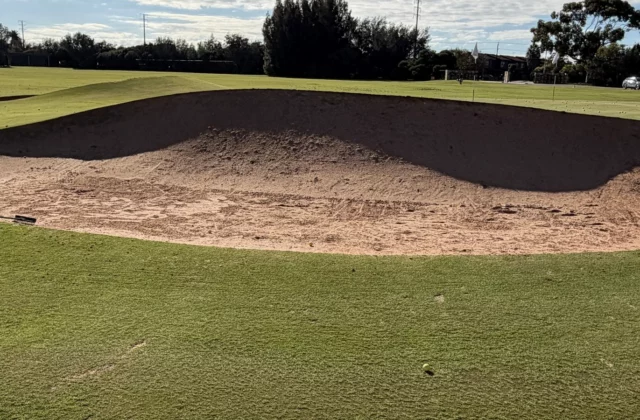
One chipping club or three: couch, kikuyu and firm Sandbelt aprons, with a 20-minute test in metres
Late spring firms the ground and tightens the couch, and that changes which chip is the safe one. One wedge for everything and one stroke with three clubs both work, at a price. A go-to club, two reasons to change and twenty minutes on the chipping green will pick for you.

In brief
- On tight couch there's little grass for a wedge to slide through, so less loft and a putting-style stroke is the lower-risk chip.
- Kikuyu grabs a running ball: loft it off kikuyu and make sure the first bounce is on the putting surface, never in a kikuyu collar.
- Most club golfers do best with a go-to wedge of about 46 to 50 degrees, a 7-iron or 8-iron when there's lots of green, and the sand wedge when there's none.
- The test takes six balls and three clubs on a 15-metre chip: measure your own roll, then count the shots inside a putter length and the worst one.
Twelve metres to the flag, four of them fringe, and the couch under your ball is cut so tight you can see the dimples sitting on the dirt. It’s the last month of spring, the ground is firming up by the week, and Saturday comps are about to get fast. This is the shot where playing partners split. One pulls the 58 he uses for everything inside 30 metres. The other grabs an 8-iron and bunts it along the deck. Both will tell you, over a drink afterwards, that their way is the simple way. They can’t both be right for you, and on Australian turf the grass itself has a big say. Here’s how the two methods stack up, what couch and kikuyu do to each, and a short session that will sort out which one belongs in your bag.
Where Australian turf picks the club for you: couch, kikuyu and the firm Sandbelt apron
Start with what’s under the ball, because around our greens it varies more than most golfers notice.
Couch. Couch is a warm-season grass, the same plant Americans call bermuda. It sulks through the cold months, browning off in the cooler states, then takes off once the soil warms. By late November it’s growing hard, greenkeepers are mowing it low, and the surface under it is firm. On a tight couch lie there’s very little grass for a wedge to slide through, so the strike has to be precise, more leading edge than bounce. That’s why so many good players on couch go to a less lofted club and a putting-style stroke: the head stays low, brushes the top of the turf and the ball runs. A coaching column in Golf Australia magazine put it simply: it’s easier to run the ball through couch, and easier to loft it off kikuyu. Couch also has grain. Chipping into it, a wedge can snag; with it, the ball skids out quicker than you’d think.
Kikuyu. Kikuyu is the opposite problem. It’s thick, spongy and common on courses in Queensland and northern New South Wales, among other places. A ball tends to perch in it, which makes getting it airborne easy, but a low runner that has to travel through any kikuyu on the way gets grabbed. The same coaching advice applies in reverse: loft it off kikuyu, and be wary of landing a chip in a kikuyu collar, because it will probably stick there and never release to the hole. On a kikuyu course the bump-and-run only works if the ball’s first bounce is on the putting surface.
Sandbelt-style surrounds. Melbourne’s Sandbelt sits on sandy soil with couch fairways and bentgrass greens, and the short grass often runs right to the edge of the putting surface. Everything is firm and quick. There’s nothing to stop a ball rolling, so the putter from five or ten metres off the green is a genuine first choice, and a 7-iron or hybrid played along the ground comes a close second. The lob wedge from a bare, sandy lie to a firm green is the hardest option on offer, yet it’s the one visitors keep choosing.
Where to work on it. Most clubs and plenty of public courses have a chipping green beside the practice fairway. Check the sign, as some are putting only. A PGA of Australia professional at your club can watch ten chips with each club and tell you in one lesson what a season of guessing won’t. The PGA of Australia is the body that accredits teaching professionals here, while Golf Australia looks after the Rules and handicapping.
Two numbers for every chip
Strip the jargon away and a chip is a low shot from near the green that rolls further than it flies. (When it flies further than it rolls, call it a pitch.) Two numbers describe it: metres in the air to the first bounce, then metres along the ground to the cup.
Loft decides the split. Take loft away and the ball leaves lower, spins less and runs out. Add loft and it climbs, lands softer and pulls up. So you’ve got two dials. Leave the swing alone and swap clubs, or leave the club alone and alter the swing. The one-club golfer has picked the second dial, the multi-club golfer the first.
Either way, the first bounce should be on the green. A metre onto the putting surface is plenty. Bounce it in the fringe and you’re guessing, and on kikuyu you’re not even guessing, you’re hoping.
The wedge-for-everything golfer
Give this player credit. Every practice ball they’ve ever chipped has gone through the same club, so they know it intimately: what a short swing carries, how the sole behaves on hardpan, how it comes out of light rough. Club selection takes no thought, which leaves all of it for the lie and the landing point.
The catch is that one club has to produce many shots. For a 58-degree wedge to release 12 metres across a green you set the hands forward, shift the ball back and hood the face. To stop it quickly you reverse all three. Each version meets the turf differently. Elite players put in the years to own that whole range, and it’s a big part of why they stick with one wedge. If you’re playing a weekly comp and hitting balls once a month, that’s three techniques to maintain, and on firm spring couch each one can be bladed across the green or stubbed a metre.
Distance adds to the risk. A chip that must fly 14 metres to get home takes a far longer swing than one that flies three and trickles the rest, and longer swings go wrong by more.
The 7-8-9 golfer
This player holds one compact stroke, not far off a long putt, and lets the number on the sole do the adjusting. It’s an old idea with a good pedigree. Paul Runyan won the PGA Championship in 1934 and again in 1938, then spent decades as one of the most respected short-game teachers in the game. His chipping stroke copied his putting stroke, and he chose the club for the amount of roll he was after.
You’ll often see the method taught with a memory aid known as the rule of 12. Subtract the iron’s number from 12 and you supposedly get the parts of roll for each part of carry: five for a 7-iron, four for an 8, three for a 9, two for a pitching wedge, and about one for one with a sand wedge.
Take it as a rough guide and nothing more. The versions doing the rounds don’t match each other, today’s irons are stronger-lofted than the ones the rule was made for, and a quick, sloping green in December bears no resemblance to a flat, medium-paced one. The bit worth keeping is the direction of travel: same stroke, less loft, more run.
On the plus side, you only have one movement to repeat, the ball’s rolling early, and a rolling ball is easier to judge than a flying one. A slightly thin 8-iron still ends up handy. On the minus side, you need to stay in touch with several clubs, go down the grip on the longer ones, and get used to how hot the ball comes off a 7-iron. And if there’s kikuyu, a bunker or a ridge to clear, the low shot simply isn’t on.
A go-to club and two changes
You don’t have to pick a side. What suits most club golfers is one go-to club and two reasons to change.
Go-to. A gap wedge, or a pitching wedge if you don’t carry one: roughly 46 to 50 degrees. It hops a metre or two of fringe and then rolls out like a firm putt. It’s the club for every standard lie, and it should soak up most of your short-game practice.
Change one: heaps of green. Back pin, nothing in the way. Step down to an 8-iron or 7-iron, or a hybrid with a putting grip. The stroke doesn’t change. On tight couch this is the shot that takes the stub out of play.
Change two: next to no green. Short-sided over rough, a bunker lip or a kikuyu collar. Step up to the sand or lob wedge and fly it. The one-club crowd are dead right about this one.
And don’t forget the club that isn’t a chipping club. From short, dry grass the putter can’t be fatted or thinned. Our guide to the spring short game on firm ground covers when to use it, and choosing your wedges explains which bounce suits hard turf.
The test: twenty minutes, in metres
Arguing about chipping is free. Finding out costs you a bucket-free visit to the chipping green.
Grab six balls, your most lofted wedge, your gap wedge and a 7-iron. Find a flat chip of 15 metres with about two metres of fringe to carry. Push a tee into the green one metre on: that’s your landing mark.
Part one: measure. Six balls a club, identical stroke, aiming to drop each one on the tee. Step out how far each bunch has rolled. Now you know your own carry-to-roll figures on your own grass, which is worth more than any chart.
Part two: compare. Same spot, but play to the hole. Six balls with the lofted wedge only. Six more with whichever club you reckon fits. Count the ones that finish within a putter length, then look hard at the worst ball in each set. In a stroke round the shocker is what wrecks the card.
Part three: repeat somewhere nastier. Pick a chip of 8 metres with barely three metres of green and do part two again.
Lofted wedge in front both times? You’re a one-club player, so put your practice into flighting it high and low. Chosen club in front, or simply fewer disasters? Build the go-to-plus-two system. Pencil your figures on a card. Check them again once summer has really baked the greens, because the roll will have grown.
Four checks at the ball
- Up or down? A ball sitting down in grass needs loft and a steeper hit. A ball sitting up gives you the full menu.
- What grass, and which way is it lying? Tight couch: less loft or the putter. Into the grain: definitely less loft. Kikuyu: loft, and land it on the green.
- What’s in the way? A metre of fringe doesn’t matter. Two metres of rough or a sprinkler does, and it sets the least loft you can get away with.
- How will it land? Into an upslope the ball checks, so take less loft. Onto a downslope it runs, so take more and land it shorter. On quick, dry greens the wedge with a short carry is easier to stop.
Fourteen clubs, no more
One point of law before you go shopping. Rule 4.1b caps the bag at 14 clubs. Chipping with a 7-iron or a hybrid is free in every sense, because they’re already in there. A specialist chipper is allowed, but it has to push another club out.
Before Saturday’s comp
- Identify the grass around the first green: couch, kikuyu or something finer.
- Pick your landing spot one metre onto the putting surface before you pick a club.
- Default to your go-to wedge. Lots of green, go down in loft. No green, go up.
- From tight couch or a Sandbelt-style apron, look at the putter first.
- Never bounce a running chip through kikuyu.
- After the round, write down every chip that finished outside a putter length and what you hit.
One club or several isn’t a measure of skill. It comes down to how often you practise and which miss you can’t afford. Do the test this week while the couch is tight, keep the card in your bag, and let the results pick for you.