Thinking your way round: course management for Stableford and firm greens
Stableford rewards the golfer who avoids zeros, not the one who hits the best shot of the day. Play the holes where you get a shot for a net par, aim for where the ball must land on firm greens, and pick up once the points are gone.
In brief
- On a hole where you receive a shot, a bogey is a net par and two Stableford points.
- Rule 21.1 encourages players to stop a hole once their score can only earn zero points.
- On firm summer greens, choose the landing zone, not just the distance to the flag.
- Before a recovery shot, ask whether you would pull it off four times out of ten.
- Record fairways, greens and putts in the Golf Australia Official app and log the decision behind every zero.
If your Saturday comp is a Stableford, it keeps a very honest ledger. A hole where you take two shots more than your net par scores zero, exactly the same as a hole where you take eight. That single fact changes how you should think your way around a course, and it is why club golfers who plan well often beat golfers who strike the ball better.
This guide is about the decisions you make before the club goes back: which target, which club, which risk. None of it costs money or range time. All of it is aimed at the thing that wrecks Australian cards: the zero-point hole that started with an optimistic choice.
Start from the scorecard, not the swing
Your Daily Handicap gives you shots on the holes with the lowest stroke index. Before you tee off, circle the holes where you receive a shot, and the ones where you receive two if your handicap is high enough. On those holes, a bogey on the card is a net par and two points. You do not need to hit the green in regulation there; you need to avoid the double.
That reframes the round. A 20-marker who plays the stroke index 1 hole as a comfortable three-shot par 4, then takes two putts, walks off with two points and no stress. The golfer who chases the green with a 3-wood from the rough to “save a shot” is the one writing a zero.
And when the points have gone, stop. Rule 21.1 of the Rules of Golf says players in Stableford are encouraged to stop playing a hole once their score will result in zero points. Pick up, draw a line through the box and save your energy and your group’s time for the next tee.
Measure what you actually carry
Most course management errors begin with a number that is too big. Ask a club golfer how far their 7-iron goes and you will hear the best one they hit, downwind on a hard fairway in February. On a firm Australian course in summer, the total distance can be flattering because of the run; the carry is what gets you over a front bunker, and it is shorter.
Get a carry chart you trust. A launch monitor session, a range with radar tracking such as the Trackman bays at Moore Park Golf in Sydney, or a structured range session with a rangefinder will do. Use the typical carry for each club, not the longest, and keep the card in the bag.
Firm greens: play to where the ball lands, not where the flag is
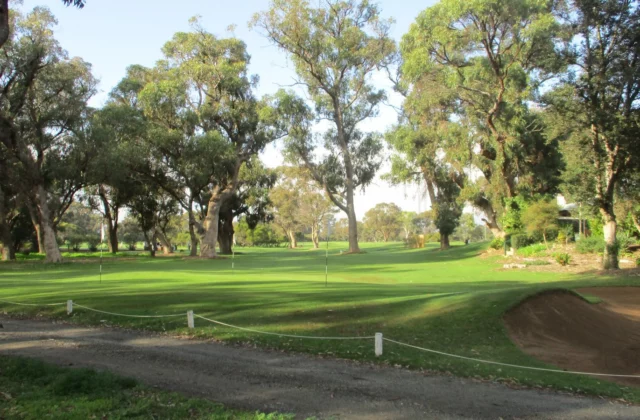
On a baked summer course, the question on approach is not just “how far to the pin?” but “where must this land for it to finish on the green?” A shot that pitches pin-high on a firm bentgrass green can bound through the back. The landing zone may be several metres short, and on a green guarded at the front that is a narrower target than the flag suggests.
Kingston Heath in Melbourne shows the idea as well as any course in the country. Its bentgrass greens sit beside couch fairways on sandy Sandbelt ground, and its signature 15th is an uphill par 3 created when Alister MacKenzie advised moving the green to the top of a rise. A hole like that punishes the shot aimed at the flag and rewards the one that finds the safe part of the green and lets the slope do the rest. Your own course will have holes built on the same principle, even if they are not on anyone’s top-100 list.
The practical rule: when the green is firm and the trouble is short, take the club that carries the trouble comfortably and accept a longer putt. When the green is soft after rain, you can fly it closer to the hole.
Aim at the middle more often than feels brave
A mid-handicapper’s approach shots do not land on a dot; they land in a spread many metres wide and deep. Aim that spread at a flag tucked near a bunker and a good share of it finishes in the worst place on the hole: short-sided, in sand, with no green to work with. Aim at the centre and most of it finishes on the putting surface.
From the middle of the green, two putts gives you par or net par. From a short-sided bunker, it takes a good bunker shot and a holed putt to do the same. Over eighteen holes that difference is several points.
Plan par 4s backwards
Choose your second shot before your tee shot. If your favourite full swing is a wedge from about 90 metres, or a 9-iron from about 110, ask which club off the tee leaves you that number, not which club goes furthest. On a short par 4 with bunkers at driver distance, a hybrid to your favourite number beats a driver that brings the sand into play and leaves an awkward half-wedge.
On any par 4 you cannot reach in two, plan three shots from the start: two comfortable swings and a wedge. It is the most reliable route to a bogey, and on a hole where you get a shot, a bogey is two points.
Trouble: the four-in-ten test
You are under a gum tree with a small gap towards the green. Before you try the hero shot, ask one question: would I pull this off four times out of ten? If the honest answer is no, chip back to the fairway. You lose one shot. The failed recovery often costs two or three, and in Stableford it can cost the whole hole.
The same test applies to carrying water, cutting a dogleg and going for a par 5 in two from a poor lie. The shot you can play safely nine times out of ten is almost always worth more points than the one you might play once.
Wind, heat and the afternoon field
Many Australian rounds finish in a stronger wind than they started in. Into the wind, take more club and swing more smoothly, because a harder swing adds spin and the ball climbs and falls short. Downwind, the ball flies and runs further, so bunkers you never reach in the morning come into play. On a hot afternoon, drink water before you are thirsty: tired golfers make poor decisions on the back nine, and poor decisions cost more than tired swings.
Keep a decision diary for four rounds
After each round, list every hole where you scored zero points or took a penalty, and next to each one write the decision that started it, not the swing that finished it. Most golfers see the same few entries again and again: driver where it was not needed, a recovery through a gap, a flag attacked beside a bunker.
The Golf Australia Official app, which runs on a free Golf ID, lets you record fairways hit, greens in regulation and putts alongside your scores. Pair those numbers with your diary and the pattern becomes hard to argue with.
Where to practise your decisions in Australia
Course management is learned on a course. A short course or a nine-hole round in the late afternoon is the cheapest place to try one rule at a time: middle of every green, or three-shot plans on every long par 4. Moore Park Golf in Sydney, currently running as ten holes near the CBD, is an example of the kind of public layout where you can do that without committing to a full round.
For your carry numbers, use a range with ball tracking or a fitting bay at a golf retailer. For a second opinion on your choices, book a nine-hole playing lesson with the PGA professional at your club: decisions only show up on a course, and a coach walking beside you will see them in a few holes.
Panxis Golf has no commercial relationship with any club, retailer or app mentioned here.
Your next Saturday comp
- Circle the holes where you receive shots and play them for a net par.
- Pick up as soon as the hole can no longer score a point.
- Aim at the middle of every green unless the flag is in the middle.
- On firm greens, choose where the ball must land, not just the distance to the pin.
- Apply the four-in-ten test before every recovery.
- Write down the decision behind every zero.
None of this needs a lesson or new clubs. It needs a plan made before the swing, and the discipline to stick to it for the few seconds the swing takes.