Hitting more fairways on firm Australian ground
On a hard summer fairway the tee shot that lands in the middle can still finish in the sand. Find your real miss, use the full width, and choose clubs for where the ball stops, not where it lands.

In brief
- Write down where every tee shot finishes for one round: most golfers have a single dominant miss.
- Aim at the edge your ball curves away from and let the whole fairway catch it.
- Couch fairways firm up in the warm months, so a bunker out of reach in winter can be in play in January.
- Into the wind, tee lower and swing smoother; a hard swing adds spin and curve.
- A range with radar tracking, such as Moore Park's in Sydney, shows your spread with each club.
Stand on the first tee of almost any Australian club on a January Saturday and you will see the same thing: a driver, a big swing, and a ball that bounds off a baked couch fairway and keeps running into whatever sits at the end of it. The fairway was hit. It just did not stay hit.
Finding more short grass off the tee in this country is less about a better swing than about three local realities: ground that adds run for half the year, wind that arrives with the afternoon, and courses whose best holes reward position over length. Deal with those and your fairway count moves within a round, with no lesson and no new driver.
Start with the pattern you already have
Before changing anything, find out what your tee shots actually do. For your next round, jot one word on the card after every drive: left, fairway, right, bunker, trees. Nothing about how it felt.
Most golfers who try this discover one dominant miss. The snap hook they remember from last month turns out to be rare; the gentle fade into the right rough turns out to happen on nine holes out of fourteen. Memory keeps the dramatic shots and quietly drops the routine ones, which is why a written tally is worth more than a season of impressions.
Once you know the shape, you stop fighting it and start using it. A fade that lands in play eight times out of ten is a weapon. A straight ball you hit twice a round is a hope.
Use the whole width
The common habit is to aim at the middle of the fairway. With a pattern that curves one way, that throws away half the target: every shot that curves as usual starts drifting toward the edge from the centre line.
If your ball moves right, set up on the left edge of the fairway, or even the left rough line, and let the curve bring it back across the grass. If it moves left, do the mirror image. Nothing about the swing has changed; the landing area has simply doubled.
Expect this to feel wrong for the first few holes. Aiming at rough on purpose goes against every instinct. Commit to it for a full round before you judge it, and count the fairways at the end rather than on the third tee.
Summer ground changes your numbers
Many Australian fairways, Kingston Heath’s among them, are couch, a warm-season grass that grows actively once temperatures are above about 15 degrees and goes dormant and light brown in winter. On a dry, warm day, a couch fairway can add a lot of run to a tee shot, and that run is where many fairways are lost.
The practical effect is that your usual driver distance is not a fixed number. A bunker that sits well past your carry in July can be in range in January once the ball starts bouncing and rolling. The same goes for the far edge of a dogleg: on firm ground, a shot that would have stopped on the corner in winter scoots through into the trees.
So check your numbers against the season, not just the scorecard. When the ground is hard, ask where the ball will finish, not where it will land, and be ready to take a club that stops short of the trouble. Our guide to fairway bunkers covers what to do when the run beats you anyway.
Driver is a choice, not a default
On a short par 4 with a bunker at the end of your driver run, a 3-wood or hybrid that finishes 20 or 30 metres back leaves a longer second shot from short grass. The driver leaves a shorter shot from the fairway if it all goes right, and a sideways wedge out of sand if it does not.
Australia’s most famous course makes the point well. Royal Melbourne’s West course, designed under Alister MacKenzie’s direction, has holes that are not long by modern championship standards, because the property is landlocked and they cannot be stretched. What protects them is angles and bunkering, which means the right position off the tee matters more than the extra metres.
One honest test before you adopt the 3-wood habit: many club golfers are not actually straighter with it. The shorter shaft helps, but the smaller head forgives less. Hit ten of each on the range, pace out the spread, and keep whichever club produces the narrower pattern.
The wind that shows up after lunch
Coastal courses and afternoon tee times bring wind into most Australian rounds. Barnbougle Dunes in north-east Tasmania, the Tom Doak and Mike Clayton links above Bass Strait, is not long, yet it becomes a stern test when the wind blows hard, as it often does there. The lesson carries to any exposed course.
- Into the wind: tee it a touch lower, take a smoother swing, and accept a shorter shot. A hard swing adds spin, and a spinning ball climbs and gets knocked sideways.
- Downwind: the ball flies and runs further. Recheck what is now reachable, especially on firm summer ground.
- Across: aim upwind and let the ball drift back. Trying to hold a curve against a crosswind is a professional’s shot, not a weekend one.
Tee height and the eight-tenths swing
With a driver, tee the ball so roughly half of it sits above the top edge of the clubface at address. Too low encourages a downward strike and extra spin; too high risks catching it on the crown. If you slice, a slightly lower tee and a ball position a fraction further back often straightens things more than a new swing thought.
Then try a round at what feels like 80 per cent effort off every tee. For most amateurs the cost is a few metres and the reward is a more central strike, which is what keeps the face square. The smoother swing often goes nearly as far, because a centred hit loses less energy than a hard one struck off the toe.
Aim from behind the ball
Alignment goes wrong quietly. Standing beside the ball, the eyes are not on the target line, so golfers aim with their shoulders and end up well right or left without knowing it.
Build the routine from behind instead. Pick the target, then pick a mark a metre or so in front of the ball on that line: a leaf, a darker patch of grass, an old tee. Set the clubface to that mark first, then place your feet and body parallel to the line. Every tee, in that order. On the range, lay an alignment stick or a spare club along your toes now and then, because alignment drifts over a season without announcing it.
Where to work on it in Australia
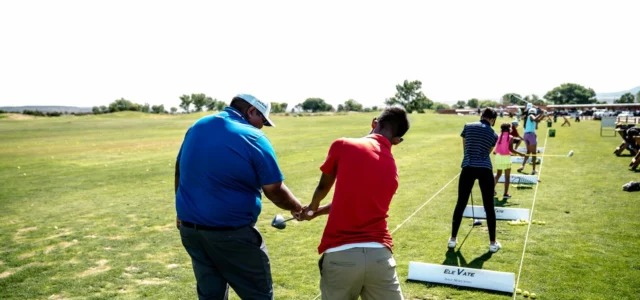
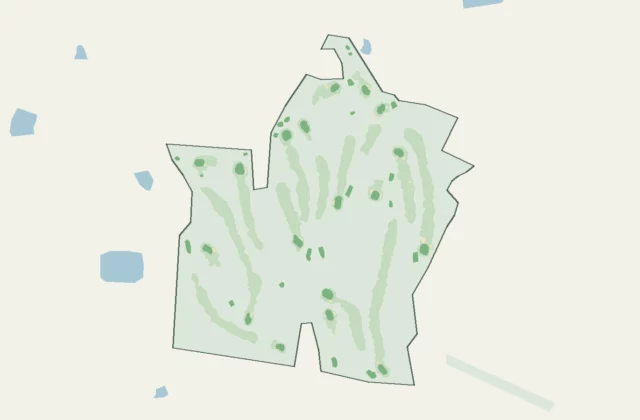
Most of the work happens on the course, but a range with ball tracking makes the pattern visible. Moore Park Golf, the public course minutes from the Sydney CBD on the corner of Anzac Parade and Cleveland Street, runs a 60-bay driving range with Trackman radar tracking that shows carry and total distance for each shot, and an app that saves your session. Hit twenty drivers and twenty 3-woods and compare the spread, not the longest one. The course itself is currently operating as ten holes while part of the site is being redeveloped, which is enough for a short on-course test of your new aim.
Elsewhere, look for a range that offers radar tracking in the bays, or simply take the tally card to your own club’s Saturday comp. The PGA professional at your club can check your alignment in a few minutes, which is the one thing on this list you cannot see for yourself.
If you travel, an exposed course such as Barnbougle is the best classroom there is for flighting the ball down into a breeze.
Panxis Golf has no commercial relationship with any course, range or coach mentioned here.
Three rounds, three experiments
- Round one: write down where every tee shot finishes and name your dominant miss.
- Round two: aim at the edge your ball curves away from, on every hole, and swing at eight tenths.
- Round three: on firm ground, take the club that finishes short of the first bunker on every short par 4, then compare the score.
Fairways hit is one of the statistics that improves fastest for club golfers, because nearly all of the gain is decided before the club starts moving.