The 50-yard pitch: three backswings, one tempo, and where to groove it in a Canadian winter
Most 50-yard misses come from a backswing with no set length, so the hands try to judge speed on the way down. Pick one of three lead-arm positions, keep one count for all of them, and let the length set the distance. The courses are closed, but the motion can be grooved indoors before spring.
In brief
- Choose the backswing before you start: lead arm at eight, nine or ten o'clock, an image popularized by Dave Pelz.
- Keep one tick-tock count for all three lengths and finish at least as long as the backswing.
- Find the wedge whose nine o'clock swing carries about 50 yards, then use the others for height or release.
- Over the winter, groove the motion in a dome, a simulator bay or the basement, and confirm your carries on grass in spring.
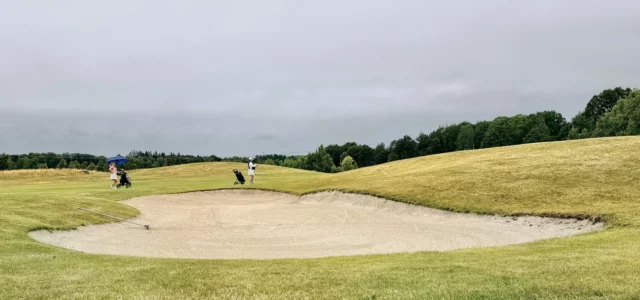
Think back over your summer and count the times you stood about 50 yards from the flag: after a punch out from the trees, after a second shot on a par 5 that came up short, after a layup that was meant to leave a full wedge and didn’t. It happens a few times every round, and for most club golfers it is the most uncomfortable distance on the course. A full swing sends the ball over the green, so you try to swing easy and the club slows down before it reaches the ball. A short swing feels too small, so you add a jab with the hands at the last moment. Neither works for long. The answer in this guide is a system with three set backswing lengths and a single tempo, where the length you pick decides the distance and nothing gets adjusted on the way down. It also happens to be one of the few parts of the game you can build properly in a dome, a simulator bay or a basement between now and April.
The real problem is a backswing with no address
From 100 yards, you rarely think. You pull a pitching wedge or a gap wedge, make your normal swing and the loft does the rest. Fifty yards offers no such club. Every wedge in your bag goes further than that with a full motion, so you have to subtract something, and most golfers subtract it by feel, differently each time.
That is how the two classic misses appear. In the first, the club goes back too far, your brain realizes halfway down that the ball is going to fly the flag, and your hands put on the brakes. When the club decelerates, the face and the bottom of the arc wander, and you get a chunk or a skull. In the second, you take the club back only a little and then try to create the speed with your wrists. On a relaxed Tuesday evening that can work. With a match on the line it falls apart, because hand speed is exactly what nerves change first.
So the goal is not a better feel for speed. It is to make the decision before you start the swing, so that the swing itself has nothing left to decide.
Three positions of the lead arm
The easiest way to describe a backswing length is to picture a clock face, with you at its centre, as seen by a friend standing opposite you. The short game coach Dave Pelz popularized this image, and plenty of teachers now use their own variation of it. Here, the hand of the clock is your lead arm (the left arm for a right-handed golfer), not the shaft of the club, because the arm is easier to see on video and easier to repeat.
Eight o’clock. Your hands stop around the height of your back pocket. It is a small swing, the one for shots well inside 50 yards. With a sand wedge, many players land this somewhere in the thirties.
Nine o’clock. Your lead arm is level with the ground and your wrists have hinged naturally, so the club points more or less straight up. This is the anchor of the system. For a lot of mid-handicap golfers, a sand wedge or lob wedge from here carries close to 50 yards.
Ten o’clock. A bit more shoulder turn and a bit more arm, short of a full swing. It covers the shots between your nine o’clock number and your full wedge, often 60 yards and a little beyond with a sand wedge.
Treat those yardages as a rough sketch. Your own speed, the lofts stamped on your wedges and the ball you play will move them, sometimes a lot. What matters far more than the exact figure is that the arm stops in the same place every time you call for that length. Prop your phone up facing you and record ten swings. A swing that feels like nine o’clock often turns out to be closer to half past ten on video, and that gap alone explains a lot of pitches that finish on the back fringe.
One tempo, no matter the length
The other half of the method is tempo. Once you have chosen the length, the downswing is left alone. You do not speed it up for the ten o’clock swing or slow it down for the eight o’clock one. Think of a pendulum: pull it further back and it arrives at the bottom moving faster, without anyone pushing it.
A spoken count keeps you honest. Say “tick” as the club goes back and “tock” as it comes through, and keep the same gap between the two words whichever length you are making. The ten o’clock swing covers more ground in the same amount of time, so it is quicker by itself. You never have to add speed.
Your follow-through tells you whether the tempo held. On a good pitch, the club finishes at least as far past the ball as it went back, so a nine o’clock backswing ends at three o’clock or higher, with your chest facing the target. If your finish is cut off just past the ball, you slowed down, and you can see that on your own without paying for a lesson.
The temptation to fight is the backswing that keeps growing because the flag looks a long way off. Commit to the length you chose before you took the club back. A few extra centimetres of arm swing on a short shot is not a detail, it is the difference between the middle of the green and the bunker behind it.
A set-up that lets the wedge work
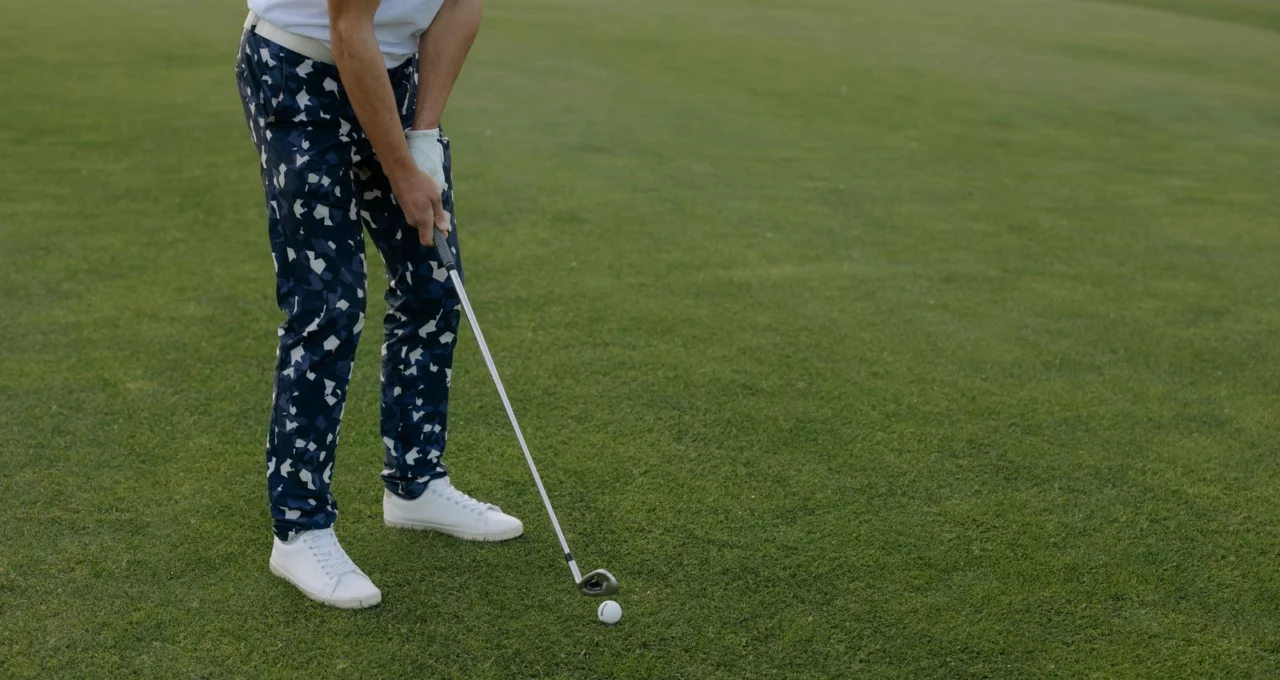
A pitch is a scaled-down swing, so the address position shrinks with it.
- Narrow your stance a little compared with a full wedge and flare your lead foot slightly toward the target.
- Play the ball in the middle of your stance for a standard trajectory. Moving it back makes the ball come out low and run.
- Set a little more weight on your lead foot and leave it there through the swing.
- Choke down an inch or two on the grip for control. The swing itself stays the same.
From there, let your chest keep turning through impact. Many thin or pulled pitches come from arms that keep swinging after the body has stopped. When the chest and the arms arrive together, the hands lead the clubhead slightly and the sole of the wedge brushes the turf instead of digging. If you want to understand how the bounce of your wedge helps here, our guide to choosing your wedges explains it.
Which wedge owns 50 yards
The idea is that your nine o’clock swing with one particular wedge lands at about 50 yards. If it doesn’t, you could stretch or shorten the swing, but it is usually smarter to change the club and keep your three lengths untouched.
Slower swingers often find their 50-yard club is the gap wedge. Faster swingers tend to end up with the lob wedge. For most mid-handicappers the sand wedge lands in between. There is no way to know which group you belong to without measuring.
The wedges on either side still have a job. Use the more lofted one from the same nine o’clock swing when you need height and a quick stop, for example over a bunker to a flag cut close to it. Use the less lofted one when you want a lower ball that releases, into a breeze or to a back pin.
Where to work on this in a Canadian November
By now most courses across the country have closed for the season, and the ones still open on the West Coast are playing soft and slow. That is fine, because a pitching system is built in two halves. The motion can be grooved indoors over the winter. The real numbers have to wait for grass.
In a dome. A heated dome lets you hit balls through the cold months, usually off mats into a long net. Use the session for the motion, not for distances. Hit the three lengths in sets of five with the tick-tock count, and film them. Mats let the club bounce off the surface into the ball, so a strike that touches down an inch early still comes off clean indoors and would have taken turf before the ball in May. Put a strip of tape just ahead of the ball and check that the club meets the ball before the tape, never after.
In a simulator bay. A launch monitor gives you carry, which is the number you care about for a pitch. Hit ten balls at each length with your sand wedge and note the average carry, ignoring the worst couple. Be careful with roll figures on short shots, which are an estimate rather than a measurement. Our article on reading launch monitor numbers over the winter covers which numbers to trust indoors.
In the basement. A low ceiling is a real limit here, so check your ten o’clock swing slowly, without a ball, before you make it at speed. Even with no hitting area at all, a mirror is enough. Rehearse the three lengths and the count until you can stop the lead arm at nine o’clock with your eyes closed and open them to find it in the right spot. Ideas for setting up a space are in our guide to basement golf through a Canadian winter.
Spring, on grass. When your home course reopens, the first weeks bring soft ground and cool air, and the ball tends to carry a little shorter than it does in midsummer. Treat any numbers you collected indoors as a starting point and check them again outdoors before you write them on a card. Then check them again in July, when the ground firms up.
Your measuring session, in four steps
Plan on an hour and about forty balls, either in a simulator bay this winter or on a practice area with grass and a known target once the season starts.
1. Hit the three lengths. With the sand wedge, play ten balls at eight o’clock, ten at nine and ten at ten, all with the same count. Forget about the target and think only about repeating the length.
2. Record the carry. You want where the ball lands, not where it stops. Throw out the two worst results in each set and average the rest.
3. Find the 50-yard wedge. If the nine o’clock number is well away from 50, repeat the first two steps with the gap wedge or the lob wedge until one of them lands near it.
4. Play it like a round. Change target and length on every ball, with a full pre-shot routine. A dozen shots this way will tell you more than fifty to the same flag.
Write the three carries on a strip of tape on the shaft or on a small card in your bag. To carry the same thinking across every wedge you own, see our guide to building your wedge numbers.
Before your first round in spring
Keep the system small enough to remember on the course. Know whether you are making an eight, a nine or a ten before you take the club back. Say the same two words for every length and finish at least as long as you started. Use the wedge whose nine o’clock swing lands near 50 yards, chosen from your measurements and not from habit. When you are caught between two numbers, take the longer swing with the more lofted club rather than a short, hurried hit.
None of this needs new equipment or a better body. It needs three arm positions, one count, a winter of rehearsal and one honest hour with a launch monitor or a bucket of balls. By the time the snow is gone, the shot that used to make you nervous can become the one you are happy to leave yourself.