What an iron fitting really tells you
Fitting is sold on distance, but the four measurements that change your scoring are lie angle, shaft weight, length and grip size. Three of them can be fixed on the clubs you already own, for a fraction of the price of a new set.
In brief
- Lie angle is the single most common fault and the cheapest to correct: bending, not buying.
- Shaft weight matters more than flex for most amateurs.
- Ask the fitter what they would change on the clubs you already own.
- Check the wedge gap at the bottom of the bag before you consider a new set.
- Single-category fittings start around $99.99, full bag from $299.99 at the big chains.
Iron fitting is sold as a way to gain distance. That is the least interesting thing it does. A proper fitting tells you why your misses happen and removes the equipment causes, which is worth far more than five yards. The golfer who leaves a fitting bay knowing their lie angle was three degrees flat has learned something they can act on for the next decade. The golfer who leaves knowing they carry a 7-iron 158 yards instead of 154 has bought a number.
The confusion is understandable. Fitting is marketed alongside new clubs, and the number on the screen at the end of the session is the number the store can sell against. But the four measurements that actually change your scoring are cheap to correct, and three of them can be corrected on the clubs already in your bag.
The four numbers that matter
Lie angle is first and it is not close. Lie angle is the angle between the shaft and the ground when the club is soled. If the toe sits up at address and digs at impact, the face points left of where you aimed at the moment it meets the ball, and no amount of practice fixes that. Two degrees of lie error moves a 7-iron shot roughly seven to ten yards offline at 150 yards, which is the difference between the middle of the green and the bunker on the short side. It is also the cheapest fault in golf to correct: a loft and lie machine bends a forged or cast-and-bendable iron in about a minute per club.
Shaft weight matters more than shaft flex for most amateurs, which is the reverse of how shafts are sold. Flex describes how much the shaft bends; weight describes what the club feels like when you start it down. Too heavy and you drag the handle and leave the face open. Too light and your tempo speeds up until you are timing the strike rather than repeating it. The difference between a 95-gram and a 115-gram iron shaft is obvious to almost every golfer within ten swings, while the difference between regular and stiff in the same weight is often not.
Length is the quiet one. Standard iron length is built for a body average that fits almost nobody exactly, and half an inch changes both your posture and where you strike the face. A club that is too long tends to produce a heel strike and a shut face; too short and you stand up out of the shot. Length and lie also interact, which is why a fitter should never change one without re-checking the other.
Grip size is a ten-dollar variable that people ignore because it costs ten dollars. A grip that is too small encourages the hands to work too actively through impact, which shows up as a hook. Too large and the hands cannot release, which shows up as a block. If your left glove is a Medium-Large and you are playing standard grips out of the box, there is a reasonable chance you are playing a grip that is a size too small for you.
What a good fitting session looks like
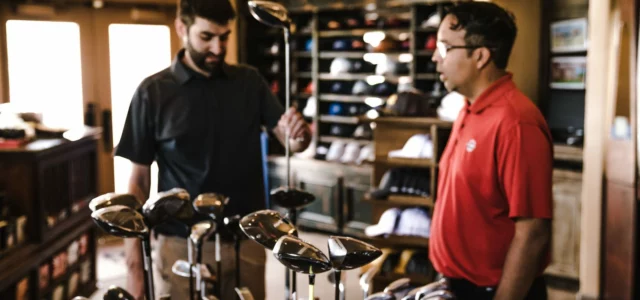
You arrive warmed up, because a fitting done on cold hands measures a swing you do not own. You hit your current irons first, so there is a baseline to argue with later. Then, before anything is changed, the fitter looks at strike location with impact tape or foot spray on the face.
That last step is the tell. Strike location explains most of what the launch monitor reports: a shot struck half an inch toward the toe loses speed and starts right, and no shaft in the rack corrects it. A fitter who reads strike before reading numbers is diagnosing. One who goes straight to the screen is shopping.
After that, one variable changes at a time. If the fitter swaps head, shaft and length together and shows you a better number, you have learned nothing about why it is better, and you cannot reproduce the decision the next time you buy clubs.
The questions to ask, and the one answer that matters
Ask what your strike pattern is. Ask for your dispersion rather than your average distance, because average distance is a vanity statistic and dispersion is what puts you on the green. Ask which single change produced which single effect.
Then ask the question that separates a fitter from a salesperson: what would you change on the clubs I already own?
A fitter who answers that honestly is worth going back to for the next fifteen years. Very often the honest answer is lie angle and grips, for something like a tenth of the price of a new set, and a fitter willing to say so in a store that sells irons is telling you something about how they will treat you when you are ready to buy.
Distance gaps, the part everyone skips
Check the gaps between your clubs, and start at the bottom of the bag rather than the top. A great many golfers carry a pitching wedge at 45 degrees and a sand wedge at 56, which leaves eleven degrees and something like 35 to 45 yards between two consecutive clubs. That gap sits exactly where approach shots are hit most often, and it is why the 80-yard shot feels impossible: you are either swinging a wedge too hard or a pitching wedge too soft.
One correctly gapped wedge costs a fraction of a new set and removes the problem permanently. Measure the gap on a launch monitor first, using carry rather than total, because roll tells you about the turf and not about the club.
When you should not be fitted
If you are a beginner whose swing changes from week to week, a fitting measures a swing that will not exist in six months. Play a season on used clubs, take lessons, and get fitted once your strike settles into a pattern.
If you are in the middle of a swing change with a coach, wait until it holds up. Fitting to a swing you are actively rebuilding locks in the pattern you are trying to leave, and you will pay twice.
What fitting costs in the U.S.
| Where | Typical iron or single-category fitting | Note |
|---|---|---|
| Large national golf chain, studio fitting | From $99.99, about 75 minutes | Full bag from $299.99, around 3 hours |
| Second national golf chain | Around $149 for a full bag | Frequently waived during brand promotions |
| Independent fitting studios | $75 to $200, flat fee | Usually brand-agnostic |
| Dedicated custom-fitting studios | Up to $400 to $450 for a full bag | Widest component selection |
Most retailers credit the fee against clubs bought the same day, which is worth confirming when you book rather than discovering at the register. Prices above are the published rates in 2026 and vary by location.
Where to get fitted
One national golf chain has fitting studios in most of its locations and the broadest hitting-bay coverage nationally, which makes it the practical default if you want a session this week. Two other large retailers cover much of the same ground, and both run brand fitting days in spring where a manufacturer’s fitter is on site with the full shaft matrix.
Dedicated custom-fitting studios sit at the premium end: more shafts, longer sessions, higher price, and no obligation to buy a particular brand. They are worth it if you have already established that your strike is repeatable and you want the last few percent.
Do not overlook your own club’s pro shop. A PGA professional who watches you play every week knows things a fitting bay cannot measure, and many carry a loft and lie machine for exactly the bend-and-grip work that most golfers actually need. If you buy used through a resale specialist or a manufacturer’s pre-owned program, budget for a lie check afterward: secondhand clubs have been bent by someone else’s fitting, or by a tree.
Panxis Golf has no commercial relationship with any retailer or fitter, and earns no commission on anything mentioned here.
What to do first
- Get your lie angles checked, even on old clubs. It costs little and changes direction immediately.
- Measure your wedge gaps on a launch monitor, in carry, and fill the biggest one.
- Check your grip size against your glove size before you spend anything else.
- Only then consider a new set, and buy it fitted rather than off the rack.
Done in that order, the first three cost less than a single round at a resort course and remove more shots than the fourth. That is the part the marketing will never lead with.
How this page was put together
Fitting prices are the published U.S. rates for 2026 from PGA TOUR Superstore, Golf Galaxy, Club Champion and True Spec Golf. Panxis has no commercial link with these companies.