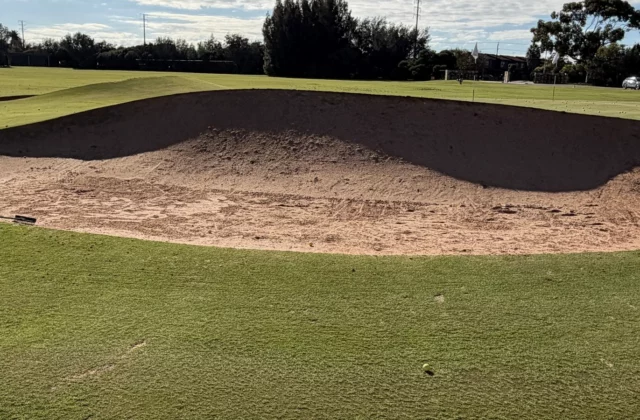
Greenside bunkers, Sandbelt lessons: set-up, sand types and the rules
A greenside bunker shot is an ordinary swing with the bounce doing the work. Set up in the right order, keep the club moving, change one variable at a time, and know the two-stroke escape when the lie is hopeless.

In brief
- The club enters the sand behind the ball; the bounce, not the leading edge, must meet the sand.
- Open the face first, then grip, dig in and choke down by the depth your feet sank.
- For distance, keep the swing and change only how much sand you take.
- Firm or wet sand needs less face opening; soft, deep sand needs more and full acceleration.
- Rule 19.3 allows back-on-the-line relief outside the bunker for two penalty strokes.
Melbourne’s Sandbelt, the stretch of sandy ground running south from Brighton along Port Phillip Bay to Frankston and east to Clayton and Springvale, gave Australian golf its most famous bunkers. When Alister MacKenzie visited in 1926, Kingston Heath asked him for a bunkering plan, and Royal Melbourne’s West course was designed by MacKenzie with Alex Russell.
You do not need to play the Sandbelt to learn from it. Its bunkers make the same point every greenside bunker makes: the shot is not a special art. It is an ordinary swing, set up so that the club skims through sand under the ball. Once that set-up is automatic, a bunker next to the green stops being the hole-wrecker it is for most club golfers.
What the club is really doing
In a normal greenside bunker shot the clubface never touches the ball. The club enters the sand a little behind it, slides underneath, and the sand pushes the ball up and out. That is good news, because it means you are aiming at a patch of sand several centimetres long, not a single point on the back of a ball.
What makes the club slide rather than dig is bounce: the rounded, lower trailing edge of a sand wedge’s sole. Present it correctly and the sole skids. Present the sharp leading edge first and it buries, the club stops, and the ball stays put. Every part of the set-up below exists to put the bounce, not the edge, into the sand.
Set up in the right order
- Open the face, then grip. Rotate the clubface open with the club resting lightly in your fingers, and only then take your grip. If you grip first and then turn your hands, they will simply return to square during the swing.
- Work your feet in. Twist your shoes into the sand until you feel stable. It also tells you what you are dealing with: soft and fluffy, or firm and shallow over a hard base.
- Choke down. Your feet are now lower than the ball, so shorten your hold on the club by about the depth your feet sank.
- Weight and ball. Favour your lead foot a little and play the ball slightly forward of centre.
- Pick a spot. Choose a point in the sand a few centimetres behind the ball and look at that, not at the ball.
Swing through, not at
The shot fails far more often from slowing down than from any other fault. A player takes a long backswing, senses it is too much for a short shot, and decelerates into the sand. The leading edge catches, the club stalls, and the ball moves a metre.
Use a shorter backswing than feels natural and accelerate all the way to a full, high finish. Think of throwing a handful of sand onto the green. If sand lands on the green, the ball usually does too.
A useful drill needs no ball: draw a line in the sand, and make swings that enter on the line and throw sand forward. Look at the mark you leave. A shallow, even scrape that starts at the line is correct. A deep hole short of the line tells you the leading edge is digging.
Controlling the distance
Change one thing at a time.
- Longer shot: keep the swing the same and take a little less sand, entering closer to the ball.
- Shorter shot: keep the swing the same and take a little more sand.
- Higher, softer shot over a steep face: the same swing with more loft, a 58 or 60-degree wedge instead of a 54 or 56.
Golfers who change swing length and sand depth together get inconsistent results and decide bunker play is luck. It is two variables, handled separately.
Firm, wet or washed-out sand
Bunker sand is not uniform across Australia, or even across one course in one year. After heavy rain, sand can pack down hard; after a dry, windy stretch, it can be loose and deep. Some bunkers end up with patches where the sand has been washed or blown away.
- Firm or wet sand: the bounce skips off it more easily. Open the face less, and expect the ball to come out lower and run further.
- Soft, deep sand: open the face more and make sure you accelerate, because the sand slows the club.
- Thin or bare base: treat it closer to a chip, with less bounce and a shallower entry.
Under the Rules, a ball resting on ground inside the edge of a bunker where sand would normally be, such as where it has been washed or blown away, is still in the bunker, so the bunker restrictions still apply.
Plugged lies and the escape option
A ball buried in its own pitch mark needs the opposite set-up. Square or slightly close the face, move the ball back in your stance, and hit down firmly behind it. There will be no spin, and the ball will come out low and run. Aim short of the flag and accept a longer putt.
If the lie is hopeless, remember Rule 19.3. For one penalty stroke you may take stroke-and-distance relief, or back-on-the-line or lateral relief inside the bunker. For a total of two penalty strokes, you may take back-on-the-line relief outside the bunker. That last option is often cheaper than two more failed swings.
What you may and may not touch
Rule 12 lets you remove loose impediments, such as leaves and twigs, and movable obstructions before playing from a bunker. You may dig your feet in for your stance, lean on a club to keep your balance, and place clubs in the bunker. You may not touch the sand with your club in the area right in front of or right behind the ball, in a practice swing, or in your backswing, and you may not deliberately test the sand. The general penalty is two strokes in stroke play and loss of the hole in match play. More on the rules people misread is in our guide to the rules golfers get wrong.
Once you are out, rake your marks and footprints and leave the bunker as you would want to find it.
Fairway bunkers are a different shot
From a fairway bunker you want the ball first and very little sand. Grip down, keep your lower body quiet, and play the ball in the middle of your stance. Above all, check the height of the lip before you choose a club: the club that clears it is the right club, whatever the distance. Our separate guide to fairway bunkers goes into detail.
Where to practise bunker shots in Australia
The limiting factor is access to practice sand. Not every club or public facility has a practice bunker, so ask when you book or check the facilities page before you go.
Private clubs with practice complexes. Some clubs list a dedicated practice bunker among their facilities. Sanctuary Cove Golf and Country Club on the Gold Coast, for example, lists practice bunkers alongside its double-ended driving range, three full-scale practice holes and chipping and putting greens, as facilities for its members. If you belong to a club, ask when the practice bunker is raked and use it then, while the sand is even.
Lessons. Half an hour in real sand with a PGA professional fixes set-up faults faster than any video. For reference, Moore Park Golf’s Sydney Golf Academy lists 30-minute private lessons with PGA-accredited professionals at A$88. Kooyonga Golf Club in Adelaide runs its own golf academy with lessons, clinics and club fitting.
Your wedge. If the club digs whatever you do, the bounce may not suit the sand you play. A fitter can check it, and some specialist stores offer a free wedge fitting in store.
Panxis Golf has no commercial relationship with any club, academy or retailer mentioned here.
A twenty-minute bunker session
- Ten ball-free swings on a line, checking where the club enters.
- Ten balls to one target, same swing, changing only how much sand you take.
- Five balls from a firm patch and five from a soft one, adjusting how far you open the face.
- Two deliberately plugged balls, played with a square face.
- Rake everything, then take the best result to the chipping green and work on the putt that follows.