What to watch for: learning from tour golf, from the Canadian Open to the CPKC Women’s Open
Canadian golfers watch hours of tour golf through the winter and take little from it, because they follow the ball. Watch aim, routines and short-game choices instead, lean on women's golf, and plan a live day at a Canadian championship.
In brief
- Watch where players aim on tucked flags; many play for the middle of the green.
- Time five pre-shot routines of one player: consistency, not length, is the lesson.
- Count putters and low chips from off the green, and never copy a swing from a replay.
- The 2026 CPKC Women's Open at Royal Mayfair in Edmonton was a 6,289-yard par 70, a length close to club golf.
- The RBC Canadian Open was played at TPC Toronto at Osprey Valley in 2025 and 2026; volunteering gets you closest.
A Canadian golfer can watch a lot of tour golf without leaving the couch, and for five months of the year there is not much else golf-related to do in the evening. Most of that viewing teaches nothing, because the eye follows the ball and the highlight. The shots that would help a club golfer are the ones the broadcast skips: the lay-up, the chip that runs to twenty feet, the tee shot aimed at the fat side of a fairway.
This guide is about watching differently. Not copying swings, which is a trap, but copying decisions, routines and short-game choices, which cost nothing and show up on your card the next weekend. It also covers the best places in Canada to see it live.
Change what you look at
Broadcast golf is edited for drama. You see the birdie putts that drop and the approaches that stop close. For learning, turn that around and give yourself a job for each hour of viewing:
- Hour one: targets. Where is the player aiming, compared with where the flag is?
- Hour two: routines. How long does each player take from setting up to starting the club back?
- Hour three: misses and short game. Where do the bad shots finish, and which club comes out around the green?
Featured-group and single-player streams are the best material for this, because they show every shot, including the dull ones.
Targets: the pros aim away from flags more than you think
When the hole is cut tight to a corner behind a bunker, count how many players in a featured group actually fire at it. Many aim for the middle of the green and accept a longer putt. The broadcast team may call it cautious. It is simply correct once you think about shot patterns.
A tour player’s approach shots from mid-iron range spread over a patch of green many yards wide. A club golfer’s spread is much larger. If the best players in the field will not attack a tucked flag with their pattern, a 15-handicap has even less reason to. That is the most useful lesson on television, and you can use it on the next par 4 you play.
Pay attention to the side of the green where misses finish. Good players leave themselves the easy recovery: with the flag right and a bunker beside it, their miss tends to finish left, on the putting surface. When a commentator says a player is “short-sided”, note how often it is someone going backwards on the leaderboard.
Routines: bring a stopwatch
Pick one player for a round and time five pre-shot routines, from the moment they step in to the moment the club moves. The times are usually strikingly close, including on the shots that decide the event.
Club golfers do the reverse. Nerves make them rush to get the shot over with; doubt makes them freeze over the ball while still choosing a club. Your routine does not need to look like anyone’s on television. It needs to take the same length every time, and that is something you can build over a winter of practice in a simulator bay.
Watch the walk after a bad hole, too. A player who has just made double bogey typically walks to the next tee the same way they walked after a birdie. The habit worth stealing is to finish each hole on the walk to the next tee, card written, no discussion.
Short game: count the low shots
Inside 100 yards, watch the backswing length on a 50 or 60-yard pitch. It is rarely a full swing. Watch where the ball lands relative to the flag and how it releases after the first bounce. The lesson is a shorter swing at a steady pace, with a chosen landing spot. Our guide to wedge numbers turns that into a practice plan.
From just off the green, count how often a player uses a putter or a low running chip rather than a high lob. The principle is simple: the less time the ball spends in the air, the less can go wrong. Most amateurs do the opposite and reach for the most lofted wedge in the bag.
What you should never copy
Swings. A tour professional has a coach, a fitter, a physio and thousands of hours of practice. A move borrowed from a slow-motion replay, without the speed and body that produced it, becomes a different move in your hands.
Equipment. Much of the ball flight you admire comes from clubs built to that player’s specifications. For what fitting can do for your own game, see our guide to iron fitting.
Copy aim, routine, misses and short-game club choice instead. All four transfer immediately.
The LPGA is the better lesson for most amateurs
Many club golfers learn more from women’s professional golf. Swing speeds are closer to those of a good male amateur, and approach shots are played with the kinds of clubs amateurs hit into greens.
The 2026 CPKC Women’s Open showed it well. It was played from August 19 to 23 at Royal Mayfair Golf Club in Edmonton, a par-70 set up at 6,289 yards, and Miyū Yamashita of Japan won at 23 under par, nine strokes clear. The year before, at Mississaugua Golf & Country Club in Mississauga, Canada’s Brooke Henderson won the title for the second time, after her first victory in 2018. A 6,300-yard par 70 is a course length many Canadian club golfers play from the back or middle tees, which makes the decisions easier to relate to.
Where to watch in Canada
On television and streaming. According to Wikipedia’s entry on the network, TSN has carried Canadian coverage of the four men’s majors, and its streaming service TSN+ launched with Canadian rights to PGA Tour Live. Golf Channel is also available in Canada. Rights change, so check your provider’s listings each spring. Featured-group streams during the majors are the richest viewing for the exercises above.
The RBC Canadian Open. The national open has been played at TPC Toronto at Osprey Valley in Caledon, Ontario, in 2025 and 2026. Ryan Fox won in 2025 after a playoff; in 2026 Bud Cauley finished at 17 under, two ahead of Matt Fitzpatrick. Nick Taylor’s playoff victory at Oakdale in 2023 is the most recent Canadian win. For practical advice on a day at the event, see our guide to attending the RBC Canadian Open.
The CPKC Women’s Open. The venue changes from year to year: Earl Grey Golf Club in Calgary in 2024, Mississaugua in 2025 and Royal Mayfair in Edmonton in 2026. Check where the next edition goes, as it may come close to you.
National amateur championships. Golf Canada’s 2026 calendar included the Canadian Women’s Amateur at Toronto Golf Club in Mississauga in July and the Canadian Men’s Amateur at Mickelson National in Calgary, along with mid-amateur and senior championships in Ontario, Manitoba and Alberta. Before you go, check each event’s page for spectator information.
From the inside. Golf Canada says it relies on nearly 6,000 volunteers across its amateur and professional championships. Volunteering puts you beside greens for hours, which is the best viewing position of all. Our guide to volunteering at a tournament explains how to sign up.
Panxis Golf has no commercial relationship with any broadcaster, tour or event mentioned here.
At the course: stand still
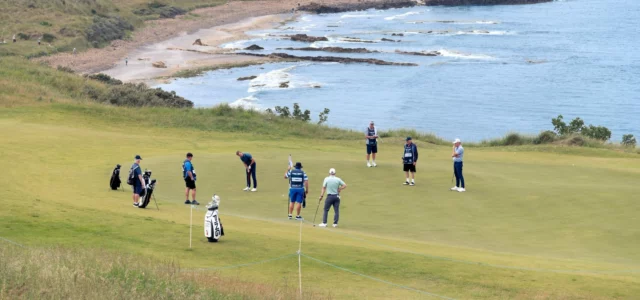
A day on site teaches more than a month of broadcasts, as long as you do not follow one group for eighteen holes. Choose a par 3 or a green complex with a tricky flag and stay there for an hour. You will watch dozens of players face the same shot and see the full range of decisions: who attacks, who plays safe, where the misses go and how the ball reacts on the green.
Watch the practice area too. The way players warm up, how many balls they hit and how much time they spend putting and chipping is a lesson in preparation you can copy before your own weekend round.
Your viewing checklist
- Give every viewing hour a job: targets, routines, or misses and short game.
- Time five pre-shot routines of one player and note how little they vary.
- On a tucked flag, count how many players aim for the middle of the green.
- Count putters and low chips from off the green, and compare with your own habits.
- Watch women’s golf, and plan one live day at a Canadian open or national amateur event.
Watching golf will not change your swing. Watched with a purpose, it will change your decisions, and in a short Canadian season that is where the quickest strokes are.