Junior golf: the sequence that keeps a child playing
Junior golf fails for three predictable reasons: cut-down adult clubs, expectations that are too high, and eighteen holes attempted far too early. The measure of success is whether the child asks to go again.
In brief
- Cut-down adult clubs are too heavy and build compensations that last years.
- Start on the putting green, where the ball actually goes in the hole.
- Group clinics beat private lessons at the start, for social reasons.
- Do not keep score for the first several outings.
- The main cause of children quitting is a parent coaching every shot.
Getting a child into golf fails for predictable reasons: clubs that are too heavy, expectations that are too high, and an eighteen-hole round attempted far too early. Here is the sequence that works, and roughly what each step costs.
The measure of success at the start is not a swing or a score. It is whether the child asks to go again. Everything below is organized around producing that request.
Equipment first, because the wrong clubs end it fastest
Cut-down adult clubs are the classic mistake, made by well-meaning parents and grandparents every year. An adult 7-iron shortened by four inches is still an adult 7-iron: the head weighs the same, the shaft is far too stiff for a child’s speed, and the swing weight is enormous.
A child cannot swing that club without compensating, usually by lifting it with the arms and casting from the top, and those compensations stick for years after the club has been outgrown.
Junior sets are designed by height rather than by age, weigh a fraction as much, and are widely available used because children outgrow them annually. Buy used, buy by height, replace as they grow. Nothing else in junior golf gives a better return, and a set of five junior clubs is enough for anybody under twelve.
Start where the ball goes in the hole
Children lose interest when nothing succeeds, and a full swing succeeds rarely at the start.
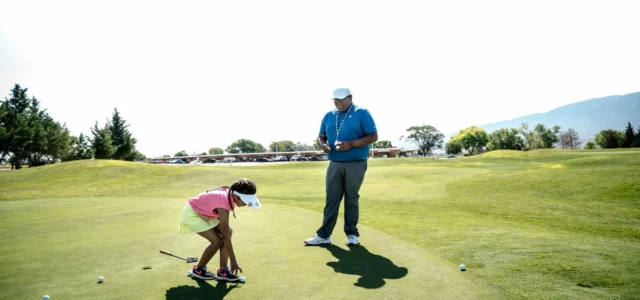
Putting greens and short-game areas provide immediate results: the ball goes in the hole, which is the whole game at eight years old. A child who has holed a twenty-foot putt has had a good afternoon regardless of anything else.
Par-3 and short courses are the next step, and they are the single most useful facility in junior golf. An eighteen-hole championship layout with a small child is a five-hour lesson in frustration for both of you.
Group lessons, not private ones
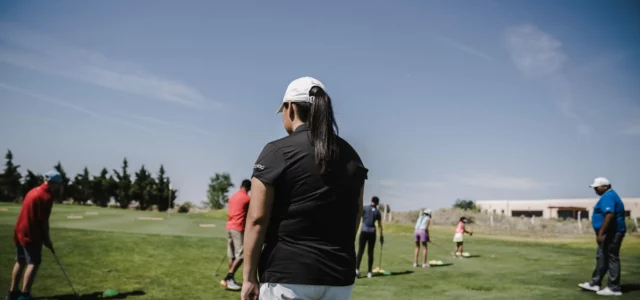
Junior clinics work better than individual instruction at the start, for social reasons rather than technical ones. Children stay in sports where their friends are, and they leave sports where they are alone with an adult correcting them.
Look for programmes run at municipal courses, which are usually the cheapest and the least intimidating, and which are used to beginners. A good junior clinic is loud, includes games, and teaches etiquette alongside technique.
The First Tee has chapters across the country built precisely for this, combining golf with a life-skills curriculum, and its programmes are subsidized in most locations. The PGA of America and the USGA both run junior initiatives, and many state golf associations run their own junior tours and clinics.
Nine holes, and let them play their own way
Let a child tee up fifty yards forward if that is what keeps the ball in play. A child who reaches a green in three from 120 yards is having a far better day than one who cannot finish a hole from the adult markers.
Play nine, let them tee off from wherever the shot is fun, and do not count strokes for the first several outings. Golf’s scoring system is discouraging by design for a beginner, and introducing it early teaches a child that they are bad at this. Introduce it when they ask what their score was.
Let them drive the cart if the course allows it, let them carry the flagstick, let them rake a bunker. The parts of golf that are not shots are most of what makes a child feel like a golfer.
The parent problem
The single largest cause of children quitting golf is a parent coaching every shot.
Let the professional coach. Your job on the course is to carry the water, keep things moving, and be visibly pleased with contact rather than with results. A child who makes solid contact and hits it forty yards sideways has done the hard part.
Two specific habits worth breaking: commenting after a bad shot, and asking what they scored. Both convert an afternoon into an assessment, and children can tell the difference immediately.
What it costs
Less than most organized youth sports, if you avoid the equipment trap.
A used junior set costs a fraction of a new one and holds its resale value, since the next family needs the same thing. Clinic blocks at municipal courses are modestly priced and often subsidized. Junior green fees at many American courses are token amounts, and a substantial number of facilities let juniors play free with a paying adult at off-peak times.
The costs that escalate are travel junior tours and individual coaching, and neither belongs anywhere near the first two years.
When they get serious
If a child wants competition, a Handicap Index through your state or regional golf association opens the door to junior events, and most associations run a junior tour with age divisions and modest entry fees.
Keep it in proportion. The goal at that age is a game for life, not a scholarship, and the attrition rate among children pushed into competitive golf early is well known to every club professional in the country. A child who still enjoys golf at eighteen has had a better outcome than one who was ranked at thirteen and quit at fifteen.
Where to start in the U.S.
Your local municipal course is the right first call, because it will have junior clinics, junior rates and a par-3 or short course more often than a private club will, and nobody there minds a beginner.
First Tee chapters are searchable by location and are the most established junior programme in the country. PGA of America professionals run junior clinics at most public facilities, and the directory lists coaches by area.
For equipment, junior sets are carried by most large golf and sporting-goods chains, and the used market, through specialist resellers and local marketplaces, is where most families should buy, given the annual replacement cycle.
Panxis Golf has no commercial relationship with any programme, retailer or association mentioned here.
Bringing a child onto a golf course, practically
Two logistical questions decide whether the outing works, and neither is about golf.
The first is when. Late afternoon on a weekday, when the course is empty and nobody is behind you, removes the pressure that makes a child rush. A busy Saturday morning with a fourball waiting on every tee is the worst possible introduction, however good the course is.
The second is how long. Three holes is a complete outing for a six-year-old, and stopping while they still want more is the entire technique. A child who plays three holes and asks for a fourth has had a perfect afternoon; one who plays nine and is bored by the seventh has learned that golf goes on too long.
Most American courses set a minimum age for juniors on the course and some require a junior to be accompanied, which the pro shop will tell you in one sentence. Many also let juniors ride, carry a short bag or play from a forward marker, and it is worth asking what is permitted rather than assuming the answer is no.
The first month, concretely
- Week 1: putting green only, thirty minutes, no full swings.
- Week 2: add chipping, and one hour of a junior clinic.
- Week 3: driving range, half swings with a 7-iron, twenty balls maximum.
- Week 4: three holes on a par-3 course, no score kept.
Repeat until they ask for more. That request is the only sign that matters, and everything in this article exists to produce it.
Where this shows up on a course
Three short or nine-hole courses from our directory, open to anyone.
- Augusta Municipal Golf Course — The Patch: Augusta’s municipal course, integrated in 1964 and rebuilt by Fazio, Welling and TGR Design for its April 2026 reopening: the history, the golf and what players say.
- Daytona Beach Golf Club: A 1921 Donald Ross course still owned by the city it was built for: turtleback greens at municipal rates, and reviews that divide sharply on conditioning.
- Grover Cleveland Golf Course: The 1912 U.S. Open was decided here, when it was the Country Club of Buffalo: Travis and Ross bones on a shortened county course, and what players make of it now.
We have not played these courses; each page says what it is based on.