Walk, push, ride or scoot: picking the golf bag that suits how you play in Canada
A pull cart at a Toronto municipal course rents for $7, a riding cart for $25 a person. How you get round decides the bag: weight and straps if you carry, base and dividers if you ride, and waterproofing depending on where in Canada you play.
In brief
- Buy for the way you play most rounds: carrying, pushing, riding a cart or a single-rider scooter.
- Loaded, a stand bag gains about fifteen pounds; two good straps matter more than extra pockets.
- On a cart bag, check full-length dividers, a stable base and which side the pockets face.
- Vancouver averages 1,159.5 mm of precipitation a year: on the coast, a waterproof bag earns its price.
- Air Canada counts a golf bag as one checked bag with no oversize charge, but no clothing inside.
Price out a Saturday at Don Valley, the longest of Toronto’s five municipal courses, and the bag question answers itself. The City lists a riding cart at $25 per person for eighteen holes and a pull cart at $7, both before HST. Over a season of weekly rounds, that gap is several hundred dollars, and it decides which bag belongs in your trunk.
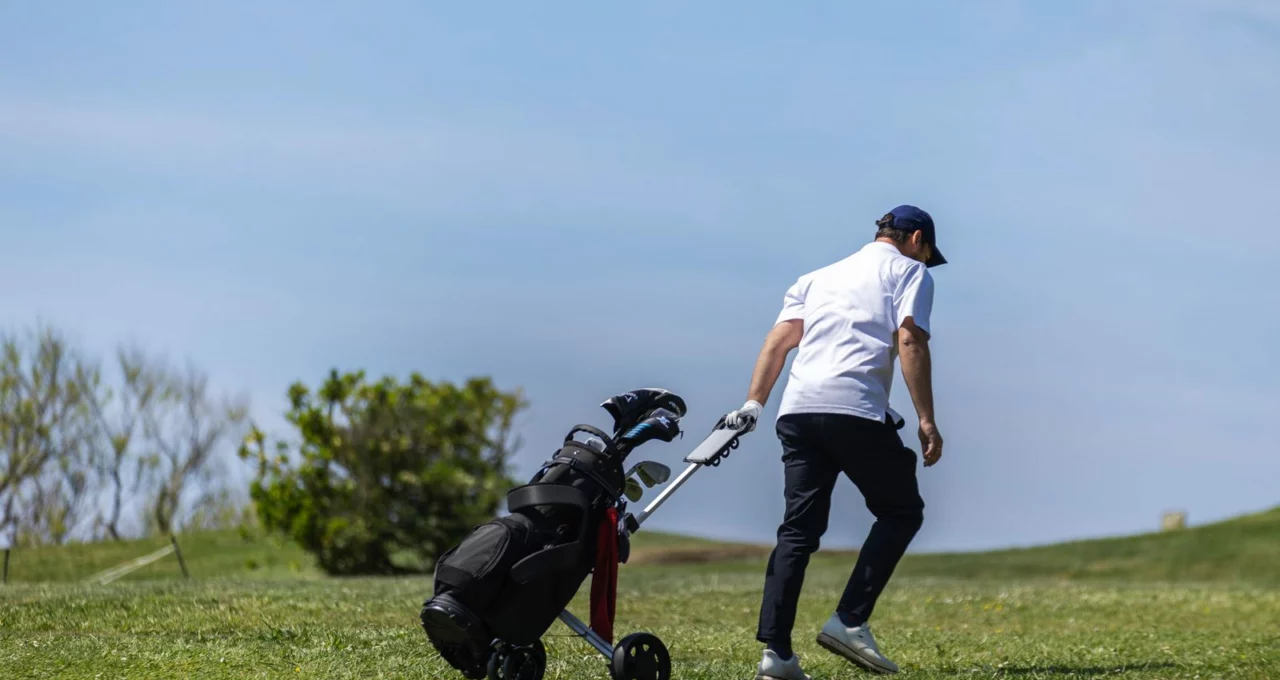
So start with transport, not colour or brand. Canadian golfers get around a course in four ways: on foot with the bag on their back, behind a push cart, in a power cart, and, at a couple of Calgary courses, on a single-rider scooter. Each one rewards a different bag, and buying for the wrong one is a mistake you feel every week from May to October.
Four ways round, four different bags
Carrying. Don Valley plays 6,163 yards from the tees the City quotes, which is about 5.6 km of holes before you add the walks from green to tee. On foot, a stand bag with two shoulder straps and fold-out legs is the only sensible choice, and its empty weight becomes the most important number on the label.
Pushing. Calgary rents push carts for $8 whether you play nine or eighteen, and Tam O’Shanter in Scarborough lists a pull cart at $6.20. If that is how you usually play, a cart bag will sit better on the cart frame than a stand bag, and it gives you more storage for the jacket you will need in May.
Riding. Calgary’s municipal courses charge $23 for an individual seat in a power cart over eighteen holes, or $46 for two riders. A cart bag straps to the back of it, and weight hardly matters any more. What matters now is how the bag sits and which way the pockets face.
Scooting. McCall Lake and Maple Ridge in Calgary rent Finn scooters, single-rider electric carts where the clubs are secured between the handlebars. A slim, light bag suits that set-up far better than a bulky cart bag, so ask the clubhouse before you arrive with a heavy one.
Most golfers use two of these, depending on the day. Buy for the one you use most often, and consider a second, lighter bag for the rest.
On your back: what the scale says
The empty weight of a stand bag is printed on the tag, and it is the least honest number in the store because nobody plays with an empty bag. Add a full set, a sleeve or two of balls, a water bottle, a rain jacket and whatever lives in the valuables pocket, and you have added something like fifteen pounds.
That load is carried the whole round, so a couple of pounds on the tag turns into a sore shoulder by the back nine. Two straps that spread the weight across both shoulders matter more than any extra pocket. The straps should lift the bag high on your back, and the adjusters should hold their setting after a season in a trunk.
Check the legs as well. Canadian municipal courses are rarely flat: Dentonia Park’s signature hole, The Cliff, starts from a tee deck the City describes as ten storeys above the green. A stand that folds out cleanly on a slope and does not topple is worth checking in the store, a few times, before you buy.
On a cart: base, top and pocket side
A cart bag has three jobs. Its base has to sit flat on the cart without rocking. The top has to keep fourteen grips apart so that pulling a club out does not drag two others with it. And the pockets have to stay reachable once a strap is cinched across the bag.
On dividers, look inside rather than at the top. Some bags have a fourteen-way top but open tubes below it, so the shafts still cross and tangle further down. Dividers that run the full length of the bag are the ones that actually keep clubs separated, and they make a quieter ride. If you use a thick grip on your putter, look for a dedicated putter well.
Then think about orientation. On a power cart, one side of the bag faces the seat and the other faces outward. A bag whose ball pocket and bottle sleeve end up against the cart is a small irritation every single hole. Many cart bags have a channel on the back for the strap, which leaves the pockets free. For a push cart, take your cart to the store if you can: not every base locks into every frame, and a bag that twists on the cart is miserable on a hilly course.
Pockets worth paying for
Ignore the count. What you actually use in a Canadian round comes down to four spaces:
- A large apparel pocket that will swallow a rain jacket and a sweater, since an April or October round can start near freezing and finish in sunshine.
- An insulated sleeve for a bottle, useful in a humid July.
- A lined, zipped valuables pocket for keys, phone and wallet.
- A ball pocket you can reach without unclipping anything.
A small pocket high on the front for a rangefinder is worth having too, because you reach for it on nearly every hole. Beyond that, extra pockets mostly end up holding things you forgot were there.
Rain on the coast, snow on the Prairies
Canadian weather makes the waterproofing question regional. Environment and Climate Change Canada’s 1991 to 2020 normals at Vancouver International Airport show 1,159.5 mm of precipitation a year, with 123.9 mm spread over roughly fifteen days in October alone. Calgary’s airport averages 445.4 mm a year, but it also records 22.9 cm of snow in April, right when the courses are opening.
Most bags are water-resistant rather than waterproof: they shed a shower but let damp in over a wet afternoon. If you golf on the West Coast into the fall, a fully waterproof bag with sealed seams earns its higher price. Elsewhere, a rain hood and a towel do the job, as long as the hood is in the bag and not in the basement. Find it in April and leave it zipped into a pocket until October.
Winter storage matters too. Toronto’s January mean is minus 3.5°C. A bag that goes into an unheated garage wet in October comes out in April with mould in the pockets and stiff zips. Empty it, dry it, and keep it indoors.
Flying with it
If the bag will also travel, check the airline’s rules before choosing one. Air Canada counts a golf bag with about 14 clubs, 12 balls and a pair of shoes as one checked bag, with no oversize charge, but says sports equipment bags must not contain clothing or other personal items. WestJet accepts a golf set in a rigid or hard-shell case, or in a bag with an attached hood, waives its oversize fee, and asks for the legs of a stand bag to be taped or secured. So a bag with its own hood fits WestJet’s wording, while a hoodless bag is better off inside a travel cover.
Where it wears out, and how to check in the store
Bags tend to fail in the same few places: where the straps are anchored, at the stand mechanism, and at the zips. In the store, look for straps stitched into a reinforced panel rather than fixed through a single layer of fabric. Open and close the legs several times. Then try the zip pulls with your gloves on, because that is how you will use them on a cold morning in May.
A bag that lasts five seasons is better value than a nicer-looking one that lasts two, and the price difference is usually small.
Where to buy a golf bag in Canada
Buy where you can pick the bag up. A specialist golf store and your own course’s pro shop are the obvious places to load a bag with clubs, put it on both shoulders, and walk around for a minute or two. Pro shops often keep last season’s model in a corner, and it is frequently the same bag in a different colour for less.
For a second bag, used is a sensible route, since most bags are replaced for looks rather than because they stopped working. Online classifieds carry local listings in cities across the country, and a Montreal-based retailer sells used equipment online. Check strap anchors and zips in photos or in person before paying.
If you mainly rent carts at a municipal course, remember that a Sunday or pencil bag holding half a set is also the easiest bag to carry for a quick nine-hole evening loop, and it is often the cheapest bag you will ever buy.
Panxis Golf has no commercial relationship with any of these retailers and earns no commission on what you buy.
A quick checklist before you pay
- Count how many of last season’s rounds you walked, pushed or rode, and buy for the majority.
- Load the bag with a real set, including your putter and all fourteen clubs, and check that the grips do not tangle.
- Make sure the base fits your push cart, or the strap channel works on a power cart.
- Open the legs on a slope, work the zips with gloves on, and look at how the straps are anchored.
- Find the rain hood now, and store the bag somewhere dry over the winter.
Get the category right and the bag disappears into the background for years. Get it wrong and you notice it on every hole.